Dream: The Butterfly Meadow

Posted January 13, 2016 by chuck bender
Categories: Communications from the Dream Time

I had this dream in February of 2012. I want to try just offering it without much comment, and let the dream speak for itself. This is a big dream in the sense that it evokes a direct experience of archetypal energies. The setting in nature, the simple ritual preparation of making and offering butterfly houses to the four directions, and the arrival of the ancient one(s)… kind of a “if you build it, he will come” moment.

2.1.12: “I had been busy making houses for butterfly habitat, and finished the project by installing one in each of the four directions in our small meadow. Then, on this beautiful sunny and warm day, thousands of butterflies appeared overhead, large, yellow and golden, with deep brown markings. They seemed to be heading towards the meadow. I hurried down the path through the woods where I saw them come flying in, descending from the sky, onto the apple trees and everywhere. Then looking down, I saw millions of small blue butterflies, who, seemingly preferring the ground, lay like a thick lively carpet, trail like; my gaze followed them westward. I started carefully walking along side them and then, looking slowly up, a very strange prehistoric creature dropped in, down, into the southwest corner below the west gate.

He seemed ancient, and was hairless with a deep brown toned, wrinkly skin. His large head with large eyes and ears was dog like, bat like, with a prominent snout; he was sitting up on his back, rather butterfly like, with his facing upwards, in greeting. It seemed he had legs, the top two more arm like, but also prominent wing like appendages protruding out of his top/rear shoulder/scapula area. They were long but folded in several sections, and not covered with much (perhaps vestigial?) Sensing this was a miraculous encounter, I approached slowly, trying on making eye contact, and we gazed into each others’ eyes. I reached forward and with my fingers gently stroked his torso, as one might with a congenial creature in the wild; in this way I seemed to get a sense, wordlessly, of his history. He was a very old being, with a life span in centuries, not years, and he came from the old country, Europe, or the Far East; he was a mythological creature who had chosen to show up and show himself to me. He was traveling with the butterflies, and was in some way royalty, their king or benefactor, intimately involved with their creation and the life cycle of the Butterfly clan. Karyl (my wife) walked into the meadow and sat next to us, amazed.”

I think it might be very interesting to share dreams, without an expectation for  them to be interpreted. I plan on commenting on this one at some point. If you find this curious, feel free to share a comment. If you would like to offer a dream of your own, send me your post and I will get back to you about sharing it here.


Musings on Metamorphosis: the Complex as Chrysalis

Posted January 9, 2016 by chuck bender
Categories: Complexes and More

Years ago I learned a beautiful Butterfly chant and felt inspired to create a simple ritual with the intention of entering into an experience of the energies of the egg, caterpillar, chrysalis, and butterfly stages, in my life. This conscious symbolic action was helpful in supporting each of those present to reflect on the ways we all have something going on with each of these stages in any given moment.

From Wikipedia, “Metamorphosis is a biological process by which an animal physically develops after birth or hatching, involving a conspicuous and relatively abrupt change in the animal’s body structure through cell growth and differentiation. Some insects, fishes, amphibians, … undergo metamorphosis, which is often accompanied by a change of nutrition source or behavior. Animals can be divided into species that undergo complete metamorphosis (“holometaboly”), incomplete metamorphosis (“hemimetaboly”), or no metamorphosis (“ametaboly”).”  wiki/Metamorphosis

Notice nature’s variations on this theme: complete, incomplete, and none.

Merriam-Webster offers this simple definition of metamorphosis: “a major change in the appearance or character of someone or something.” M-W/Metamorphosis

How might the image of metamorphosis contribute to our dance?

I want to begin an exploration of the idea the magnitude of the midlife shift in dynamics from ego-Self axis separation to ego-Self axis reunion represents a metamorphic level transformation. For ego consciousness, encounters with the Self are experienced as a dying to one’s self, a symbolic death. Edinger on Mortificatio

Goethe’s “Holy Longing” comes to mind.

What do we know about the conditions conducive to enabling this transformative dying to one’s self?

Inner work starts with reflection. As we begin to sort through inner and outer conflicts, it becomes clear there is a part of us that carries the details of our early childhood conditions. Every story leads back to earlier experiences of emotional overwhelm and return; symbolically, these are death and rebirth or life – death – life cycle origin stories. Stories from the ancestral realm.

The early conditions provide the “design build” requirements for our character. These defenses bring us through, enabling us to move into our adult lives and solider onward as best we can. However, at some point we may be fortunate enough to notice our best is no longer good enough. This sets up the opportunity to consider our way of being in the world reflects what has been called the partial cure.

As one begins to turn inward in an effort to better understand why one’s intimate life has become burdened with some dis-ease, the plot thickens. Life offers many distractions, and troubles out there can be very compelling. (see Exteriorization of Inner Antagonist) The partial cure dilemma reflects the problem of the life saving defenses: while they support us, the price we pay is we’re denied the memory and direct access required to heal the original wounds. At this time we are internally drawn to begin to put together the story of how we came to be divided within; the story of our origins.

It is likely this is the midlife developmental imperative at work. When I see this in younger people, I suspect a degree of split off trauma which cannot be effectively repressed, thereby necessitating a precocious relationship to the Self. With the help of the Self, psyche is calling the ego to submit to a metamorphosis, known in the analytic community as ego-Self reunion.

At this time, some precious parts of our experience need time in the depths, undisturbed by outer influences. The chrysalis offers an image of protection and containment in support of this organic, phase specific, going within process. How much consciousness of such depths is possible? It seems the hard wired mystery of metamorphosis is by design hidden behind the veil; help from consciousness may not be a requirement for the success of the transformation. Behind the veil, the caterpillar will essentially turn to mush before evolving into its adult form, and its internally timed emergence.

This process takes the time it takes. The mystery is present here. In the waiting period, in the spirit of at least do know harm, one can endeavor to practice the art of alert reflection with, borrowing from Jung, those memories, dreams, and reflections which do come into mind.

A big idea: Is it possible complexes, with their hardwired, biological substrate, provide a primary chrysalis function? If so, this is the teleology of the complex. Wikipedia offers: Teleology (from τέλος, telos, ‘end,’ ‘aim,’ or ‘goal,’ and λόγος, logos, ‘explanation’ or ‘reason’)[1] or finality[2][3] is a reason or an explanation for something which serves as a function of its end, its purpose, or its goal, as opposed to something which serves as a function of its cause.[4wiki/Teleology

I have pages and posts dedicated to  describing and diagramming ways we might understand the depth psychology underlying all manner of presenting problems. The D. H. Lawrence poem “Healing” suggests it is all about wounds to the soul, the deep emotional self.

The singularity of the “mistake” referred to by Lawrence suggests to me the workings of a complex in the background. It is the nature of the complex to drive the “endless repetition of the mistake, the mistake which mankind at large has chosen to sanctify.” As Perry observes, in their favorable aspect, complexes, via the repetition compulsion, keep us connected to our missing links, in order that we may at some point find the connection that heals us, in some happy moment. Complexes as Components of Development

In followup posts, I will be exploring the role of complexes in bringing us through and never giving up on us. Perhaps their teleology is to support healing our splits in the service of recovering our wholeness, to the degree such is possible. (see Sandner and Beebe, paragraph 2)

For a beautiful artistic representation of metamorphosis, see Alex Grey’s work. I just learned about his art and work with the subtle body from Monika Wikman. Very amazing!

Beyond Analysis: Empathy

Posted August 2, 2015 by chuck bender
Categories: Uncategorized

I generated this sound bit two years ago, and taking another look today, my heading seems a little harsh. Of course analysis is all about empathy. Here I am entertaining the idea that the point of analyzing complexes in the blur is, simply put, to increase one’s capacity to stay centered enough so that one may choose to empathize deeply with and be moved by the acute suffering at hand (provided by the activation the blur.) Granted, this is difficult if one is feeling personally attacked.

Ideally we can sense when we are getting triggered. “Getting one’s buttons pushed” indicates the activation or constellation of a complex. Unless reflected upon, such an activation threatens to hijack consciousness and push/pull for unconscious enactments. Jung referred to this level or layer of betwixt and between, consciousness blurred with unconsciousness, as the participation mystique. For a beautiful collection of Jungian and psychoanalytic essays see Shared Realities: Participation Mystique and Beyond.

Why must we go there? (unconscious enactments) The bottom line may be they enable time transport, compelling us to return to the scene of some important unfinished business.

Not primarily for the purpose of suffering again the original wounding, though that seems to be required, but in the service of providing us with the opportunity to re-act differently. This difference looks something like waking up from a bad dream and finding you have the power and lucidity to dream the dream onward towards the best resolution possible. Together, might we agree to support each other in finally going there?


Primal Scene: Imagine the Blur is an Out-Picturing of the Experiential State

Posted August 2, 2015 by chuck bender
Categories: Uncategorized

First we recognize those relationships we hold dear. If we believe in our loving and best intentions, how might we understand the experience of repeatedly failing to show up in loving and supportive ways?

If you keep a journal for the purpose of documenting episodes of emotional upset, it is likely you will begin to see common patterns. When you gather them together, mindful of the similarity of emotional tone, before, during, and after each episode, you will be gazing upon composite elements of your experiential state.

Consider the possibility the quality of the intensity of the emotional tone alerts you to the presence of the blur.

The blur affirms the reality of an emotional connection between the here and now conflict and an earlier breakdown in loving.

To the degree a painful memory has been effectively repressed, psyche will hijack a here and now potential for conflict in order to project the involved parties onto the environment. This is how what has been unconscious begins to find its way into consciousness. What is unconscious, that is to say, we are not consciously relating to the detail, is ripe for projection. If/when we can reflect on the experience, we can perhaps see the interior scene matching the outer world perception. This is the idea of the exterior image revealing an out-picturing of an inner reality.

I am trying on the primal scene frame to suggest the archetypal origins found in the nucleus of every complex. When the intensity of a trauma is sufficient to overwhelming the ego in the moment, psyche provides access to ancient, primordial knowledge from the collective, stored in the archetypal blueprints. Something like that…

From one’s history, we can imaging those scenes likely to have initiated archetypal resources. See discussions about complexes and their nuclei.

Source: Images of the Dance

Posted May 11, 2015 by chuck bender
Categories: Uncategorized

“In healthy families, a baby forms a secure attachment with her parents as naturally as she breathes, eats, smiles, and cries. This occurs easily because of her parents’ attuned interactions with her. Her parents notice her physiological/affective states, and they respond to her sensitively and fully. Beyond simply meeting her unique needs, however, the parents “dance” with her. Hundreds of times, day after day, they dance with her. … There are other families where the baby neither dances nor even hears the sound of any music, in these families, she does not form such secure attachments. Rather, her task – her continuous ordeal – is to learn to live with parents who are little more than strangers. Babies who live with strangers do not live well or grow well.”

(Dan) Hughes quoted by Colwyn Trevarthen in The Healing Power of Emotion, p. 55. Complete reference to follow)

Source Quotes: Dreams as Portal to the Source (Eward Whitmont and Sylvia Perera)

Posted November 9, 2014 by chuck bender
Categories: Communications from the Dream Time, Connecting the Dots Series, Dream, Individuation, Learning to Think and Work Symbolically

Tags:

Here are a number of selected quotes from a very wonderful offering by Whitmont and Perera:

P. 2: Quotes: “the dream itself is an actual and necessary expression of the life force– One that manifests in sleeping consciousness and is sometimes remembered and re counted across the threshold of waking. Like a flower or a hurricane or a human gesture, its basic purpose is the manifestation in expression of this life force. It gives us images of energy, synthesizing past and present, personal and collective experiences.” (Page 2)

P. 3. “To approach dream interpretation adequately we need to find perspectives beyond those created by dualistic consciousness, which rest content with oppositions–exterior/interior, object/subject, day/night, life/death, functional – descriptive/imaginal, focused attention/openness, etc. While these opposites are valuable for defining rational awareness, we need also to develop an integrated consciousness that can read both daily and nightly actions and events and nightly and daily visions from many perspectives and to integrate these perspectives for our selves and the patient–dreamer before us in our consulting rooms. This capacity relies on an ability to shift between the many forms of magic– affective, body, mythological, allegoric, symbolic, and rational awareness.

 P. 5: “The clinical understanding of dreams requires both art and skill. The art consists of an ability to sense the dream as a multifaceted dramatic presentation, as if one were allowed to witness a scene from the play of life. The performance would require attendance with full respect, empathy, sensitive intelligence, intuition, and a sense of symbolic expression.”

P. 6: “…  the skills acquired through the practice of techniques must always be subject to the art of interpretation. The first ‘rule’, then, is the paradox of all the healing arts: the applicability of basic principles must be determined by feeling, sensitivity, and intuition.”

P. 6: “as expressions of pre-rational, ‘altered’ states of consciousness, dreams are as variable as nature itself. Indeed they are a lusus naturae, a play of nature that can never be fitted into rigid systems. Rather, our rational thought capacity has to learn to adapt itself to the Protean variability of the life processes which dreams represent. Rational or ‘secondary’ thought must learn to adapt itself to the feeling tones and images of the dream, in reverie and to play intuitively, as seriously as a musician does with a sonata, until meanings emerge.”

P. 7: “…  in clinical practice each dream offers diagnosis, prognosis, and appropriate material and timing to address the dreamers current psychological reality and to address and compensate the dreamer’s– and/or analyst’s – blind spots of consciousness. Diagnostically, the dream’s images and structure give evidence of ego strength and may reveal qualities of relationship between various forms of consciousness and the psychological and somatic unconscious. Prognostically, the dream calls attention to what confronts consciousness, as well as to likely clinical developments, and often, to how the present awareness and capacities of the dreamer and/or analyst tend to relate to those confrontations. … The psychological reality and blind spots of consciousness are addressed because every dream points to an unconscious complex and to the archetypal dynamism behind the complex’s emotionally charged layers.”

P. 8: “Not only does the dream inevitably address the dreamer’s and analyst’s blind spots, it also… is ‘an answer in hieroglyphics to the question we would pose.’ …  The dreamer is invariably unable to see those blind spots or to realize the nature of the ‘question’ he or she needs to ‘pose.’ Too often the dreamer identifies only with the dream ego’s perspective and it’s emotional responses to the images presented.

…  Dream work, thus, requires a witness, someone to provide a perspective coming from other than the dreamer’s context, with whom the dream can initially be encountered.”

P. 9: “But even at best, and even among experienced therapist themselves, dream work needs dialogue with another person. In spite of extensive experience with dreams, such collegial checking and confrontation usually reveals essential details and personal applications that were overlooked. The saying popular among doctors, ‘the doctor who treats himself has a fool for a physician,’ applies here, for the dream brings us unconscious dynamics, and we cannot, by definition, be aware of them easily.

P. 11: “Musing on the contents of the person’s ‘own’ dreams with an empathic other, associating to them, grounding specific dream images in analogous events and patterns of daily life, finding objective explanations, sharing reactions–all provide method and material to build the safe enough therapeutic relationship in which, eventually, genuine affects and individuality can come forth. Repeatedly, such dream work brings about a sense of valuable individual contents and of awareness of capacity to deal with images. Over time such mutual activity assists greatly in conveying and developing a sense of fluid and merged, yet constant and separate, identity – a felt individuality for which play and symbolic understanding is both possible and pleasurable.”

P. 12: “Knowing immediately what a dream purports to mean rest usually on a projection of the therapist’s own bias or countertransference, rather than on genuine, and often necessarily mutual, understanding. Like all utterances from the ‘other side’, the dream tends to be multi-leveled and oracular, hence ambivalent (even polyvalent) and resistant to a rational, black– white, simplistic approach.”

P. 14: “… the therapist must revere the dream’s image material carefully in it’s context and with open puzzlement until a corresponding associative affect–response emerges from the dreamer. …  Jung’s warning: ‘The analyst who wishes to rule out conscious suggestion [must] consider every dream interpretation invalid until such time as a formula is found which wins the patients assent.” … If assent is to be reliable, it must come from what might be called an embodied or gut sense of ‘Aha!’ ‘Yes!’ ‘Touché.’ This kinesthetic validation presents a deep confirmation from ‘the Self in the body’ which knows even when the conscious ‘I’ cannot. Unless this response is forthcoming, the analyst’s views of the meaning of a dream can only be considered hypothetical possibilities still awaiting confirmation or disavowal from the Self of the dreamer. Inevitably, too, the following dreams will confirm, modify, or challenge an interpretation and the dreamer’s understanding of the dream.”

P. 17: “The dream is a spontaneous self portrayal, symbolic form, the actual situation in the unconscious.” Jung

“In each of us there is another whom we do not know. He speaks to us in dreams and tells us how differently he sees us from the way we see ourselves. When, therefore, we find ourselves in a difficult situation to which there is no solution, he can sometimes kindle a light that radically alters our attitude. (Jung)

Jung called the dream ‘a highly objective, natural product of the Psyche…  [a] self representation of the psychic life– process. …  The dream compensates or compliments a deficiency of the dreamer’s conscious position; And/or of the therapist’s position with regards to the dreamer or the analysis.”

Page 18: “… to differentiate Jung’s postulated Self from the self concept psychoanalysis… we shall capitalize it and referred to it as Guiding Self…. It is also to be viewed as the source and director of the individuation drive, that archetypal urge to ‘become what one is’. It is also to be viewed as the source and director of life events and of dream material, both providing invaluable metaphoric/allegoric and symbolic messages which aid the individuation process to those who learn to read them.

The Dream ego may represent: the dreamer’s actual and felt sense of identity as observing witness or actor.

Appears as the Guiding Self sees her or him.

The dream may point up the Self’s view of the dreamer’s identification (merger) with an ego-ideal or an inflated grandiosity.

P. 22: “Developmental possibilities through Dream Work

The dreams dramatic outcome, then, is to be considered conditional: given the situation as it is now (namely, the setting or exposition of the dream, to be discussed below), this or that is likely to develop. … nothing in a dream outcome, therefore, is to be regarded as fixed or unalterable; unless it is explicitly shown to be so by the terms of the dramatic structure of the dream itself and by the symbolic or allegoric tenor of the images.”

P. 24: “Rarely, if ever, will the dream tell the waking ego what to do. Even when a problem is solved in the dream this shows only a possibility that is available. The dream shows what psychological realities the dreamer is up against, what happens to work for or against his current attitude and position, and what the effects of that position or particular approach are likely to be. It leaves the matter to the dreamer to draw his or her own conclusion, to make decisions, and to act. In this way an ongoing dialectic occurs between conscious and unconscious dynamics. For better and/or worse, conscious freedom of response is respected and preserved.

The ‘situation as it is,’ seen from the perspective of the Guiding Self, includes both inner developmental potentials and trends, as well as the consequences inherent in the dreamer’s current, ‘just so’ psychological situation.”

P. 119: “dream series

Until now, we have been dealing with single dreams. However, there is a continuity, we might almost say, an extended story, as dreams unfold sequentially as part of a steadily evolving series. They tend to tell a running narrative, which feeds the conscious ego the kind of information it requires and is able to assimilate, given its particular position in the developmental process. As consciousness takes in response to the dream’s messages, the dreams again respond to the newly gained positions of consciousness; thus a dialectical play develops. When it is a matter of vitally important or fundamental life issues and consciousness does not respond adequately to assimilate the message, dreams will recur. Sometimes they repeat in the same form; sometimes the images become more numerous, larger, or threatening. These kind of recurrent dream series may even lead to nightmares. Such nightmares and recurring dreams – and particularly those that have been recurring since childhood – deserve urgent attention.

… When a dream journal is kept, one gets the impression of an unfolding continuum of views, and of a seeming intentionality in the selection of themes for each given moment.

Indeed, in the instance of a specific, organic symbol, birth in dreams can usually be seen to refer back to a process seeded some nine months before. Or the age of a dream figure will refer to some energy that was ‘born’ those many years before. But more than that, it is as though dream number six in October knew what dream number twenty-nine in April was going to raise and was preparing the dreamer with preliminary insights. Subsequent dreams quite often, therefore, need to be considered in the light of preceding ones, that might have dealt with the same or similar subject matter. A central theme or themes are developed in sequence overtime. Often, one cannot avoid the impression that the series operates as though the unconscious could ‘anticipate . . . future conscious achievements,’ no less than future unconscious dilemmas, for an early dream seems already to know or plan what a later dream is to pick up and carry further. This is an aspect of what Jung called the ‘prospective function’ of dreams.

Usually, such an elaboration occurs not a linear progression but rather like a circular or spiral movement around a central thematic core, casting light upon the central theme from, what might be considered, different psychological angles. It is as though dream one raises a theme; dream two raises a seemingly different one; dream three presents again another angle and so forth; while dream 12 may perhaps pick up on one, and 14 may link up what was raised by three and 12 – or whatever. This circumambulation of the dreamer psyche field bus repeatedly brings up crucial complexes, and elaborates on them, building on previous consequences. Gradually a sense of wholeness pattern adults to the process of being shown the various aspects of the themes, presented with all their very nations from a variety of viewpoints. And keeping up with the images of the dream series, one can keep up with the life– And the individuation process.”

see: Dreams, A Portal to the Source, by Whitemont, Edward, and Pereira, Sylvia, 1992.

I think most men do not know what love is…

Posted July 15, 2014 by chuck bender
Categories: Uncategorized

“After a long life and a long night, I think most men do not know what love is because they don’t ever love as equals, and the master never really loves the slave.” “To love an equal – it takes big men and big women.”

Clare Luce Booth quotes from “Clare, in love and war” Vanity Fair, July 2014, adapted from Price of Fame: The Honorable Clare Luce Booth, by Sylvia Jukes Morris, Random House, 2014.

Orienting to the Couple Experiential State Complex

Posted April 2, 2014 by chuck bender
Categories: Complexes and More

The Couple Experiential State Complex

In the “dance” depicted above, we might consider the center image as “the blur” referred to in the Observation: Healing Only Occurs in the Blur. As such, it can also be seen from the Couple Experiential State Complex as Activated Threshold perspective. I am proposing the usefulness of directing our attention to the in-the-moment-felt-experience of this altered and altering state.

We might consider the emotional intensity of such a moment as reflective of dueling complexes. This is the level of shared resonance with the wound, the place of overlapping unfinished emotional business. Here we try on the idea this shared blur experience is an out-picturing of each participant’s inner conflict, projected onto the moment at hand. I’ve hired you/you’ve hired me, to follow this divine co-created script. Together we have the opportunity to see into and access the original “character building” experience.

The emotional resonance of the blur state provides the time transport sense. To the degree one or both can wake up as if in a dream, we are afforded the opportunity to connect with the early scenes. How can we learn to bring a witnessing consciousness to this miraculously direct experience of the historically unbearable, split off trauma?

We want to consider the possibility this peculiar here and now struggle is an opportunity. Others (Kalsched) have noted the importance of having binocular vision: the capacity to access both inner and outer experience. It is important to keep breathing and bring awareness to the intensity and details of both inner and outer worlds. Internally, we’re looking for the source of the blur.  Beyond the legitimacy of the here and now offense, we want to access the earlier wound which sets up the present trajectory towards the re-enactment at hand. We can choose to call on the guardians of solitude to help us hold the space (see Rilke below), and wait, present with ourselves and each other, to see that which will emerge, festively clothed.

This is very difficult work. When complexes have been engaged to help survive trauma, we have the complication of the presence of the archetypal energy/dynamism associated with the original personal history scene of the wounding. By virtue of the intensity of the trauma episode being enough to trigger archetypal resources, we can be sure there is an archaic mirror, reflecting the first, as in ancient, primordial scenes of such an overwhelm.

Movie Reflections: From the developmental side, the movie Field of Dreams comes to mind. Imagine, as if in a dream, your daughter informs you that your father, younger than your current age, has just walked out of the cornfield onto the baseball diamond. What would you do with such an invitation?

From the archetypal world, the movie Jumanji suggests it may be necessary to keep rolling the dice to complete our journey, even though every time we do something tries to kill us! How can we mobilize and not be killed by the activation? Remember,  from a mythological perspective, the motif of death and rebirth symbolizes a temporary loss of consciousness in the face of emotional overwhelm.

It seems the reasonable idea is to simply be open to what shows up. Pay close attention. The experience may be very human and personal, or alien, out of this world, totally from the dream time. Rumi’s “The Guest House” offers a beautiful poetic tutorial on how/why we might want to do this.

On seeing each other “whole and against a wide sky?”

Posted April 2, 2014 by chuck bender
Categories: Uncategorized

Re: Rilke quotes on Love and Other Difficulties, ( recently liked!) I appreciate Rilke’s observations on just why we might choose to become known to each other; this active process in contrast to thinking we can assume any thing about another’s experience.

And how about the idea of the preciousness of recognizing those relationships where in one is willing to stand guard over the other’s solitude? It seems Rilke is orienting us to the positive aspects of being with one’s self deeply. And perhaps, allowing another to be present with us in this conscious experience. As if we could be, and remain centered in our being, in the presence of another. Quite an achievement.

He then suggests that out of this conscious recognition of being with another, in solitude, we are in the position to learn “only through that which steps, festively clothed, out of the great darkness.”

In short, when in the presence of emotion, suggesting an activation/constellation of complexes, if only we could breathe, get deeply centered, and wait, present in the moment, for that which steps, festively clothed, out of the great darkness.

Stories about encounters with the Festively Clothed?

“A togetherness between two people is an impossibility, and where it seems, nevertheless, to exist, it is a narrowing, a reciprocal agreement which robs either one party or both of his fullest freedom and development. But, once the realization is accepted that even between the closest human beings infinite distances continue to exist, a wonderful living side by side can grow up, if they succeed in loving the distance between them which makes it possible for each to see the other whole and against a wide sky!

Therefore this too must be the standard for rejection or choice: whether one is willing to stand guard over the solitude of a person and whether one is inclined to set this same person at the gate of one’s own solitude, of which he learns only through that which steps, festively clothed, out of the great darkness.”

See page Source: Rilke on Love and Other Difficulties


From the Developmental to the Archetypal: The Experiential State as Complex

Posted March 17, 2014 by chuck bender
Categories: Uncategorized


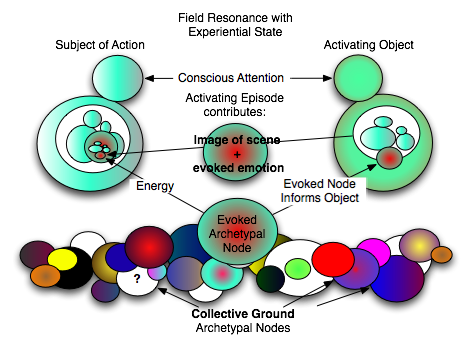
ExperientialStateAsComplexNucleus10-21-12

Experiential State as Complex Nucleus: Trauma, Image, and Affect

First, unpacking some of the Psycho-Educational Symbolic Overview material, consider the idea of the symbol in its step down transformer function: the image as symbol provides a way for the 110 wired ego to reflect on the 220 plus experiences. A symbol both informs us about, while at the same time protects us from, an emerging, essential to conscious life awareness. Jung (1921) defined the symbol as “the best possible designation or formula for something relatively unknown yet recognized to be present, or required.” (Jung, C.G., CW6)

The symbol comes alive for me in the Experiential State as Complex Nucleus image. The elements present combine the internal representation of self/other/affect, in its scene remembered composite form, with its associated complex. In its experiential state aspect, it captures the essence of one’s family of origin experience. Countless interactions averaged and generalized over time serve to inform the transference at the level of primitive invariant organizing principles.

From a complex perspective, the experiential state image mirrors directly the key elements comprising the nucleus of a complex:  the scene of activation depicting the object “in the act,” and the evoked archetypal node’s energy, or dynamism, corresponding to the scene. The presence of archetypal energy suggests the resources of the collective unconscious have been called into service and will need special consideration.

I think the difficulty in grasping the meaning/implication of this detail is in understanding how the developmental experience, the human, relational dance, is key in setting the stage for archetypal activations.

I am thinking it is reasonable to observe that when one becomes overwhelmed by the presenting environmental press, at a certain point, psyche, via the collective resources, initiates to dialogue with us. Heads up! How detailed and specific may/will this guidance be? I have been thinking about the idea of archetypal bandwidth. (See next post.)

Note the Experiential State, Complex, and the Ego-Self Axis Plate differentiates the experiential state image from the complex nucleus, and the ego-Self axis