Archive for the ‘Learning to Think and Work Symbolically’ category

Couple Power Struggle as Compromise Formation?

November 8, 2025

This post was first published in October of 2016. This frame just came up for me in some couples work, and I thought it might be helpful to re-post it today. What I like about it is it gets at this idea we are all operating out of some degree of partial cure defenses. When we show up with each other and commit to honoring our depth work, think Clarrisa Pinkola Estes’ telling and interpretation of Skeleton Woman, our primary wounds to loving will always show up. Always. Freud’s recognition of compromise formations, or what I like to think of as psyche’s camouflage tool, helps us understand we have powerful defenses dedicated to (Bromberg): “... controlling both the triggering of unprocessed emotion schemas that were created by trauma and the release of ungovernable affect of hyperarousal that could threaten to destabilize its function.Here is the archival post:

As I’ve been exploring the idea our most challenging and repetitive intimate partner conflicts may be generated by our dueling partial cures, Freud’s discussion of dreams and compromise formations popped into my head in the middle of the night. The unbidden thought/question was: Is it possible what we can remember and report about a painful fight is really the waking dream equivalent of a dream’s manifest content? I recalled Freud’s view of dream work is that the dream we remember – the “manifest” dream is actually a compromise formation: a psychic product, symptom, symbol, or dream form that expresses simultaneously and partially satisfies both the unconscious impulse and the defense against it.” (For more on manifest versus latent contents, see link below.)

What gets our attention, what we fight about, is something we can think about. Something deeper, and sensed to be threatening at some level, remains hidden – latent – from consciousness . (see link below) The compromise formation is psyche’s camouflage tool.

So what about the unconscious impulse and the defense against it? The Wilkinson discussion of micro-fractures in communication comes to mind. Micro-fractures as manifest content carry a charge reflective of a compromise formation dynamic at work. Through the opening/piercing they provide, something unintended is shown to us. What is being shown at some level can be thought of as an out-picturing of “raw material from the patient’s internal world and history.” As compromise formations, these spontaneously expressed offerings can become the engine of self – other analysis. Note it is best to recognize by definition that what is being revealed is wearing camouflage, and all parties want to respect the dynamics at play to keep hidden the true meaning until the conditions are favorable.

The phenomenon of the blur, as an altered and altering state of emotional consciousness, provides an important bridge between the here and now and the unconscious-to-ego “latent” contents. When triggered, internally or externally, activating complexes, if unchecked, provide the stage, actors, and script for the purpose of re-enacting the wounding. That is, until such time as one or both can gather enough consciousness to wake up within this dream.

How might it shift the dialogue to consider, mutually, what we are fighting about in the blur reflects to some degree a manifest content? Note one does not want to ask is this or is this not the real fight we’re having. Rather, if something of our reality is defensive, in what ways might this reflect our co-created manifest content? And if so, how might we  penetrate the defensive camouflage? Recall, if manifest content rules are in play, psyche is allowing into consciousness material which expresses simultaneously and partially satisfies both the unconscious impulse and the defense against it.

A simple example which comes to mind is if we argue about who gets to drive the bus and something about your tone awakes my inner child, I am likely to project my shaming parental figure/introject onto you. My impulse might be to scream or cry out “NO! I want this, that, or the other” but, fearful I might sound like a two year old, and/or be shamed or punished for trying to have a say, I may hold back, in silence or protest. The defenses responsible for our early survival will kick in automatically and silence the impulse to be heard, to matter, to be a part of all that is good in the family. How are the defenses enabling our survival then still being deployed today? Getting to the core character building origins of his/her/they stories is never easy.

I am struck with the overlap between the concept of compromise formation and Jung’s view of the symbol. An image functioning as a symbol both informs us about, while at the same time protects us from, an emerging, essential to conscious life awareness. Jung (1921) defined the symbol as “the best possible designation or formula for something relatively unknown yet recognized to be present, or required.” (Jung, C.G., CW6)

Is it possible the blur, when recognized for what it is, may be the best possible designation or formula for something relatively unknown yet recognized to be present, or required? For more on this see my section on Complexes as Bridge to the Symbolic World in the Psycho-Educational Symbolic Overview, or my exploration of the teleology of the complex in Musings on Metamorphosis post.

When one can see the unconsciousness present in the blur as an unbidden opportunity, one can get perhaps more  wholeheartedly embrace the suffering which comes with the piercing of the the veil of camouflage. In telling our stories we create opportunities to reminisce deeply, experience again more and more of the original affects. We practice embracing our lost selves, taking care of them and bringing them home.

The take away is be on the look out for mysterious movements and meanings. The participation mystique is more than an abstract concept!

Here is more response ease for Freud’s use of manifest versus latent dream content:

“Manifest content
The manifest content can be interpreted as the information that the conscious individual remembers experiencing. It consists of all the elements of actual images, thoughts, and content within the dream that the individual is cognitively aware of upon awakening. Illustrated through iceberg imagery, the manifest content would be identified as the “tip”: it is barely exposed above the surface with an enormous portion still hidden underneath. As the hallmark of psychoanalytic theory suggests, what is observed on the surface is only a partial representation of the vastness that lies beneath (Friedman & Schustack, 2012). Although images may initially appear bizarre and nonsensical, individual analysis of the dream can reveal its underlying meaning.

Latent content
Related to yet distinctly separate from manifest content, the latent content of the dream illustrates the hidden meaning of one’s unconscious thoughts, drives, and desires. The unconscious mind actively suppresses what can be revealed from the latent content in order to protect the individual from primitive feelings that are particularly difficult to cope with. Freud (1900) believed that by uncovering the meaning of one’s hidden motivations and deeper ideas, an individual could successfully understand his or her internal struggles through eventually resolving issues that create tension in their lives. In contrast to the information easily recognizable, latent content makes up everything underneath the surface. Illustrated once again through iceberg imagery, the depth of meaning that can be derived from examining this layer can reveal deeper underlying thoughts within an individual’s unconscious.”
Jung on the therapeutic value of abreaction (pp. 130-132, CW16) (update from 01/2010 post)

November 8, 2025

Here is a source quote from Jung, with a comment from me, on the importance of recognizing it is the dissociation itself that needs healing. Given the early conditions…glint in the eye of our parents, fetus, infant, toddler and on up, it is the nature of the situation that we will all have a number of unbearable split off episodic memory based encapsulated trauma complexes. Each of these, at the time, required the activation of psyche’s super power – dissociation – to survive. While life preserving at the time and into the mid-life, these dissociation based defenses do not allow vulnerability and emotional intimacy. Before we can heal we have to first “cure the cure” ie: let go of the dissociation based defenses, before we can get to the healing of the original overwhelm. Blur states, getting triggered that is, provide the energy to eventually pierce the encapsulated trauma complex, allowing us then more conscious access. See what you think about Jung’s take here:

“. . . the trauma is either a single, definite, violent impact, or a complex of ideas and emotions which may be likened to a psychic wound. Everything that touches this complex, however slightly, excites a vehement reaction, a regular emotional explosion. Hence one could easily represent the trauma as a complex with a high emotional charge, and because this enormously effective charge seems at first sight to be the pathological cause of the disturbance, one can accordingly postulate a therapy whose aim is the complete release of this charge. Such a view is both simple and logical, and it is in apparent agreement with the fact that abreaction, i.e., the dramatic rehearsal of the traumatic moment, it’s emotional recapitulation in the waking or in the hypnotic state – often has a therapeutic effect. We all know that a man has a compelling need to recount a vivid experience again and again until it has lost its affective value. As the proverb says, “What filleth the heart goeth out by the mouth.” The unbosoming gradually depotentiates the affectivity of the traumatic experience until it no longer has a disturbing influence.”

We recognize, Jung on McDougall, however that “the essential factor is the dissociation of the psyche and not the existence of a highly charged affect and, consequently, that the main therapeutic problem is not abreaction but how to integrate the dissociation. . . .that a traumatic complex brings about dissociation of the psyche. The complex is not under the control of the will and for this reason it possesses the quality of psychic autonomy. . . .it pounces on him like an enemy or a wild animal…” “Abreaction then is an attempt to reintegrate the autonomous complex, to incorporate it gradually into the conscious mind as an accepted content, by living the traumatic situation over again, once or repeatedly,” (pp. 130-132, CW16)

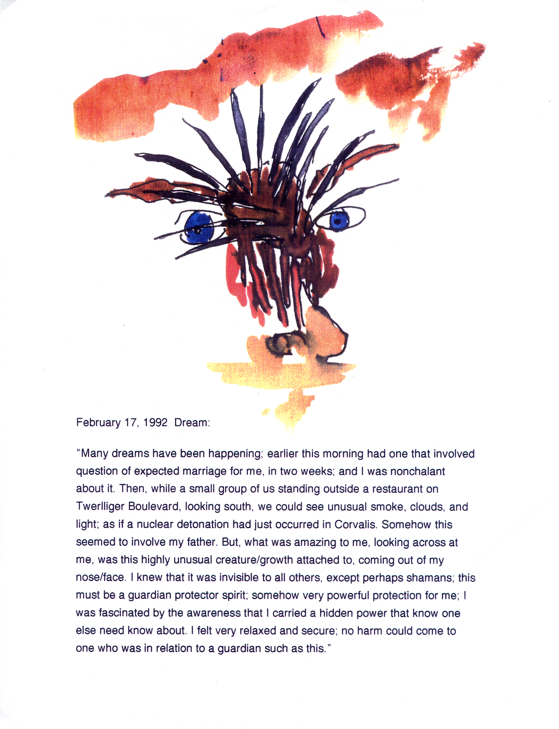
Dream Time Encounters with the Powers: Seeing a Guardian Protector Spirit Attached to My Face

October 10, 2025

This dream image plus my journal entry transcription – typos and all – captures a very vivid, energetic connection with a Protector Spirit Power who was shown to me, in the Dream Time in February 17, 1992. I have a couple more equally vivid dreams from this time period, on the theme of acquiring Powers, to add to this one. Coming up.

I am not going into some of the interesting manifest dream details, like a pending wedding, a nuclear explosion somehow connected to my father, my work with coming to consciousness about the fact of his mostly split off rage. Today, I’m just looking at the introduction to the presence of a super power which was invisible to most. In bringing this dream forward today I am in the position to consider scheduling an active imagination session to see if I can get into a direct dialogue with this Protector Spirit. A very interesting idea indeed!

Is it possible such a protector entity actually exist, and if so am I really benefiting from this protection? The feeling I got at the time, and still have, is, I was/am carrying a not me protection. In light of my recent posts about what it takes to be in the presence of exteriorized, embodied Inner Antagonists or, from the dream time perspective, Archetypal Predator energies/constellations, these kind of powers offer variations on the invulnerable to fire power associated with mature King and Queen energies. To be in the presence of fire-storms of affect and not become identified with the emotion allows one to keep conscious enough to experience the fire as a purification, not a consuming, destructive force. I trust I am able to be with very intense stuff. My discovery around having split in the face of the recent challenge, unable to be with my own anger in the moment, is/was evidence of my continued at least episodic reliance on dissociative process. At no time did I consciously feel threatened by the emotional charge in the room. I just wanted and needed to talk about it all directly, and as mental health professional with 50 plus years of clinical experience, I am always sorting through how much can I just be with my process, out loud, when I am not in my consultation office.

…A Different Kind of Homewrecker…? Bringing My Own Dissociative Enactment to the Table

October 7, 2025

Author note: Rather than embedding hyperlinks throughout the text, I am listing them by titles at the bottom.

Early on the morning of September 18th, 2025, I generated a post with the title: A Different Kind of Homewrecker: When the Inner Antagonist Gets Exteriorized and Embodied.

By mid-afternoon I was able to recognize something of my own deeper process, and see my choice in words – labeling one party as a homewrecker – as evidence of my own passive aggressive defenses. I then re-titled it: A Very Serious Microfracture in Communication: When the Inner Antagonist Gets Exteriorized and Embodied.

Yes I was hurt. Yes I was deeply saddened by the very real impact of the activation of an Exteriorization of an Inner Antagonist on our friend group. And then, reflecting on my agitation about it all, I was able to begin to connect with my anger. I recognized it, felt it, struggled against it, and finally dropped down into it. It seemed we were all hijacked – at some level – by the emotion. What we can see from the outside looking in, in the face of a strong, triggering perturbation (how about that word!) provides a snapshot of our core defenses. And it seems psyche’s channel changing super power is dissociation. Why might we be so conflict avoidant?

Recall Bromberg’s observation: “When emotional experience is traumatic (more than the mind can bear), it remains unsymbolized cognitively, and the mind recruits the normal mental function of dissociation as a means of controlling both the triggering of unprocessed emotion schemas that were created by trauma and the release of ungovernable affect of hyperarousal that could threaten to destabilize its function.” It is helpful to recognize this core fear concerning the potential release of the ungovernable affect of hyperarousal that could threaten to destabilize its (the mind’s) function. I believe this detail may be at the center of the Adverse Childhood Experiences research. Our survival depends on our ability to do whatever it takes to change the channel, rather than risk falling apart, symbolically getting eaten alive or thrown on the broiler.

Back to my process: I could begin to see how my decision to write about my/our process, through the lenses of my model, was clearly in the service of my own dissociation of how upset I was at the time of the microfracture. Turning to my symbol system as a way to “work” with the complexity can also be seen as a candidate for my “mistake” and the “… the endless repetition of the mistake…” in DH Lawrence’s poem Healing. As in I learned how to defensively go into thinking and analyzing rather than simply feeling feelings. From this perspective, I relied on my tried and (not!)true partial cure defenses. More on that later.

Bromberg makes the point that what the patient needs to get better is for the important other, therapist, whomever can consciously participate, to bring their own enactments to the table. For each of us, how sensitive are we in tracking our own moments of dissociation? What happens if we become dedicated to bringing them forward at our first opportunity? It is another way of saying, best practice is to own your own stuff. Try to spot the evidence of your own “raw material” driving your vulnerability to a microfracture.

In recognizing the frame “A Different Kind of Homewrecker” was in reality name calling and assigning blame to one party, othering that person if you will – I could see the evidence of my own dissociation. I was caught in/participating in the split. Yes, the actions and impacts driven by the Exteriorization of an Inner Antagonist does pull mightily for that split. We can work on being in the presence of powerful energies/affects which pull for devolving into an identification with one side or pole (think for example of the pair: Dominant Harshness versus Vulnerable Woundedness) of our own complexes, without becoming complexed ourselves. See Edinger’s discussion on Emotion and Invulnerability to Fire for an image of this important super power here.

As it happens, the very best clues for which complexes are driving our enactments can be found in how it all feels when it goes down. In the immediate aftermath of a complex activation, what is palpably present in the room will, like a dream state, be an out-picturing of the core conflict(s). By this, we start with the basic image of The Experiential State; something has happened and the two participants in the scene each have their full expressions and affects associated directly to what just happened. This is psyche’s shorthand for bringing forward our entire history with regards to loving. See Representations Averaged and Generalized over Time to read more about how this comes out of our earliest infant experiences.

Beyond my theorizing, I now need to say something about my complex activation, my vulnerability to the blur: working from the conflict in the room, what could I learn about my Inner Antagonist? What was I projecting into the room onto someone who could carry it for me? Over a few days of process with myself and my wife, I landed on the presence, in the room, of a He-She-They-Who-Structures-with-a-Vengeance function/figure/other/antagonist complex. What was revealed through this encounter was the degree to which I continue to suffer – not consciously enough – with a less than relational, rather rigid, would be director. Like a critical parent introject, a task master who doesn’t get a more balanced approach. I have this longstanding sensitivity to what I perceive as others, who would in choosing for themselves, in effect choosing for me. Part of how this opened things up for me was in playing it out as a core couple complex dynamic. When can we discern He-She-They-Who-Structures-with-a-Vengeance is in the room? Of course my wife and I have different ways of approaching structuring our world(s). While I would like to share more on this soon, I’m going to leave it there for right now.

Importantly, we are all dreaming this dream together. Or rather, our complexes are co-creating this shared dream state. The key to sorting this out is asking the question in what ways is this my dream? And at the same time, in what ways it is each person’s dream? How can we understand what it looks like if each of us is having an encounter with an exteriorized inner antagonist. If you can only talk about your experience of an actual other person, you have locked out exploration of how that actual other has been employed by psyche to carry something for you in your dream process. This gets into Freud’s manifest versus latent contents and psyches use of compromise formations or what I like to think of as psyche’s camouflage tool (see below). When an actual beloved or friend shows up/populates a dream, we do want to consider all the associations to that person; we do not want to stop there. In an Active Imagination session, we can ask the recognizable outer world figure to take off their mask and show us who is calling from an earlier place. Who is showing up now via the dream, looking for dialogue and integration or release?

Again, the key concept here is enactments drive microfractures in communication. Bromberg suggests we make our own dissociative process available to working through the rupture. Modeling the capacity to sit together and find new language for what just happened is the work of becoming conscious. The sub-symbolic mode of experience needs our help, in relationship with each other, to move into the symbolic mode of experience.

Today I touched on my recognition after the fact, of my own dissociative reaction to a powerful activation in a friend group. I wanted to zero in on the startling and critically relevant implications of Bromberg’s discussion of this work: sitting together in the aftermath of enactments (micro/macro-fractures in communication), bringing our/my own dissociative experience to the table, is how we can support our cycles of rupture, repair and reconciliation. We honor those not-consciously-bidden parts of ourselves who show up, in the service of the re-integration of our lost selves/self-states. While early in life reliance on dissociative defenses was life saving, it becomes life-denying.

Enactments: Setting the table…together

A Very Serious Microfracture in Communication: When the Inner Antagonist Gets Exteriorized and Embodied*

Source: Wilkinson on Microfractures in Communication, Rupture, Repair, and Reconciliation

Source: Sandner/Beebe on Dominant Harshness and Vulnerable Woundedness Complex Split

Representation of Persona Submitting to Emotion

On The Importance of Getting Triggered

Co-Created, Dissociation Enabled Enactments

Emotion and Invulnerability to Fire

Couple Power Struggle as Compromise Formation?

Philip Bromberg on Self – States

Helpful posts for background:

Imagination in the Body: A Community-Based Dream Group Offering

September 20, 2025

I am delighted to announce Kimberly Christensen and I have a time and date for our Imagination in the Body: Community-Based Dream Group offering. The first round is coming right up! Please feel free to forward this invitation to clients, friends, or colleagues who may be interested in deepening their feeling practice through dream work. If we’re unable to get enough participants to start in October, we will likely shift the start date to early February 2026. If you are interested but find the Thursday AM time slot is not workable, please let us know about your interest and what days and time frames might work best for you.

For more information and registration please contact Kimberly at embodiedcounselingpdx.com. I am also available to talk about the offering. For me, best to start with counseling@chuckbenderms.com. Here is the flyer:

Imagination in the Body Community-Based Dream Group

This Dream Practice offers a warm, supportive sanctuary to explore your feelings and somatic experiences. Through dream imagery, we’ll journey toward greater wisdom and a deeper relationship with the Imaginal.

This practice is for you if you’re ready to: 

  • Deepen your connection to feeling and the body
  • Explore symbolic and creative pathways for growth
  • Cultivate subtle awareness and insight through dreams 

Together, we’ll uncover wisdom, nurture self-awareness, and process feelings—guided by the archetypal energies and unconscious forces that shape us.

Dates & Time:  October 9, 23 · November 6, 20 · December 4, 18

Thursdays: 10:00–11:30 am

Cost: $40–$80 per session (sliding scale)

Location: NW Portland (private practice office)         About Us      

Kimberly Christensen, PhD, LMFT is a Portland-based psychotherapist specializing in Jungian dreamwork, depth-oriented therapy, and embodied healing practices. She integrates alchemy, imaginal inquiry, and community-based dreaming in her work. Learn more at embodiedcounselingpdx.com.    

Chuck Bender, MS, LMHC brings over 50 years of clinical experience in psychotherapy, community mental health, and Jungian-oriented practice. His work draws on object relations, self psychology, and dreamwork, grounded in a deep commitment to the unconscious. Learn more at chuckbenderms.com.

Together, we invite you into a six-session exploration of how dreams move through the body and how embodiment anchors the dreaming psyche into everyday life.

A Very Serious Microfracture in Communication: When the Inner Antagonist Gets Exteriorized and Embodied*

September 18, 2025

The Microfracture frame is a reference to Wilkinson’s work here. Here I want to walk us through the usefulness of Edward Edinger’s writings on the exteriorization of an inner antagonist. The link takes you to a post titled: A Consciousness Challenge: Recognizing the Inner Antagonist in the Outer World. (I will track down the quote and add to my source quote collection lower left)

In my world, this is a very real problem which needs some special language to help us recognize when it is in play. Once you can see it, you also may find it hidden in plain sight…with a surprising frequency.

Edward Edinger suggests we consider the possibility conflict in the outer world is psyche propelling us into a situation specifically for the purposes of learning something essential. The timing reflects our readiness in the moment to consider the next piece in working through a complex. From this perspective, what we are in conflict with is an exteriorized, embodied, Inner Antagonist. This is a radical notion. What is the teaching?

For this to be a real thing, we need to understand psyche’s powers to project. And that we understand this will be unconscious to the ego. Recall, we only project what is truly unconscious (to the ego), and that projection is how psyche gets a split off piece of our depth work back out into the world, as an assist in beginning a sorting process where in at some point we can recognize it is our own shadow driving this. Because the true meaning is unbearable to ego consciousness, if you notice you are being asked to carry someone’s exteriorized inner antagonist, and try to talk about it with the person who is relying on this defense, they will not be able to consciously see what you are trying to point out. That is the special challenge. If you understand the dynamic and can feel the pull to carry the emotional tone associated with the antagonist, but do not get pulled into the force field created by this level of projection, you can be chill enough to experience the blur and even offer some help. My plate Representation of Persona Submitting to Emotion offers a map to support trying this on. The bad news is when someone gets strongly complexed, imaged by shall we say – Hansel and Gretal and the Witch in the gingerbread forest setting – in the moment one can become identified with either the Witch or the vulnerable child state; which ever one gets control of the steering wheel, the other gets projected onto the environment. AND it can switch in a nano second. The GOOD news is when you can see this, you can help by containing the Witch and supporting the vulnerable child state in being powerful enough to send the Witch back into the dream time. This requires a capacity to stay conscious within a blur state. Both the here and now and the dream time are activated in this altered and altering state of consciousness.

Before going into some theory which helps us think about how complex and yet often utilized these defense are, I want to make a case for a very useful try on with stuff that erupts into the environment like a bad dream. And that is, simple put: imagine this is a dream, your dream. When both parties can aspire to take 100% responsibility for where each goes within an outer world encounter – with or without video coverage – we have our best chance to get to the deeper layers of work which drive our repetition compulsions – or – episodes of enactment which fit our re-enactment of the wounding dynamics. The Edinger teaching after all works in both directions: how is what I’m getting from you an encounter with my Inner Antagonist, while at the very same time, what you are getting from me is an encounter with your Inner Antagonist? This is a truly awesome complexity!

When you wake up with a start from this dream, grab your journal and start writing as fast as you can to capture everything that just happened, as if it was your dream. Treat it as a communication from your Guiding Self. Include as much detail as you can. Keep adding to your depiction of the setting(s), scenes, speech, feelings, sensations, all of it. Note your spontaneous associations, call for memories. Try to get busy with all of that in an effort to get inside with your own process.

Remember, if you have just encountered conflict in the world, in what way are you being shown an inner antagonist? This helps us find our way into the co-created, dissociation enabled enactment which will show us, like an out-picturing of our soul wound via the dream time, what our core resonance or reactivity is about. Why now, why in this way has this come up?

And while we want to give serious consideration to the actual others in our relational world who will populate our dreams, intense feeling toned episodes always point back to our earliest challenges. It is the deeper level of personal developmental history and ancestral complexes at play in the dream at hand. In short, what can I hope to learn about my cast of inner antagonists?

Back to a depth psychological view: How is this impossibly complex defense even possible? From the psychoanalytic side, Christopher Bolus has described the defense mechanism employed here: “Kleinian psychoanalysts, in particular, have focused on one way in which a person may rid himself of a particular element of psychic life. He does so by putting it into someone else.” See the linked post for an interesting case illustration. I have a more lengthy comment on his observations in my post Projective Identification: Informing the Experiential State.

I am wanting to restate that assertion: One way in which a person may rid himself of a particular element of psychic life is by putting it into someone else. If like most, you have not heard about this power, try to think about if this could be true. The implication being that until we are ready to embrace parts of ourselves which through our known histories likely could not have survived our childhood conditions intact, we/psyche can just rid ourselves of them by just putting it/them into someone else? Mind blowing really. And try on what it might be like to have someone make such a deposit of emotionally charged experience into your core, and not notice it came from outside one’s self? Another big wow. It is also true that if/when we share similar core conflicts – core shame – we are more vulnerable to taking in these projected antagonists and becoming identified with them as if they were only our own self. Meaning we don’t see that the sometimes dramatic shift in our mood reflects something was put into us by another.

Suffice to say now, whenever we get triggered, get our buttons pushed, or simply are on the receiving end of an emotionally charged offering, with or without getting activated, it is important to consider, how might this be something deeper trying to come into consciousness?

For more on the subsymbolic and symbolic worlds and the role of enactments, see my Bromberg review post: Enactments: Setting the table…together.

*If you saw this offering before 2:30 PM on 9/18/25, you would be reading: A Different Kind of Homewrecker: When Inner Antagonists Get Exteriorized. Sitting with the post today, it has become obvious the use of label Homewrecker, whatever I was thinking, and I do have thoughts, was to jump into the deep end of the name-calling which has been such a toxic part of our political discourse/discord. Name calling reduces our world to othering; from complexity devolving into either/or, in contrast to both and more. It reflects an activation of splitting and scapegoating defenses. These primitive defenses are hardwired. Dante’s Divine Comedy describes a special place in Hell for Sowers of Discord (written between 1308 and 1321). It does not recognize the shared complexity. Seeing this I was able to connect more consciously with my own sadness and deep discouragement about the seriousness of the impact on family and friends when we can’t choose to be with our own contributions to the disharmony. When name calling seems to be again tolerated… My sincere apologies.

Let’s leave it there for now….

goodby for now,

chuck

A Dream Time Image of Piercing Encapsulated Trauma: Three Crones Receive the Knife

June 18, 2025

(Note this post is a lightly revised post from August of 2019) How can we image the sticky wicket problem of opening to split off complexes, given their/our lifetime of dedicated defenses working to keep them split off? As Donald Kalsched has observed, healing requires the dismantling of the dissociation based defenses which were our survival; one must first cure the (partial) cure. For me this dream provided an orientation to the requirement that the defenses containing an episodic memory based trauma complex must be pierced prior to them allowing direct contact with the split off image and affect charged scene. Here is the dream:

11-29-12 Thursday 4:56: Very vivid, short dream with three of us, all women. I’m one of the them, and I am also myself, observing my woman-self as if standing behind and looking over my crone self’s shoulder. We are standing together in a kitchen and we understand we are dead, or have died, and its not a problem for us. The focus turns to the idea, the recognition of the timing being right, for giving and receiving the knife. This is a ritual process we are in charge of doing periodically. It is somehow vitally important we attend to this for the sake of the community. The woman opposite me pulls out several ancient, long curved bladed knives and with great intention brings one forward towards the belly of the woman on my left, making contact and slowly plunging it into her; the movement is a bit downward; I/we can all feel it going in deeply. Then, slowly withdrawing the blade, she turns to see me, signaling now it will be my turn to receive the knife. I seem to ready myself for this by involuntarily shuddering and leaning first forward, leading with my head/chin pulling up and back, offering my belly, and then, intensely anticipating the knife finding my belly, I can’t help flinching and pulling slightly back. I am struck by how deeply I can feel this wounding, penetrating me to my core, opening me up completely; there is a moment of tremendous surrender and release of pitiful grief as I fully experience receiving the knife. Coming out of this deep practicing of having been pierced, I am silently, through my tears, attentive to what will happen immediately, my turn… I am thinking, yes, this is what we do; this is what it is like, it happens like this to all of us. It is painful. This is the way it is.”

Waking Reflections: At the time I had this dream, my sense was it was a compensatory dream pointing to my ongoing vulnerability to inflation; this offered a radical image of deflation. The intensity and directness of the action suggested I was/am experienced in the giving and receiving of this primary wound. The ritual, anchored by ritual elders, crones in this instance, seemed to be in the service of supporting the community/collective to be continuously aware of the reality of ongoing sacrifices, both conscious, in this case, but also unconscious. A contemporary example of this would be government actions which seem completely removed from the profound impact on the children separated from their parents, without notice.

My analyst at the time, Jerome Bernstein, offered what seemed to me to be a very helpful interpretation. He suggested the crone on my left represented the opening of encapsulated trauma. While I have been able to grasp the conceptual meaning of this dynamic in this regard, the dream provided a direct experience of the relationship between function/purpose of the encapsulation in defending against previously unbearable trauma, in contrast to gaining direct access in the service of healing: this piercing of the encapsulation is necessary for one to access the original wound directly.

From this perspective, this sequence signals progress on the continuum of my personal work to support the deconstruction of my own dissociation enabled defenses. (see Kalsched’s “cure the cure”.)

In order to access our wounds directly for purposes of healing the split one must both suffer and bear witness to an immersion into the original affects. As Donald Kalsched has observed, for this to occur, a deconstruction of the partial cure defenses is required.

One more comment for now: We clearly have problems with inflation at the collective level. At this level, it seems the three crones are keeping the vigil for all who may not be able to choose deflation. At the human, personal and couple work level, how often do we put our partner in the position of delivering a necessarily deflating message? What might be going on here for you?

If the Experiential State as Complex is a Thing, Then What?

January 3, 2025

Greetings to all in this very new 2025! I am tracking my need to show up more often in shorter sound bites. Still sorting through what am I doing here with this, my passion project. As usual, it seems I am still working to distill out a ten page, graphic comic like guide/representation to understanding psyche, our universal challenge, and a pathway to healing born out of the mystery, the reality of the numinosum. Note the posts here are inventoried to the right, below the fixed pages. I try to use hyperlinks to provide easy access to other essays and what I call source quotes. Hopefully you can search within an offering and find your way around. Feel encouraged to talk to me if inspired…

Today we begin with my opening assertion about this symbol system:

These practice-informed symbolic representations reflect intuitive connections. With regards to the validity of the system, reflecting my 50 plus years of clinical practice and process observations, I appreciate this observation by Jung cited by Helene Shulman (Living at the Edge of Chaos, 1996, p.18.):

“All knowledge is the result of imposing some kind of order upon the reactions of the psychic system as they flow into our consciousness … it is not a question of … asserting anything, but of constructing a model, which opens up a promising and useful field of inquiry. A model does not assert that something is so; it simply illustrates a particular mode of observation.” (The Structure and Dynamics of Psyche, Volume 8, par. 362, 381)

We will start with an orientation to Jung’s Ego-Self Axis. I believe this plate captures more on a page than any of the others. It introduces the foundational idea the Ego is in reality the center of the conscious personality, but, the Self is the ordering and unifying center of the total psyche (conscious and unconscious). We can see the importance of usual and unusual episodes of unbearable experiences in activating core dissociative defenses, in relationship to how those get buried somewhere in our bodies. These impossible to metabolize at the time episodes, swallowed whole, encapsulated, split off from consciousness, and uninventoried, constitute a special category of sub-symbolic, incomplete initiatory experiences. From this perspective we will then drop into the deep end with imagining together, don’t hold your breath, the nucleus of a complex in contrast to Representations of Interactions Generalized over time (RIGS).

Recall the nucleus of a complex is simply the scene of a wounding, in the act of being wounded… if/when we have the opportunity to explore this together, I will be calling for important memories of emotionally charged experiences. We will practice listening carefully and each try to drop into the scene as presented, have the experience of taking a look around, noticing what we each can about the ancestral, archetypal layer of collective/genetic memory.

With the help of the symbol system, and your stories, we will think together about what it takes to complete the initiations. And how psyche is working 24-7 to support us in our own timing.

Now it’s time to say goodbye…

Ask Chuck: A Great Question about Self States

March 12, 2024

I was pleased to get an email from a reader asking: “… I had a question about self states or emotional states. How do I get out of a self state or an emotional state? For good.”

The short answer is we want to recognize self-states as important parts of ourselves that historically could not find a way to stay conscious, given our sensitivity and complexity. Growing up and getting stronger means they can start to rattle and make themselves known, and we want to commit to honoring their request to be in relationship, and begin sorting out who are they really and what will our relationship to them be? Some of these emerging self-states are actually the internalized/introjected parental and authority figure “others”, who, populating our complexes, contributed to our rejection of parts of ourselves. Lots more on that via Donald Kalsched’s work with the archetypal predator/persecutor complexes. Not going there now.

Having some additional communications with the person asking the question, I am going to connect some dots tailored to the backstory. Note, recognizing one’s sensitivity and complexity, potentially a mixed blessing at best, seems actually to me like winning life’s most important lottery!

Of note, most of us have grown up believing the key to success in life depends upon the development of a well functioning ego based consciousness, which then can identify and apply best practices in everything we do. It is interesting to remember Donald Winnicott, from the psychoanalytic side, believed a successful, integrative analysis resulted in one achieving a unit – self personality. In contrast, a Jungian perspective recognizes a multiplicity in consciousness as the rule. Jung’s concept of ego and Self, imaged as the ego-Self Axis, is extremely useful. It lends its self to a non-denominational, ancestral, archetypal understanding of consciousness in relationship to the unconscious, or collective consciousness. It also addresses the developmental stage dynamics working for and against remembering what has been unbearable. We will close with more on that below.

I am thinking the reader is familiar with self – states through prior study or analysis, or, has reviewed some of my posts on the importance of the concept (see Philip Bromberg)

In his (my Source Quote) discussion, Bromberg notes when at times he might think a person’s mood has shifted, he has learned rather to consider a shift in self – states as the explanation for the change in mood. He then offers this review:

“For those who are not yet totally at home with how the concept of self – state is different from a shift in affect or mood, let me offer a one sentence clarification: Self – states are highly individualized modules of being, each configured by its own organization of cognitions, beliefs, dominant affect and mood, access to memory, skills, behaviors, values, actions, and regulatory physiology. (Chuck’s bold)

These highly individualized modules of being sound like active, dynamic willing entities with minds of their own!

Take a minute to think about what this (having your own cast of highly individualized modules of being characters within) might mean to you. And, where might they come from?

We can start with orienting to the concept of evoked companions. When I just googled evoked companions, an excellent paper popped up reviewing some of the literature around the concept as it informs the development of spontaneous imaginary characters from early childhood and throughout our lives. And the importance of recognizing this capacity for interacting with these figures as a power, not a pathology. For here, it serves to provide context around our experience of finding unknown presences in us, coming into our world, which can be confusing and frightening.

An early mentor put it this way: After about the first 24 – 48 hours of being born, the infant is never alone, because enough actual interactions have occurred with the mother and caregivers to allow the infant to experience connections with the evoked companions; something of each of those experiences with the actual others taking care of us, provides psyche with enough to begin forming internal representations of the holding environment; when a new need arises, the associated state then evokes internal representations of the presences of the caregivers who have attended to us earlier in our very short time in the world. We are wired to begin connecting, with the help of these evoked companions. See my Developmental Considerations for more on the importance of of the gradual evolution of this internal representation of being held, refueled, and released. Countless traces of interactions, averaged and generalized over time, become the condensed, composite template for one’s Experiential State.

In every childhood, there are tremendous pressures put on the child to conform with expectations to behave, in short. A beautiful image of why this is so can be found in Robert Bly’s A Little Book on the Human Shadow:

“Let’s talk about the personal shadow first. When we were one or two years old we had what we might visualize as a 360° personality. Energy radiated out from all parts of our body and all parts of our psyche. A child running is a living globe of energy. We had a ball of energy, alright; but one day we noticed that our parents didn’t like certain parts of that ball. They said things like: ‘Can’t you be still?’ Or ‘It isn’t nice to try and kill your brother.’ Behind us we have an invisible bag, and the part of us our parents don’t like, we, to keep her parents’ love, put in the bag. By the time we go to school our bag is quite large. Then our teachers have their say: ‘Good children don’t get angry over such little things.’ By the time my brother and I were twelve in Madison, Minnesota we were known as ‘the nice Bly boys.’ Our bags were already a mile long.”

And he offers this gorgeous description of our arrival, ‘trailing clouds of glory,’:

“The drama is this. We came as infants ‘trailing clouds of glory,’ arriving from the farthest reaches of the universe, bringing with us appetites well preserved from our mammal inheritance, spontaneities wonderfully preserved from our 150,000 years of tree life, angers well preserved from our 5,000 years of tribal life – in short, with our 360° radiance – and we offered this gift to our parents. They didn’t want it. They wanted a nice girl or a nice boy. That’s the first act of the drama. It doesn’t mean our parents were wicked: they needed us for something. My mother, as a second-generation immigrant, needed my brother and me to help the family look more classy. We do the same thing to our children; it’s a part of life on this planet. Our parents rejected who we were before we could talk, so the pain of the rejection is probably stored in some pre–verbal place.”

so the pain of the rejection is probably stored in some pre–verbal place. Somehow, somewhere in psyche, the unconscious, our bodies, all these rejected part of our selves, self -states, remain, continue on, waiting for the conditions conducive for them to re-enter our consciousness.

While we’re here, this pre-verbal place is also the realm of the sub-symbolic mode of experience, in contrast to the symbolic mode. Much more on that later as it informs our vulnerabilities to enactments.

As it is our fate, all starting out as infants, we will be overwhelmed at many points in life, and it is helpful to acknowledge and appreciate psyche’s life-saving super power of dissociation, or what we think of as the splitting off and encapsulation of unbearable, whole episodes of experience. It is as if dissociation functions to take the 110 voltage wired ego off-line in the face of 220-10,000 voltage traumatic physical and emotional episodes of overwhelm.

We can/will go on, but one more key concept for right now: recognizing the blur.

As in “healing only occurs within the blur.” When I first heard my psychoanalytical mentor reference this profound notion, at about age 41 for me, I immediately recognized how important it was to understanding the healing process. He went on to clarify that the blur state represented a betwixt and between state where in what was happening in the here and now, for real, was activating a remote time and space experience of something unfinished in our emotional life. Which is to say, our here and now experience is somehow infused, as if in a dream, with some emotionally charged unfinished business. This can be thought about as a co-created, dissociation enabled re-enactment of the wounding. The blur state refers to the peculiar experience of finding one’s self in this activated state.

Learning to recognizing this it-is-going-to-be-uncomfortable-state is key to begin having more choice in when to go there. Preparing to go there may be psyche’s first half of life task.

For a story like imaging of a number of important inter-related concepts, see my companion pages: Couple Experiential State Complex: Re-enactment of the Wounding and the Couple Experiential State Complex as Activated Threshold.

The key concept here is we all have lots of parts of ourselves that have become lost to us along the way, from birth to now. And our life’s work is re-integrate those split off parts. This requires building the capacity to hold what in earlier life was unbearable. This ultimately requires being able to consciously suffer the powerful affects evoked by unbearable traumatic experiences. Typically, this is the work of the midlife and second half of life. If one is called to this early, the challenge is to know how powerful it is and that psyche has your back. Think of it as a totally precocious midlife initiation. Because it is just that. It can be very helpful to begin to orient to Jung’s Ego-Self Axis Separation and Reunion frame.

In closing, here is an observation which suggests what we can try do to reconnect with our precious little lost selves: do your best to create/embrace opportunities to dance with your inner child:

“In healthy families, a baby forms a secure attachment with her parents as naturally as she breathes, eats, smiles, and cries. This occurs easily because of her parents’ attuned interactions with her. Her parents notice her physiological/affective states, and they respond to her sensitively and fully. Beyond simply meeting her unique needs, however, the parents “dance” with her. Hundreds of times, day after day, they dance with her. … There are other families where the baby neither dances nor even hears the sound of any music, in these families, she does not form such secure attachments. Rather, her task – her continuous ordeal – is to learn to live with parents who are little more than strangers. Babies who live with strangers do not live well or grow well.”

Be well and, borrowing from Joyce Vance,

We’re in this together,

chuck

Consultation Services Update

April 15, 2023

Greetings! And thank you all for your continued interest in some of what is going on here.

First, I am pleased to announce I am planning an official start for my consultation practice for fall of 2023. By then the major construction and landscaping projects will be complete and my office will be very accessible again. Until then, I have established 2-4 days per month office hours and am available to schedule in person or remote individual, couple, family, and case consultations. Please see my Professional Disclosure page for details on fees and services.

When I peruse through this blog, following active links, I am reminded of how much work I was able to put in while maintaining my full time private practice. I am also struck with questions about who is this person, writing this stuff? In truth, I find some of it remarkably clear and radically helpful . . . if only it can be comprehended and applied. I recognize there is an important offering here: a book, a graphic novel, a series of YouTube mini-presentations, a program of live interviews for illustration purposes, a group workshop dedicated to exploring the role of conscious enactments in the service of healing splits.

We are all challenged to find our own way, our own language, into our full lives. I am dedicated to finding shared language.

My posting guidelines moving forward are to be more spontaneous, less anxious about my inferior editor functions. I really am looking for more of a conversation with you.