Archive for the ‘Communications from the Dream Time’ category

From the Dream Time: An Eye Fetish

January 18, 2019

During an hour this past week, in reflecting on an apparent mismatch in enthusiasm between two family members, and the amount of suffering this produced, consciously, for one of the party, the issue of archaic human longing came up. The dream below is one of several which moved me towards a deeply felt experience of this. I will be looking through my archives for a couple more in series as part of bringing this forward. As a stand alone dream, this one is pretty fun in terms of the sheer intensity of the energy. I had the dream the second night into a week long gathering of men with Robert Bly, Robert Moore, Malidoma Some and others, in the primitive Mendocino Woodlands Camp.

July 24, 1991: I woke up at 4:30 AM with a long dream in mind; details fuzzy/sharp and excessive. Doing men’s work here at Mendocino Camp; On and on and on; making shit, talking shit, doing shit; singing and dancing and drumming and imagining.

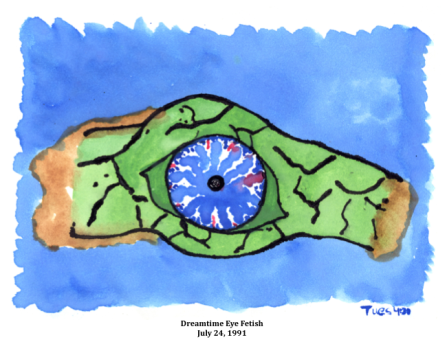
After all this stuff, what a mess of bodies and stuff happening everywhere, all over, all the time. Robert Bly picks up a little piece of wood I had painted to look like a green snake(?) eye; blue eye, mottled green and white serpents shape; fashioned from a stick with a knot in the center, or maybe plywood, jigged out, and painted. Pretty crude representation at that.

I’m delighted at his interest in something I made. “Why do you want that thing Robert? What is so special about it to you?” He just laughs that big grin and says: “I just like the feel of it, you know…” and caresses it in his fingers and moves on.

EyeFetishDream1.22.14I woke up somewhat disoriented, having gone to sleep with one ear plug in (snoring in the cabin) and decided to go outside with my journal to write it down. The moon was overhead, moving powerfully through the sky channel created by the creek running through the very tall old growth forest. After writing it down and spending some time with it, I went in to the Lodge and painted the image. Just when I was finishing doing so, I heard the voice of an elder coming down the path, quietly singing, who, coming into the lodge to get a cup of tea, walked up to me, took a long look at me, my painting, and then back at me, and said: “Something’s happened! When you are ready, we must talk!” Later that week, we did.
Luminous Wolf, Shared Piercing Dream

January 18, 2019

January 26, 2009 Dream: “My friends are giving me a medal, to be ‘pinned’ on my left flank, belly. I’m apprehensive, say ‘are you going to use rubbing alcohol on that large pin?’

Just then, a luminous wolf crosses from left to right in front of me. Hard to say how far, how close, her actual size, as she seems to be arriving from another dimension. Very healthy with a full silvery black coat, and surrounded by an incredible aura. She stops, turns her head over her right shoulder, to gaze at me. I notice, as part of her energetic aura, from her left flank, extending above her back, is a large arrow shaft, with feathers, suggesting she has an embedded arrow point in her left side, about where I am to be pierced. Her aura incorporates the arrow, as if she is living with it in vibrant health…”

WolfPiercedbyArrowDreamSelected

Waking Reflections: What struck me was how healthy she was, while still carrying the evidence of a likely mortal wound. Still, energetically, this arrow wasn’t limiting her presence and power.

In the dream it seems I am about to receive a blessing from the Spirit Brothers, a medal of some kind, in recognition of my relationship to my wound.

(Unpublished back story) The pinning itself will be a flesh offering. At this moment the Wolf appears, affirming our work from the dream time. YES, she shows us, one’s wound need not be the death of one’s vitality. Something like that. Associations to the pelican piercing her own breast, the piercing of Jesus’ side on the cross, and the Sun Dance ceremony all come to mind.

And, we might ask, who is she, showing up with such vibrancy and generating such an incredible aura? An image of the Self? A trans-rational presence/being?


Image and Force: Jung’s Supreme Meaning

March 23, 2016

RockLight DreamImage1NoMargin3.23.16


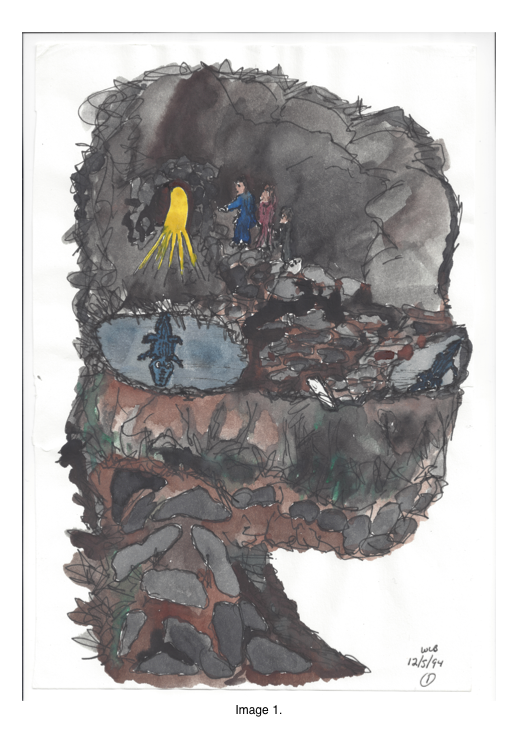
After recording the Rite of Passage Rock-Light Being dream, I decided to represent the image in pencil, pen and ink, and watercolor. My method for illustrating dreams is to begin by trying to establish the starting point of the dream sequence in the place most likely to allow me to work through and capture all the action, step by step, on one page. I opened this dream with the stone path at the bottom center of the page. I began penciling in the details with no conscious awareness of the greater reveal (Image 1.) As I finished the initial sketch, I couldn’t help but think, “Behold the ancient being with his bright flash of light for consciousness, crocodile brain stem extending into the olfactory region, and stunning child like silhouette! How striking, how primordial!”

EncounteringRLBeingImage2.3.23.16

After completing this scene, I turned my attention to capturing a close up of our approach along the rock face. My intention was to create an image-as-threshold to assist me in my ritually re-entering the startling moment. (See Image 2.)

I was challenged at this time in my work to understand what this powerful dream was really offering me. It was one of a number of dreams in a series which seemed to move out into the world, connecting me in important ways to mysterious meanings which defied rational explanation.

Twenty years later, deepening in my Jungian orientation through a seminar series with the analysts of the Santa Fe group, I came across Jung’s description of the serf’s predicament: “I am the serf who brings it and does not know what he carries in his hand. It would burn his hands if he did not place it where his master orders him to lay it” (Jung, Red Book, 2009, p. 230).

In the Red Book collection, we get to look in on Jung’s initiatory process. In his dialogues with the spirit of the times and the spirit of the depths, Jung describes how he came to understand the existence of an ancient consciousness enlivening us all, and how this guidance, this “supreme meaning” comes to us. The spirit of the depths comes in and places understanding and knowledge at the service of the inexplicable and the paradoxical, sense and nonsense. The melting together of sense and nonsense is what produces the supreme meaning. In Jung’s words (2009), supreme meaning is “the path, the way and the bridge to what is to come… image and force in one, magnificence and force together … the beginning and the end … the bridge of going across and fulfillment…

Furthermore, from this perspective, Jung observed “To understand a thing is a bridge and a possibility of returning to the path. But to explain a thing is arbitrary and even murder…” (Jung, Red Book 2009, p. 229-230).

While I was enjoying a newfound sense of freedom from my compulsion to explain and contemplating on magnificence and force together, this 1994 dream and these illustrations came to mind: might they be an example of image and force in one, magnificence and force together?

RockLight DreamImage1NoMargin3.23.16EncounteringRLBeingImage2.3.23.16

1994 Dream: Rites of Passage and the Rock-Light Being

March 22, 2016

EncounteringRLBeingImage2.3.23.16

The following two part dream was a big dream for me, one of a series of dreams during my early years with the mytho-poetic men’s community; during this period I attending many weekend and week long workshops with Robert Bly, Micheal Meade, James Hillman, Robert Moore, and Malidoma Some among others. Locally, a ragtag band of us dedicated ourselves to exploring first hand what we could learn about midlife initiatory ritual process through an evolving collective and personal story enactment model. The dream:

“I am at a grand competition of some kind, like a graduation rite, with lots of people cheering on those who have achieved their goal; the ritual consisted of the graduate first throwing a small ball out as far as he could, and then running as fast as he could to bring it back. This was an individual act, with no attention paid to the time or comparisons with anyone else. Sending him out and welcoming him back, the crowd simply roared in celebration of his achievement, reflected in his level of clarity and intention. This was most impressive, an honor and joy to behold, and the enactment enabled all to witness. I didn’t know how the game worked but his throw was so compelling that I elected to go running after the ball also; Coming from the side of the field, he had thrown it down field in my direction, I dived over and behind a large bolder in pursuit of it, and then heard an urgent warning: “Get ready because he surely is coming after it. It means a great deal to him.” The implication is that his force could unintentionally kill me if I were in his path.

Part 2: Then the scene switched to three of us, two men guided by a woman, working our way up a rocky terrain stream-bed like path. I am in the middle. It’s quite dark and there is a strong sense of wilderness, adventure. We get to a rocky rise and our guide stopped suddenly, pointing to a watery place contained by the stone to a set of large eyes watching us. An archaic archetypal crocodile, huge, was perfectly lined up on us; should we have continued up and over we would have been eaten. She motioned us to move sideways and we looked for a way up while watching for more crocodiles. I saw another one and couldn’t find an easy way up. Calling to her, she had gone up and was out of sight, she doubled back and offered a hand, pulling me up near by, saying “this old VW bus windshield comes in handy.” Working our way along the trail next to a vertical rock face, I got into the lead. As we walked along in darkness a door suddenly flew open, right in front of me, letting a flood of bright yellow light out; with it, I saw something was tossed out; then the door closed just as quickly, leaving no trace. At first I felt anxious about almost being hit or seen, then I was curious about who or what lived in the rock, and what had been thrown out? I sensed some indigenous peoples must be living there secretly.” Pausing, the alarm went off.

REFLECTIONS: At the time of this dream I was wrestling with my awareness that while I felt very serious about my personal analysis, more attention and focus was possible. In the opening celebratory ritual process scene, I noticed my dream ego was identified more with the witness who  jumped into the ritual action from the sidelines, in contrast to the dream figure  who has done the work and is moving into the new life with community blessing. In reality, I was at the time deeply engaged in working through my own childhood near death, initiatory life event with the help of a band of spirit/soul brothers.

In active imagination, I re-entered the second scene, hoping to dream-the-dream-onward and discover more about the origins of the rock dweller and the meaning of the tossed out object. I dialogued with an ancient reptile man-like being, a self identified gatekeeper and light tender who releases the light. In response to my question, “What did you throw out?” he replied they were shards of light, reflections of everything that has ever happened in my (Chuck’s) life. Each shard mirrored a scene of my life. I was to know they existed and seek to gather them all up; this was my path to self-knowledge. Considering the flash of light as an image of enlightenment, the Self shining through, I interpreted this as signaling the importance of doing the work to remember everything fully. The shards would provide every detail in turn.

A Dream Time Case Study: Identifying a “Terrestrial Canalization” Complex

February 16, 2016

This was an interesting dream in that it so vividly introduced a very specific complex, at least in terms of its name! It has been sitting in my private posts  will offer my personal reflections at some point. At this point, I am posting dreams which stand out in one way of another. My hope is to encourage your interest in dreams as communications from the Guiding Self.

March 27, 2010 Dream: “Seminar setting with an analyst teaching via a case. I was orienting to a screen with images, which I then realized was a modern overhead projector, showing diagrams from a text book. The analyst seemed older, but with dark hair and was prominent, but not known to me. His name was something like Bonaventuri, Italian sounding; with his shade style glasses, black tops and and clear bottom rims, he looked a bit like Marcello Mastroianni, from a 1960’s movie. The conversation, didactic at that point, got a little quiet and hard for me to hear; the analyst was surprisingly relaxed, in fact reclining on the green grass next to the podium. He had his head propped up on one hand and elbow. I asked if he could talk a little louder for me. He did so while standing up and began in earnest to orient me to the case at hand, a man with a complex demonstrating what he called a ‘terrestrial canalization.’

Next he pointed to the screen, which was now more of a blueprint or architectural drawing depicting the first floor of a house. It was a schematic, showing traffic flow, ie: kid’s play movements, as if observed and recorded over time, each signified by a stylized curved arrow symbol. These arrows showed the repeated movements, typically as if a child would duck behind a chair, moving from right to left. These multiple movements, all in the same direction, he explained, were the traces which were the indication the children had grown up in a house where the father suffered with an activated terrestrial canalization complex. The picture revealed a dozen or so arrows, all as if capturing the data from a time lapse study, and pointing to the evidence that an unseen power was guiding the movements of the family in a particular way. He observed this patterning was the basis for recognizing the presence of a terrestrial canalization complex.”

Waking reflections: The dream time naming of the complex seemed familiar, and marvelous. Could it actually exist? I have dreams about the origins, function (teleos) and healing of splits and complexes quite regularly. Upon waking, after recording it and pondering on it, I decided to Google terrestrial canalization and was surprised and gratified to find a number of hits. Psyche can be so playful! The particular one which caught my eye, in the top handful of hits, was a research paper discussing primate evolution and scapula differentiation. Plains dwellers vs jungle dwellers show critical distinctions; in short, primates evolving on the plains tend to be dedicated quadrupeds. In contrast, jungle dwelling evolutionary process pulls for a greater range of motion and differentiation of forelimb function; a shift in the scapula canalization is what enables, is required, to accomodate reaching up and overhead movements, necessary for climbing and bipedal walking. I played with the idea the dream might be showing me my upbringing was ruled by a dedicated quadruped, a plains dweller who was not evolved enough to move through the world upright? Funny, if not true!

And what about the analyst? Was he a little too relaxed, chill? A grasshopper slacker not an ant fable image? He was pretty cool, carried a deep understanding of psyche, and was teaching with the help of schematics, which is definitely a core part of my work. I thought about the detail of needing to ask him to speak up for me, and how this worked in the dream to increase our engagement in the work at hand. Back to the analyst presence, I also associated to my first pair of black rim glasses in the 1950s; Buddy Holly died ten miles from my home town about that time. I will share more at some point but the idea is play and reflection, trying on the scenes, images, and affects; opening to seeing what sticks, what doesn’t.

I recognized canalization as a real word, but didn’t remember Jung’s discussion of the canalization of libido (which was familiar to me) until my analyst referenced it the next week. Jung used the phrase canalization of libido to “characterize the process of energic transformation or conversion.” He discusses it in the context of analogues, such as a water wheel on a stream, which enables one to convert the stream/libido into a more differentiated, directable, power resource. How do we develop/evolve a healthy relationship with our full blessing of libido? (CGJ, CW Vol. 8, p. 41.)

In reviewing this offering, which has been in unpublished status for 13 years, I now see I need to update it and offer more reflections. But for now, I a

My First Remembered Dream (1955)

January 24, 2016

In Memories, Dreams, and Reflections, Carl Jung talks about his first dream and his decades long discovery process, with a key piece coming to him 50 years later. This got me thinking about my first remembered dream and my own unanticipated opening in understanding 50 years later. The shift in my appreciation of its energy and meaning stems from the idea dreams offer both a look backwards, bringing forward the earlier conditions, a reductive function, as well as glimpses into our anticipated future developments, the prospective function; reductive and prospective. I believe I was four or five at the time.

The dream (1955): “I was very happy and excited about my first day on as a fireman. After dinner it was time to get some sleep before our first call. We all processed upstairs to get into our beds. They were neatly organized in two rows, opposite each other. My assigned bed was on the far end of the bunk house. Each fireman’s gear, overalls with boots attached, was positioned at the end of his bed, just right for jumping into them and sliding down the fire pole at the far end of the room. I stood next to my bed, taking in the order and the importance of what we were doing. It was a wonderful moment. As we all sat down on our beds, it seemed everyone was looking at me. I was very happy. Then, as if choreographed, each fireman reached under his chin and in one movement, all pulled off their human masks, revealing their true identities: they were actually vibrant wolves, grinning with exceptionally long snouts full of big sharp teeth! In that instant, I thought they were going to make a meal of me! Terrified, I woke myself up screaming. Both of my parents, startled awake by my screams, came running into the room. They tried to comfort me, reassuring me it was only a nightmare.

I don’t remember ever talking about the dream with them again.

In my 20’s and 30’s, working with psychiatric inpatients and psychiatrists’ inclined to interpret dreams from a Freudian bent, I revisited this dream from the perspective of age appropriate unconscious rivalries with my father and mysterious imaginings of my mother (See: castration anxieties and vagina dentata). This psychoanalytic perspective reflects the reductive aspects of the dream.

50 years later, I received a lovely gift: The Wolf Ritual of the Northwest Coast, an ethnography published in 1952.  As I reflected on the role and meaning of the Wolf Ritual for these peoples, from my own now direct knowledge of rites of passage, I was struck with the profound notion that what I had experienced as a nightmare at the time could also be seen as a dream time encounter with the Wolf Clan elders. Surprised and delighted, I pictured them coming to welcome me into the powers! This interpretation is an example of the dream’s prospective function. From this perspective, my young witnessing ego, terrified by the hiddenness of their true natures revealed(?), their toothy wildness(?), assumed the worst. Surely they were now going to eat me. However, in the manifest dream they didn’t make a move to threaten me. They did reveal their true natures. They were relaxed and smiling. They were full of power. Had a wise elder presence been available to guide me in accessing my imagination, might I have been able to see past my initial terror and begin to see them as allies in Nature? What if in dreaming the dream onward, I had been able to identify with my wolf nature?

What if, as Carl Sandburg proclaims in opening of Wildnerness:

“THERE is a wolf in me … fangs pointed for tearing gashes … a red tongue for raw meat … and the hot lapping of blood-I keep this wolf because the wilderness gave it to me and the wilderness will not let it go….”

Sandburg goes on to claim a whole menagerie of wild creatures, because “the wilderness gave it to me and the wilderness will not let it go…”

For a beautiful shapeshifting image variation on this theme, see the the Inuit poem Magic Words:

“In the very earliest time,
when both people and animals lived on earth,
a person could become an animal if he wanted to and an animal
could become a human being.
Sometimes they were people
and sometimes animals
and there was no difference.
All spoke the same language…(continues)”

It is interesting to consider this dream from these very different, both and more perspectives.

From the prospective function perspective, the dream foreshadows my relationship with nature, alerting me to the Wolf Clan. For a macro level perspective on opening to this transrational world, see Jerome Bernstein’s formulation on Borderland consciousness.

Ernst, Alice Henson, The Wolf Ritual of the Northwest Coast, University Press, University of Oregon, Eugene, Oregon, 1952.


Dream: The Butterfly Meadow

January 13, 2016

I had this dream in February of 2012. I want to try just offering it without much comment, and let the dream speak for itself. This is a big dream in the sense that it evokes a direct experience of archetypal energies. The setting in nature, the simple ritual preparation of making and offering butterfly houses to the four directions, and the arrival of the ancient one(s)… kind of a “if you build it, he will come” moment.

2.1.12: “I had been busy making houses for butterfly habitat, and finished the project by installing one in each of the four directions in our small meadow. Then, on this beautiful sunny and warm day, thousands of butterflies appeared overhead, large, yellow and golden, with deep brown markings. They seemed to be heading towards the meadow. I hurried down the path through the woods where I saw them come flying in, descending from the sky, onto the apple trees and everywhere. Then looking down, I saw millions of small blue butterflies, who, seemingly preferring the ground, lay like a thick lively carpet, trail like; my gaze followed them westward. I started carefully walking along side them and then, looking slowly up, a very strange prehistoric creature dropped in, down, into the southwest corner below the west gate.

He seemed ancient, and was hairless with a deep brown toned, wrinkly skin. His large head with large eyes and ears was dog like, bat like, with a prominent snout; he was sitting up on his back, rather butterfly like, with his facing upwards, in greeting. It seemed he had legs, the top two more arm like, but also prominent wing like appendages protruding out of his top/rear shoulder/scapula area. They were long but folded in several sections, and not covered with much (perhaps vestigial?) Sensing this was a miraculous encounter, I approached slowly, trying on making eye contact, and we gazed into each others’ eyes. I reached forward and with my fingers gently stroked his torso, as one might with a congenial creature in the wild; in this way I seemed to get a sense, wordlessly, of his history. He was a very old being, with a life span in centuries, not years, and he came from the old country, Europe, or the Far East; he was a mythological creature who had chosen to show up and show himself to me. He was traveling with the butterflies, and was in some way royalty, their king or benefactor, intimately involved with their creation and the life cycle of the Butterfly clan. Karyl (my wife) walked into the meadow and sat next to us, amazed.”

I think it might be very interesting to share dreams, without an expectation for  them to be interpreted. I plan on commenting on this one at some point. If you find this curious, feel free to share a comment. If you would like to offer a dream of your own, send me your post and I will get back to you about sharing it here.


Source Quotes: Dreams as Portal to the Source (Eward Whitmont and Sylvia Perera)

November 9, 2014

Here are a number of selected quotes from a very wonderful offering by Whitmont and Perera:

P. 2: Quotes: “the dream itself is an actual and necessary expression of the life force– One that manifests in sleeping consciousness and is sometimes remembered and re counted across the threshold of waking. Like a flower or a hurricane or a human gesture, its basic purpose is the manifestation in expression of this life force. It gives us images of energy, synthesizing past and present, personal and collective experiences.” (Page 2)

P. 3. “To approach dream interpretation adequately we need to find perspectives beyond those created by dualistic consciousness, which rest content with oppositions–exterior/interior, object/subject, day/night, life/death, functional – descriptive/imaginal, focused attention/openness, etc. While these opposites are valuable for defining rational awareness, we need also to develop an integrated consciousness that can read both daily and nightly actions and events and nightly and daily visions from many perspectives and to integrate these perspectives for our selves and the patient–dreamer before us in our consulting rooms. This capacity relies on an ability to shift between the many forms of magic– affective, body, mythological, allegoric, symbolic, and rational awareness.

 P. 5: “The clinical understanding of dreams requires both art and skill. The art consists of an ability to sense the dream as a multifaceted dramatic presentation, as if one were allowed to witness a scene from the play of life. The performance would require attendance with full respect, empathy, sensitive intelligence, intuition, and a sense of symbolic expression.”

P. 6: “…  the skills acquired through the practice of techniques must always be subject to the art of interpretation. The first ‘rule’, then, is the paradox of all the healing arts: the applicability of basic principles must be determined by feeling, sensitivity, and intuition.”

P. 6: “as expressions of pre-rational, ‘altered’ states of consciousness, dreams are as variable as nature itself. Indeed they are a lusus naturae, a play of nature that can never be fitted into rigid systems. Rather, our rational thought capacity has to learn to adapt itself to the Protean variability of the life processes which dreams represent. Rational or ‘secondary’ thought must learn to adapt itself to the feeling tones and images of the dream, in reverie and to play intuitively, as seriously as a musician does with a sonata, until meanings emerge.”

P. 7: “…  in clinical practice each dream offers diagnosis, prognosis, and appropriate material and timing to address the dreamers current psychological reality and to address and compensate the dreamer’s– and/or analyst’s – blind spots of consciousness. Diagnostically, the dream’s images and structure give evidence of ego strength and may reveal qualities of relationship between various forms of consciousness and the psychological and somatic unconscious. Prognostically, the dream calls attention to what confronts consciousness, as well as to likely clinical developments, and often, to how the present awareness and capacities of the dreamer and/or analyst tend to relate to those confrontations. … The psychological reality and blind spots of consciousness are addressed because every dream points to an unconscious complex and to the archetypal dynamism behind the complex’s emotionally charged layers.”

P. 8: “Not only does the dream inevitably address the dreamer’s and analyst’s blind spots, it also… is ‘an answer in hieroglyphics to the question we would pose.’ …  The dreamer is invariably unable to see those blind spots or to realize the nature of the ‘question’ he or she needs to ‘pose.’ Too often the dreamer identifies only with the dream ego’s perspective and it’s emotional responses to the images presented.

…  Dream work, thus, requires a witness, someone to provide a perspective coming from other than the dreamer’s context, with whom the dream can initially be encountered.”

P. 9: “But even at best, and even among experienced therapist themselves, dream work needs dialogue with another person. In spite of extensive experience with dreams, such collegial checking and confrontation usually reveals essential details and personal applications that were overlooked. The saying popular among doctors, ‘the doctor who treats himself has a fool for a physician,’ applies here, for the dream brings us unconscious dynamics, and we cannot, by definition, be aware of them easily.

P. 11: “Musing on the contents of the person’s ‘own’ dreams with an empathic other, associating to them, grounding specific dream images in analogous events and patterns of daily life, finding objective explanations, sharing reactions–all provide method and material to build the safe enough therapeutic relationship in which, eventually, genuine affects and individuality can come forth. Repeatedly, such dream work brings about a sense of valuable individual contents and of awareness of capacity to deal with images. Over time such mutual activity assists greatly in conveying and developing a sense of fluid and merged, yet constant and separate, identity – a felt individuality for which play and symbolic understanding is both possible and pleasurable.”

P. 12: “Knowing immediately what a dream purports to mean rest usually on a projection of the therapist’s own bias or countertransference, rather than on genuine, and often necessarily mutual, understanding. Like all utterances from the ‘other side’, the dream tends to be multi-leveled and oracular, hence ambivalent (even polyvalent) and resistant to a rational, black– white, simplistic approach.”

P. 14: “… the therapist must revere the dream’s image material carefully in it’s context and with open puzzlement until a corresponding associative affect–response emerges from the dreamer. …  Jung’s warning: ‘The analyst who wishes to rule out conscious suggestion [must] consider every dream interpretation invalid until such time as a formula is found which wins the patients assent.” … If assent is to be reliable, it must come from what might be called an embodied or gut sense of ‘Aha!’ ‘Yes!’ ‘Touché.’ This kinesthetic validation presents a deep confirmation from ‘the Self in the body’ which knows even when the conscious ‘I’ cannot. Unless this response is forthcoming, the analyst’s views of the meaning of a dream can only be considered hypothetical possibilities still awaiting confirmation or disavowal from the Self of the dreamer. Inevitably, too, the following dreams will confirm, modify, or challenge an interpretation and the dreamer’s understanding of the dream.”

P. 17: “The dream is a spontaneous self portrayal, symbolic form, the actual situation in the unconscious.” Jung

“In each of us there is another whom we do not know. He speaks to us in dreams and tells us how differently he sees us from the way we see ourselves. When, therefore, we find ourselves in a difficult situation to which there is no solution, he can sometimes kindle a light that radically alters our attitude. (Jung)

Jung called the dream ‘a highly objective, natural product of the Psyche…  [a] self representation of the psychic life– process. …  The dream compensates or compliments a deficiency of the dreamer’s conscious position; And/or of the therapist’s position with regards to the dreamer or the analysis.”

Page 18: “… to differentiate Jung’s postulated Self from the self concept psychoanalysis… we shall capitalize it and referred to it as Guiding Self…. It is also to be viewed as the source and director of the individuation drive, that archetypal urge to ‘become what one is’. It is also to be viewed as the source and director of life events and of dream material, both providing invaluable metaphoric/allegoric and symbolic messages which aid the individuation process to those who learn to read them.

The Dream ego may represent: the dreamer’s actual and felt sense of identity as observing witness or actor.

Appears as the Guiding Self sees her or him.

The dream may point up the Self’s view of the dreamer’s identification (merger) with an ego-ideal or an inflated grandiosity.

P. 22: “Developmental possibilities through Dream Work

The dreams dramatic outcome, then, is to be considered conditional: given the situation as it is now (namely, the setting or exposition of the dream, to be discussed below), this or that is likely to develop. … nothing in a dream outcome, therefore, is to be regarded as fixed or unalterable; unless it is explicitly shown to be so by the terms of the dramatic structure of the dream itself and by the symbolic or allegoric tenor of the images.”

P. 24: “Rarely, if ever, will the dream tell the waking ego what to do. Even when a problem is solved in the dream this shows only a possibility that is available. The dream shows what psychological realities the dreamer is up against, what happens to work for or against his current attitude and position, and what the effects of that position or particular approach are likely to be. It leaves the matter to the dreamer to draw his or her own conclusion, to make decisions, and to act. In this way an ongoing dialectic occurs between conscious and unconscious dynamics. For better and/or worse, conscious freedom of response is respected and preserved.

The ‘situation as it is,’ seen from the perspective of the Guiding Self, includes both inner developmental potentials and trends, as well as the consequences inherent in the dreamer’s current, ‘just so’ psychological situation.”

P. 119: “dream series

Until now, we have been dealing with single dreams. However, there is a continuity, we might almost say, an extended story, as dreams unfold sequentially as part of a steadily evolving series. They tend to tell a running narrative, which feeds the conscious ego the kind of information it requires and is able to assimilate, given its particular position in the developmental process. As consciousness takes in response to the dream’s messages, the dreams again respond to the newly gained positions of consciousness; thus a dialectical play develops. When it is a matter of vitally important or fundamental life issues and consciousness does not respond adequately to assimilate the message, dreams will recur. Sometimes they repeat in the same form; sometimes the images become more numerous, larger, or threatening. These kind of recurrent dream series may even lead to nightmares. Such nightmares and recurring dreams – and particularly those that have been recurring since childhood – deserve urgent attention.

… When a dream journal is kept, one gets the impression of an unfolding continuum of views, and of a seeming intentionality in the selection of themes for each given moment.

Indeed, in the instance of a specific, organic symbol, birth in dreams can usually be seen to refer back to a process seeded some nine months before. Or the age of a dream figure will refer to some energy that was ‘born’ those many years before. But more than that, it is as though dream number six in October knew what dream number twenty-nine in April was going to raise and was preparing the dreamer with preliminary insights. Subsequent dreams quite often, therefore, need to be considered in the light of preceding ones, that might have dealt with the same or similar subject matter. A central theme or themes are developed in sequence overtime. Often, one cannot avoid the impression that the series operates as though the unconscious could ‘anticipate . . . future conscious achievements,’ no less than future unconscious dilemmas, for an early dream seems already to know or plan what a later dream is to pick up and carry further. This is an aspect of what Jung called the ‘prospective function’ of dreams.

Usually, such an elaboration occurs not a linear progression but rather like a circular or spiral movement around a central thematic core, casting light upon the central theme from, what might be considered, different psychological angles. It is as though dream one raises a theme; dream two raises a seemingly different one; dream three presents again another angle and so forth; while dream 12 may perhaps pick up on one, and 14 may link up what was raised by three and 12 – or whatever. This circumambulation of the dreamer psyche field bus repeatedly brings up crucial complexes, and elaborates on them, building on previous consequences. Gradually a sense of wholeness pattern adults to the process of being shown the various aspects of the themes, presented with all their very nations from a variety of viewpoints. And keeping up with the images of the dream series, one can keep up with the life– And the individuation process.”

see: Dreams, A Portal to the Source, by Whitemont, Edward, and Pereira, Sylvia, 1992.