Possession 101? Taking another look at my page “Observation: Healing Only Occurs Within the Blur”

Posted August 26, 2016 by chuck bender
Categories: Uncategorized

From an interaction and process perspective, the presence of emotion or feeling tone is a very reliable signal indicating the unconscious is activated and something is at risk for being projected onto someone or something in the environment. The emerging priority at this point of awareness is to create a bridge from the content of the issue to include the reality of the emotional tone. Emotion is meaningful in alerting us to important complications involving the unconscious.

The Experiential State as Complex symbol supports beginning to consciously connect to a primary, felt relationship experience within a particular feeling tone. In its symbolic aspect, it both informs and protects ego consciousness. Something has happened. This “scene remembered” exits in a betwixt and between place. This activated emotional state is the “blur” referred to in the psychoanalytic observation “healing only occurs in the blur.”

As we become conscious of the presence of the blur, the here and now wounding is revealed, through associations to the emotional state, to be sharing the stage with an earlier encapsulated relationship failure episode(s). This may be sensed/experienced as a peculiar swirling of sensation, feeling, images, affects, and memories; associations which somehow reveal connections between one’s past, present, and anticipated/intuited future. The felt vividness suggests the plausibility of time tripping or time slipping. One’s usual experience of time and space has shifted. What has happened is the emotion evoked by the conflict in this moment has initiated a time transport, as if opening a time portal, pulling into the now an earlier wounding via an uncanny match of emotional resonance. How might we understand this phenomenon?

Edward Edinger (1992) observed: “… experience teaches us that the collective unconscious does transcend time and space. Time and space are categories of the ego so they are necessary for ego consciousness but they do not apply to the unconscious. … archetypes… are eternal entities that erupt into the temporal process. … On such occasions the ego is caught in a piece of the divine drama and lives it out, more or less consciously or unconsciously. Another way of putting it is that the ego is in time and the Self is in eternity. The ego is the agent of the Self in time so to speak. When certain archetypal entities erupt into ego existence, then it is the task of the ego to embody those entities, incarnate them, and realize them as consciously as possible. If there is little consciousness attached to the event, then the ego becomes the tragic victim of the archetype it is constellating. If there is more consciousness involved, then the ego does not have to be a tragic victim, because the ego knows what is happening to it. It behaves in a much different way, and can mediate the archetypal pattern much differently.”  (Transformation of the God-Image, 1992, pp. 68-69)

I recognize that depending on where you are with regards to a working orientation to complexes and archetypes, this quote may be quite obscure. The concept of archetypes as eternal entities is central to our understanding of what the ego is up against in the face of an emotional activation. This challenge, captured conceptually in the idea of the image of the nucleus of a complex, is at the center of the symbol system.

When complexes activate and succeed in temporarily possessing one or more parties, in the blur, the significance of “the ego is in time and the Self is in eternity” takes center stage. The complex, in contributing its archetypal dynamism to the experience, pulls for a shift in the time and space continuum. With this activation, it is as if the gates to eternity open, and what needs to come in comes in. Importantly, this is not just random material erupting into consciousness from the collective unconscious, but rather, these are the highly charged images and affects usually bound to and contained by the split off complex. Their energetic emergence into the present moment is the blur. Now it is as if our personal, intimate conflict, here and now, is to be played out in the dream time, in the presence of towering episodic memories.

The significant others who show up include younger versions of ourselves. Traveling through time and space to be here, they all have something essential to contribute to our deep healing. Imagine what might happen if we chose to “embody those entities, incarnate them, and realize them as consciously as possible.” This waking dream time stage includes/represents a casting call for generational experiential state figures. These are as if emotional bodies, longing to incarnate, pressing for a holographic enactment at the interface of conscious and unconscious experience.

Love Interruptus – Are Smart Phones the New Menage a Trois?

Posted July 27, 2016 by chuck bender
Categories: Uncategorized

Love Interruptus? This link will take you to an interesting article in the August 2016 Psychology Today.

Portions of Eternity too Great for the Eye of Man?

Posted July 20, 2016 by chuck bender
Categories: Uncategorized

“The roaring of lions, the howling of wolves, the raging of the stormy sea, and the destructive sword, are portions of eternity too great for the eye of man.”

Blake’s “too great for the eye of man” frame here helps us not pathologize self and others when it comes working through post traumatic stress level experiences.

My opening to poetry really began with a workshop with Robert Bly dedicated to orienting to the archetypal energies of the King, Lover, and Wild Man. I was 39 years old at the time. Bly opened the session with the observation images are the language of the soul. This meant a lot to me at the time because I identified with being a very visual, image and affect based processor. What was less consciously familiar at the time was the idea of the reality of soul. I found myself thinking what is soul really? I resonated deeply with Robert Moore’s reflection on the importance of the “good enough ritual elder” function in supporting community in recognizing and negotiating rites of passage. The men who carried this mythopoetic work brought me the gift of the realm of the soul. I am forever indebted and feel great gratitude for them all.

For your reading and puzzling pleasure, check out the full poem below.

Proverbs of Hell
William Blake, 1757 – 1827

From “The Marriage of Heaven and Hell”

“In seed time learn, in harvest teach, in winter enjoy. Drive your cart and your plow over the bones of the dead. The road of excess leads to the palace of wisdom. Prudence is a rich ugly old maid courted by Incapacity. He who desires but acts not, breeds pestilence. The cut worm forgives the plow. Dip him in the river who loves water. A fool sees not the same tree that a wise man sees. He whose face gives no light, shall never become a star. Eternity is in love with the productions of time. The busy bee has no time for sorrow. The hours of folly are measur’d by the clock, but of wisdom: no clock can measure. All wholsom food is caught without a net or a trap. Bring out number weight & measure in a year of dearth. No bird soars too high, if he soars with his own wings. A dead body, revenges not injuries. The most sublime act is to set another before you. If the fool would persist in his folly he would become wise. Folly is the cloke of knavery. Shame is Prides cloke.

~ Prisons are built with stones of Law, Brothels with bricks of Religion. The pride of the peacock is the glory of God. The lust of the goat is the bounty of God. The wrath of the lion is the wisdom of God. The nakedness of woman is the work of God. Excess of sorrow laughs. Excess of joy weeps. The roaring of lions, the howling of wolves, the raging of the stormy sea, and the    destructive sword, are portions of eternity too great for the eye of man. The fox condemns the trap, not himself. Joys impregnate. Sorrows bring forth. Let man wear the fell of the lion, woman the fleece of the sheep. The bird a nest, the spider a web, man friendship. The selfish smiling fool, & the sullen frowning fool, shall be both thought wise, that they may be a rod. What is now proved was once, only imagin’d. The rat, the mouse, the fox, the rabbit: watch the roots; the lion, the tyger, the horse, the elephant, watch the fruits. The cistern contains; the fountain overflows. One thought, fills immensity. Always be ready to speak your mind, and a base man will avoid you. Every thing possible to be believ’d is an image of truth. The eagle never lost so much time, as when he submitted to learn of the crow.

~ The fox provides for himself, but God provides for the lion. Think in the morning. Act in the noon. Eat in the evening. Sleep in the night. He who has suffer’d you to impose on him knows you. As the plow follows words, so God rewards prayers. The tygers of wrath are wiser than the horses of instruction. Expect poison from the standing water. You never know what is enough unless you know what is more than enough. Listen to the fools reproach! it is a kingly title! The eyes of fire, the nostrils of air, the mouth of water, the beard of earth. The weak in courage is strong in cunning. The apple tree never asks the beech how he shall grow, nor the lion, the horse, how he shall take his prey. The thankful receiver bears a plentiful harvest. If others had not been foolish, we should be so. The soul of sweet delight, can never be defil’d. When thou seest an Eagle, thou seest a portion of Genius, lift up thy head! As the caterpiller chooses the fairest leaves to lay her eggs on, so the priest lays his curse on the fairest joys. To create a little flower is the labour of ages. Damn, braces: Bless relaxes. The best wine is the oldest, the best water the newest. Prayers plow not! Praises reap not! Joys laugh not! Sorrows weep not!

~ The head Sublime, the heart Pathos, the genitals Beauty, the hands & feet Proportion. As the air to a bird of the sea to a fish, so is contempt to the contemptible. The crow wish’d every thing was black, the owl, that every thing was white. Exuberance is Beauty. If the lion was advised by the fox, he would be cunning. Improvement makes strait roads, but the crooked roads without Improvement, are roads of Genius. Sooner murder an infant in its cradle than nurse unacted desires. Where man is not nature is barren. Truth can never be told so as to be understood, and not be believ’d. Enough! or Too much!”
This poem is in the public domain.

Thank you Poets.org

Proverbs of Hell, William Blake, 1757 – 1827

Connecting the Dots: A Case for Embracing Conscious Enactment

Posted June 8, 2016 by chuck bender
Categories: Connecting the Dots Series, Initiation, Poems

My intention with this post, the first in my connecting the dots series of posts, is to pull from my pages the cluster of most helpful frames on universal problems and needs, in language everyone can hope to get working for themselves. Like it or not, we are all agents of consciousness, and when we can understand the importance of our conflicts in bringing us back into the wound that never seems to heal, we can perhaps access the guidance available within us to win our healing, self and other, together, in some happy moment. , It is, after all, a co-created system. This dot is about death and rebirth. Here we go.

Let’s start with a poem by Johann Wolfgang von Goethe, “The Holy Longing”:

“Tell a wise person, or else keep silent,
because the mass man will mock it right away.
I praise what is truly alive,
what longs to be burned to death.

In the calm water of the love-nights,
where you were begotten, where you have begotten,
a strange feeling comes over you,
when you see the silent candle burning.

Now you are no longer caught in the obsession with darkness,
and a desire for higher love-making sweeps you upward.

Distance does not make you falter.
Now, arriving in magic, flying,
and finally, insane for the light,
you are the butterfly and you are gone.
And so long as you haven’t experienced this: to die and so to grow,
you are only a troubled guest on the dark earth.”

Translated from the German by Robert Bly

The opening Tell a wise person, or else keep silent is cautionary. It seems Goethe knows something about the mass man who will mock it right away. I believe he is referring to this same mass man when he suggests And so long as you haven’t experienced this: to die and so to grow, you are only a troubled guest on the dark earth.

Until we are able to bring consciousness to our experiences of death and rebirth, we will be a troubled guest on a dark earth. This is an initiatory process. Learning to get one’s binocular vision back on line – the capacity to look both out and in with consciousness  – separates one from the herd. Honoring the reality of inner work puts one at risk for being discounted and shamed by those who have do not have a relationship with their inner work; having a sense of being locked out of one’s inner life is a kind of terrible darkness indeed. The price one pays in tolerating this state of being locked out brings Stafford to mind: “I call it cruel and maybe the root of all cruelty to know what occurs but not recognize the fact.” Reacting defensively to an invitation to share feelings is an engaging form of emotional disconnection.

From a trauma informed perspective, Sandner observed: “Death and rebirth are the mythological symbol for a psychological event: loss of conscious control, and submission to an influx of symbolic material from the unconscious.”

Emotionally overwhelming episodes – what I think of as wounds of overwhelm – introduce us to the archetypal world of mythology and the dream time, while the ego is in a state of unconsciousness.

It is critical to recognize psychological events associated with loss of conscious control may be split off from ego consciousness; at the same time they will be conscious, but not to the ego.

And until trauma, as incomplete initiatory experience, can be worked through, re-integrated into consciousness, psyche relies heavily on dissociation and projection. To be continued…


Rilke: “The Man Watching”

Posted April 7, 2016 by chuck bender
Categories: Uncategorized

Just pondering this morning on the importance of relationship in our work with healing trauma. Rilke opens this poem with:

“I can tell by the way the trees beat after

so many dull days, on my worried window panes

that a storm is coming,

and I hear the far-off fields say things

I can’t bear without a friend,

I can’t love without a sister….”


Image and Force: Jung’s Supreme Meaning

Posted March 23, 2016 by chuck bender
Categories: Communications from the Dream Time, Images of the Self, Initiation

RockLight DreamImage1NoMargin3.23.16


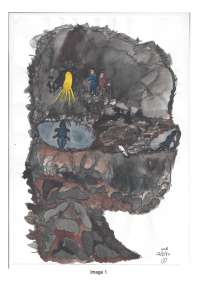
After recording the Rite of Passage Rock-Light Being dream, I decided to represent the image in pencil, pen and ink, and watercolor. My method for illustrating dreams is to begin by trying to establish the starting point of the dream sequence in the place most likely to allow me to work through and capture all the action, step by step, on one page. I opened this dream with the stone path at the bottom center of the page. I began penciling in the details with no conscious awareness of the greater reveal (Image 1.) As I finished the initial sketch, I couldn’t help but think, “Behold the ancient being with his bright flash of light for consciousness, crocodile brain stem extending into the olfactory region, and stunning child like silhouette! How striking, how primordial!”

EncounteringRLBeingImage2.3.23.16

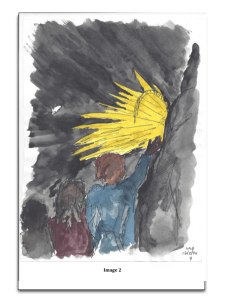
After completing this scene, I turned my attention to capturing a close up of our approach along the rock face. My intention was to create an image-as-threshold to assist me in my ritually re-entering the startling moment. (See Image 2.)

I was challenged at this time in my work to understand what this powerful dream was really offering me. It was one of a number of dreams in a series which seemed to move out into the world, connecting me in important ways to mysterious meanings which defied rational explanation.

Twenty years later, deepening in my Jungian orientation through a seminar series with the analysts of the Santa Fe group, I came across Jung’s description of the serf’s predicament: “I am the serf who brings it and does not know what he carries in his hand. It would burn his hands if he did not place it where his master orders him to lay it” (Jung, Red Book, 2009, p. 230).

In the Red Book collection, we get to look in on Jung’s initiatory process. In his dialogues with the spirit of the times and the spirit of the depths, Jung describes how he came to understand the existence of an ancient consciousness enlivening us all, and how this guidance, this “supreme meaning” comes to us. The spirit of the depths comes in and places understanding and knowledge at the service of the inexplicable and the paradoxical, sense and nonsense. The melting together of sense and nonsense is what produces the supreme meaning. In Jung’s words (2009), supreme meaning is “the path, the way and the bridge to what is to come… image and force in one, magnificence and force together … the beginning and the end … the bridge of going across and fulfillment…

Furthermore, from this perspective, Jung observed “To understand a thing is a bridge and a possibility of returning to the path. But to explain a thing is arbitrary and even murder…” (Jung, Red Book 2009, p. 229-230).

While I was enjoying a newfound sense of freedom from my compulsion to explain and contemplating on magnificence and force together, this 1994 dream and these illustrations came to mind: might they be an example of image and force in one, magnificence and force together?

RockLight DreamImage1NoMargin3.23.16EncounteringRLBeingImage2.3.23.16

1994 Dream: Rites of Passage and the Rock-Light Being

Posted March 22, 2016 by chuck bender
Categories: Author, Communications from the Dream Time, Dream, Images of the Self, Individuation, Initiation, Soul

EncounteringRLBeingImage2.3.23.16

The following two part dream was a big dream for me, one of a series of dreams during my early years with the mytho-poetic men’s community; during this period I attending many weekend and week long workshops with Robert Bly, Micheal Meade, James Hillman, Robert Moore, and Malidoma Some among others. Locally, a ragtag band of us dedicated ourselves to exploring first hand what we could learn about midlife initiatory ritual process through an evolving collective and personal story enactment model. The dream:

“I am at a grand competition of some kind, like a graduation rite, with lots of people cheering on those who have achieved their goal; the ritual consisted of the graduate first throwing a small ball out as far as he could, and then running as fast as he could to bring it back. This was an individual act, with no attention paid to the time or comparisons with anyone else. Sending him out and welcoming him back, the crowd simply roared in celebration of his achievement, reflected in his level of clarity and intention. This was most impressive, an honor and joy to behold, and the enactment enabled all to witness. I didn’t know how the game worked but his throw was so compelling that I elected to go running after the ball also; Coming from the side of the field, he had thrown it down field in my direction, I dived over and behind a large bolder in pursuit of it, and then heard an urgent warning: “Get ready because he surely is coming after it. It means a great deal to him.” The implication is that his force could unintentionally kill me if I were in his path.

Part 2: Then the scene switched to three of us, two men guided by a woman, working our way up a rocky terrain stream-bed like path. I am in the middle. It’s quite dark and there is a strong sense of wilderness, adventure. We get to a rocky rise and our guide stopped suddenly, pointing to a watery place contained by the stone to a set of large eyes watching us. An archaic archetypal crocodile, huge, was perfectly lined up on us; should we have continued up and over we would have been eaten. She motioned us to move sideways and we looked for a way up while watching for more crocodiles. I saw another one and couldn’t find an easy way up. Calling to her, she had gone up and was out of sight, she doubled back and offered a hand, pulling me up near by, saying “this old VW bus windshield comes in handy.” Working our way along the trail next to a vertical rock face, I got into the lead. As we walked along in darkness a door suddenly flew open, right in front of me, letting a flood of bright yellow light out; with it, I saw something was tossed out; then the door closed just as quickly, leaving no trace. At first I felt anxious about almost being hit or seen, then I was curious about who or what lived in the rock, and what had been thrown out? I sensed some indigenous peoples must be living there secretly.” Pausing, the alarm went off.

REFLECTIONS: At the time of this dream I was wrestling with my awareness that while I felt very serious about my personal analysis, more attention and focus was possible. In the opening celebratory ritual process scene, I noticed my dream ego was identified more with the witness who  jumped into the ritual action from the sidelines, in contrast to the dream figure  who has done the work and is moving into the new life with community blessing. In reality, I was at the time deeply engaged in working through my own childhood near death, initiatory life event with the help of a band of spirit/soul brothers.

In active imagination, I re-entered the second scene, hoping to dream-the-dream-onward and discover more about the origins of the rock dweller and the meaning of the tossed out object. I dialogued with an ancient reptile man-like being, a self identified gatekeeper and light tender who releases the light. In response to my question, “What did you throw out?” he replied they were shards of light, reflections of everything that has ever happened in my (Chuck’s) life. Each shard mirrored a scene of my life. I was to know they existed and seek to gather them all up; this was my path to self-knowledge. Considering the flash of light as an image of enlightenment, the Self shining through, I interpreted this as signaling the importance of doing the work to remember everything fully. The shards would provide every detail in turn.

“Progress of the Soul” Series by Alex Grey

Posted March 20, 2016 by chuck bender
Categories: Uncategorized

After a very informative weekend workshop exploring the reality of the subtle body with Monika Wikman, I wanted to share her website and this link to Alex Grey’s work with you. Grey’s Progress of the Soul series captures the possibility we are all participating in an energetic field of incredible beauty. Check it out for yourself.

Dr. Wikman’s website includes several links to her podcasts and some written material.

Jung on “… a balance between joy and sorrow

Posted March 14, 2016 by chuck bender
Categories: Uncategorized

“The principle aim in psychotherapy is not to transport the patient to an impossible state of happiness, but to help him acquire steadfastness and philosophic patience in face of suffering. Life demands for its completion and fulfillment, a balance between joy and sorrow.” (C.W. 16, par. 185)

Thanks to Elie Humbert for this selected quote. Humbert, Elie, C.G. Jung – The Fundamentals of Theory and Practice, p. 136, 1984.

Perry on the Genesis of Complexes

Posted March 13, 2016 by chuck bender
Categories: Complexes and More

The following quote helps us think about the early challenges present in the family of origin home environment at the level of what was going on in the psyches of those in charge of our childhood well being. From the ancestral complex perspective page we have Vine Deloria citing Jung and observing: “If the psychology of the parents affected the infant, it was largely because the parents themselves were subject to influences that had been accumulating for many generations. When it came to the individual, Jung considered the person as but a brief episode in a much larger family spanning generations and perhaps centuries: ‘We ought rather to say that it is not so much the parents as their ancestors – the grandparents and great-grandparents – who are the true progenitors, and that these explain the individuality of the children far more then the immediate, so to speak, accidental parents.’” The following Perry quote offers additional help in thinking about how our present day challenges invariably include unfinished emotional material from days gone by.

“… the child’s emotional psyche is not affected by these ego-personalities of the parents anywhere near as much as by the unconscious components in the parents. It is at the level of ‘participation mystique’ and emotional embroilment and interaction that the complexes are formed... The genesis of complexes takes place at the level of the non-ego of the child and the non-ego of the parents, where the really powerful and uncanny parent figures are the reverse ones, the pseudo father and pseudo mother; that is, mother’s animus and father’s anima. In relation to these figures the child is apt to slip into affect-ego positions and respond with his own complexes in emotional interactions. So it is of the various other complexes that take shape along the way: they are the product of emotional relationships, bearing the imprint of non-ego and subliminal aspects of the personalities of these significant figures. They arise out of affect-objects, not true objects.” (My italics and bold)

Perry’s language around affect ego – affect object offers a way for us to think about the importance of sorting out “Am I present and conscious in this moment, or, am I succumbing to the heightened emotional state associated with the blur, signifying a/my/our complex is constellating? He observes: ‘During the emotion the energetic value of the ego is lessened, and that of the complex heightened, and in this situation one should speak of an interrelation of an affect-ego and an affect-object.‘ This affect-ego/affect-object language is such a concise way to help us reflect on being conscious within the blur; the intensity of emotion suggests the degree to which we are experiencing through a lense of projected and/or introjected emotion. Orienting to the  level of the non-ego is by definition remarkably complex! Learning to help each other recognize when we are under pressure from intense emotion is more manageable.

John Weir Perry paper: Emotion and Object Relations

Deloria, Vine, Jr., C.G. Jung and the Sioux Traditions, 2009, pp. 133-134.