Intolerable Suffering and Neurosis

Posted October 2, 2017 by chuck bender
Categories: Complexes and More, Poems

I chose the heading above to re-introduce this quote from Sandner and Beebe:

“Jung contended that neurosis sprang from the tendency of the psyche to dissociate or split in the face of intolerable suffering. … Such splitting ‘ultimately derives from the apparent impossibility of affirming the whole of one’s nature’ (Jung 1934, p. 98), and gives rise to the whole range of and conflicts characteristic of feeling toned complexes. This splitting is a normal part of life. Initial wholeness is meant to be broken, and it becomes pathological, or diagnosable as illness, only when the splitting off of complexes becomes too wide and deep and the conflict too intense. Then the painful symptoms may lead to the conflicts of neurosis or to the shattered ego of psychosis. The way back, the restoration – perhaps always partial – is the work of individuation. …”

Let’s think about the idea that such splitting ‘ultimately derives from the apparent impossibility of affirming the whole of one’s nature’.

Might we choose to embrace our inner guidance? Dedicate ourselves to making a place for our true selves? Not easy!


The Secret of Salvation in Dante’s World

Posted September 28, 2017 by chuck bender
Categories: Connecting the Dots Series, Soul

The paragraph below is excerpted from a source quote posted under Images of the Journey in Dante’s Divine Comedy, by Charles H. Taylor & Patricia Finley:

“The secret of salvation in Dante’s world … is insight into the nature of who one is, how one injures, what it feels like to be oneself the victim and to make others the targets of one’s desirousness, rage, pride, and deceits. Those who make it to Purgatory are not less shadow-driven, narcissistic, obsessed, or pathological than others, but they have not refused to make conscious what they are, to bear the burden of themselves, and to come in time to take full responsibility for their own natures. By coming to know what operates in us behind appearances, whether driven by unconscious instinct and aggression or by more deliberate betrayals we can choose to take a stand against whatever in our personal character moves us to wound others and our larger selves.

Archaic Human Longing in Everyday Life

Posted August 14, 2017 by chuck bender
Categories: Uncategorized

I want to talk about some key concepts offered by Robert Moore years ago in a men’s workshop concerning the importance of recognizing archaic human longing. When men get together with an expectation for achieving a depth of intimacy, this ancient longing is activated. Of course this also applies to all humans.

Robert said this archaic human longing is – simply put – a longing for enthusiastic response. The notion is none of us got enough enthusiastic response growing up. (see Bly on the shadow) It seems to me you know you’re in it when you notice the intensity of your desire too be seen or known feels curiously, painfully humiliating.

In order to survive the pain of the recognition of what this must mean about us, we all develop a grandiose exhibitionistic self. We find a way to pump ourselves up, say we don’t need the enthusiastic love and acceptance of the one who would withhold this. What do you know about your grandiosity? Note this would be a compensatory grandiosity rather than a connection with true grandiosity via ego-Self reunion.

Because that defense takes so much energy, we then develop a defense against the grandiosity, dedicated to facilitating radical grounding. These two reflect something of a bipolar experience, mania followed by depression if you will.

Until we’re able to work into the core wound about not being seen and celebrated, allowing us to connect with, embody, and embrace our split off hurt feelings, confusion, and vulnerability, we are set up to rely on addiction defenses. Here, one gives up on approaching the longed for human connection, and instead substitutes an enthusiasm for X, Y, or Z. The addiction cycle keeps us busy with longing, longing satisfied, loss of satisfaction, and the inevitable crash. After some recovery time, we’re back at it.

We might say all the X, Y, and Z’s are but “counterfeits of goodness“. (Beatrice to Dante in the Divine Comedy)

Application: it’s helpful to think of these in a vertical column and always try to move up towards your longing. This means approaching as directly as you can that which is painful, most vulnerable and likely humiliating. If you find yourself in your grandiosity, ask where is my longing and go there directly.

If you find yourself in radical grounding/depression, ask where is my grandiosity as the grounding/depression experience is likely a defense against your grandiosity.

If you catch yourself in a little or big addiction cycle, think about who really matters to you and approach them directly about the enthusiasm problem.


Complexes as Bridge to the Symbolic World

Posted August 1, 2017 by chuck bender
Categories: Complexes and More, Connecting the Dots Series

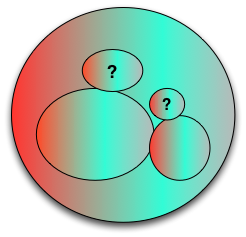
ComplexSymbolpng

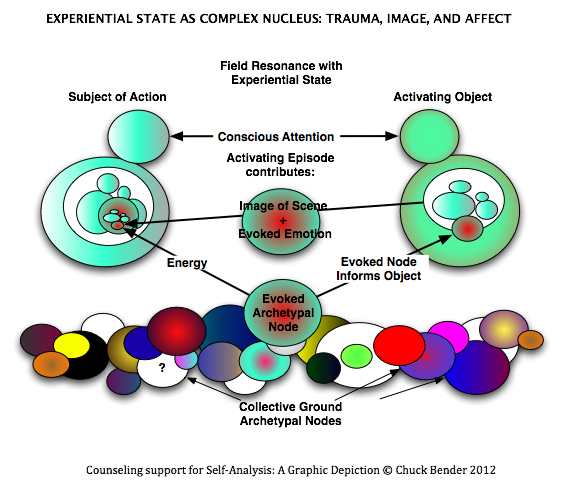
As I prepare to move into diagramming the next step on projective identification, I find I want to support reviewing complex theory as it comes into play here. My graphic representation signifying the presence of a complex is:  The key is in seeing and recognizing the significance of the overlap between the experiential state image and the image of the complex nucleus. I have tried to capture this in my page on the experiential state as a complex nucleus. Below I am going to bring forward some of my psycho-educational symbolic overview page discussion of this detail:

“Complexes as Bridge to the Symbolic World: In its mysterious, true symbol system aspect, these images hold something beyond that which I can consciously fully grasp. An image functioning as a symbol both informs us about, while at the same time protects us from, an emerging, essential to conscious life awareness. Jung (1921) defined the symbol as “the best possible designation or formula for something relatively unknown yet recognized to be present, or required.” (Jung, C.G., CW6)

The symbol comes alive for me in the Experiential State as Complex image.

The elements present combine the internal representation of self/other/affect, in its scene remembered composite form, with its associated complex. In its experiential state aspect, it captures the essence of one’s family of origin experience. Countless interactions averaged and generalized over time serve to inform the transference at the level of primitive invariant organizing principles.

From a complex perspective, the experiential state image mirrors directly the key elements comprising the nucleus of a complex: an archetypal energy, or dynamism, and the scene of activation depicting the object “in the act.” The presence of archetypal energy suggests the resources of the collective unconscious have been called into service and will need special consideration.

analytical psychology complex nucleus image affect evoked node

Jung’s formulation of the complex bridges personal experience with the archetypal world. Complexes are generated in response to overwhelming personal life experiences. Murray Stein, on the structure of the complex, notes:

“. . . Jung describes it as being made up of associated images and frozen memories of traumatic moments that are buried in the unconscious and not readily available for retrieval by the ego. These are repressed memories. What knits the various associated elements of the complex together and holds them in place is emotion. This is the glue. Furthermore, “the feeling-toned content, the complex, consists of a nuclear element and a large number of secondarily constellated associations.”(19) The nuclear element is the core image and experience on which the complex is based – the frozen memory. But this core turns out to be made up of two parts: an image or psychic trace of the originating trauma and an innate (archetypal) piece closely associated to it. (Stein, Murray, “The Structure of Complexes, “Jung’s Map of the Soul, pp. 52-53.

Traumatic experiences, by virtue of their energies having overwhelmed the ego’s ability to stay conscious, evoke specific archetypal responses, thereby connecting us to the hardwired resources of the Self. The associated nuclear element, the evoked node, provides access to the collective memory of the human experience with the same insult/injury at hand; through this activation pattern recognition resources become available to inform our personal response.

For an example of one such bridge, imagine a young child unexpectedly finding him/herself confronted with an extremely distraught mother or father. Edward Edinger observed: “When the child Maneros witnessed Isis’ terrible loss and grief upon seeing the dead Osiris, this awesome sight was so intolerable to Maneros that he fell out of the boat and drowned.” (Edinger, Edward, Anatomy of the Psyche, p. 60.)

This mythological image helps us understand the power of an upsetting personal experience at the level of the archetypal layer; it may be that while part of us that was able to stay in the boat, another part may have symbolically fallen overboard and drowned. We may not be conscious of or remember this detail. Edinger, reflecting on male psychology, goes on to say: “Most men, if they are honest, will acknowledge having had the experience of Maneros when confronted with a woman’s intense grief, desire, or anger”.

This “scene” can become the nucleus of a complex; when this happens, the complex nucleus records and contains the original activating scene of the trauma.

In this respect complexes serve to archive wounds of overwhelm, preserving them until such time the conditions allow us to revisit and heal that which has been split off from consciousness. They also function as dynamic, energetic, sub-personality-like entities. When activating, or what we call constellated, complexes challenge ego consciousness for the driver’s seat, pushing for unconscious enactments.”

Comment from today: We are all blessed with a repository of ancient knowledge via the hardwired resources of the collective unconsciousness. From an evolutionary standpoint, it seems this system is biologically auto-updating. When we experience in this life time an event of emotional significance, the corresponding evoked archetypal node contributes help in the form of image, affect, and energy.  The archetypal layer, by definition primitive, archaic patterning, resists ego level defense efforts to intervene directly. This detail speaks to the necessity of learning to think symbolically, as in the dream, mythology, and fairy tales, in order to cultivate one’s relationship with the archetypal realm.

My experiential state complex graphic representation is:

ExperientialStateComplexpng8.1.17

Projective Identification: Informing the Experiential State

Posted July 9, 2017 by chuck bender
Categories: Complexes and More, Connecting the Dots Series, Transference and Countertransference

In the Bollas quote posted below, we are invited to picture an interaction between a father and child complicated by the father’s not conscious enough awareness of his personal issue with feeling guilty over impulse buying or the pressure created internally by the urge to be impulsive.

For your response ease, here is the Bollas quote from the link (edit 7/10/19):

”Kleinian psychoanalysts, in particular, have focused on one way in which a person may rid himself of a particular element of psychic life. He does so by putting it into someone else. If a father feels guilty over impulse buying or the pressure created internally by the urge to be impulsive, he may break psychological contact with this impulse and its inspired guilt by criticizing his child’s ordinary impulsiveness. As the parent unconsciously rids himself of this unwanted part of himself, his overly censorious relation to the child’s impulsiveness creates the ‘desired’ effect. Unable to bear the father’s censorious approach, the child becomes even more impulsive. In studying human relations, whenever we note that one person compels another to ‘carry’ an unwanted portion of himself, then we speak of ‘projective identification’.

I believe there is a process that can be as destructive as projective identification in its violation of the spirit of mutual relating. Indeed, I am thinking of an intersubjective procedure that is almost exactly it’s reverse, a process that I propose to call extractive introjection. Extractive introjection occurs when one person steals for a certain period time (from a few seconds or minutes, to a lifetime) an element of another individual’s psychic life. Such an intersubjective violence takes place when the violator (henceforth A) automatically assumes that the violated (henceforth B) has no internal experience of the psychic element that A represents. At the moment of this assumption, an act of theft takes place, and B may be temporarily anesthetized and unable to ‘gain back’ the stolen part of the self. If such extraction is conducted by parent upon a child it may take many years of an analysis before B will ever recover the stolen part of the self.” (pp 157-158)

Discussion

The concise pattern language based example does not comment on a possible continuum of alternatives to this father’s reliance on employing this defense, only that for him the stage is set to rid himself of this discomforting conflict by simply putting it into someone else. This works, allowing him to break psychological contact with this impulse and its inspired guilt… Unfortunately, the cost of this ridding is to find/experience cause for alarm in what is described as, in reality, his child’s ordinary impulsiveness. Through his overly censorious criticism of the child, the father off-loads his burdensome urge-to-impulse-and-inspired-guilt (complex). This is a blur moment. Most people looking in on this exchange would recognize a deeper dynamic at play, something a bit or more off in some way, but not so with the father. By design, one’s consciousness is protected entirely from experiencing the dynamics responsible for the impulse/guilt conflict in need of discharge, as well as it’s origins.

ExpStateSelfOtherAffect

Representing this image/affect graphically as an experiential state scene, we can try picturing the father in the act of criticizing the child. Imagine the depth of expression for both, surrounding the giving and receiving of the wound. I am suggesting wound here, because of its identified unconscious dynamic. The father is, through this mechanism, transferring his personal conflict with impulses and guilt into the child.

How might we think about the whys? Why this mechanism? Why now? What is adaptive about its deployment? How is it likely to effect the child, over time? In the instance of this example, we see a parent has misinterpreted or miss-apprised what is identified as in reality the child’s ordinary impulse. The father is reacting to his child’s identification with the father’s projection, not his child.

From the perspective of the child being criticized with an unconscious-to-the-father overly censorious driver, we can picture this scene as one which will inform the child’s developing experiential state on the theme of something in me is not OK.

The experiential state image is a useful tool to think about what psyche does with encapsulated episodic memories. Recall, humans as early as several weeks of age demonstrate the capacity for episodic memory: in this memory storage system emotionally charged episodes get swallowed whole, encapsulated and stored, without being fully inventoried. It seems as long as unconscious contents remain unconscious, their intensities are not diminished by time and space.

When we get emotionally triggered, it is likely one of these highly charged capsules of traumatic experience has activated, contributing it’s resonant emotional tone to the scene. Typically, the encapsulated trauma memory does not announce it’s role in providing the emotion. Again, this is the blur.

If we were to orient the father to his vulnerability to employing such a defense, with increasing awareness, he might choose to experiment with checking his impulse to censor his child. If he is able to do so, what might he notice? The increasing internal pressure may well lead to a spontaneous memory or feeling. From a psychodynamic perspective, it is possible an unthought known can begin to be thought about.

The action disorder formulation gets at this starting with the observation: “Any affect or emotion which in its raw and unaltered form is too intense to be controlled by will alone may need its ritual. Without ritual, such energies may inundate the ego and force it into acting out or into obsessive behavior. Ritual brings about containment and acceptance, control of intensity, and ‘dosage’.” (Whitmont, E., Return of the Goddess, p.235.)

At a personal level, we may or may not have much of an idea about how much of a charge we are carrying related to still split off trauma.

At the level of at least doing no harm, the father in his unconsciousness is likely to be initiating a reenactment of his original wound.  From this perspective, what he puts on the child and what the child experiences, will quite likely be an out-picturing of the father’s core experiential state scene. Almost from the beginning, any two who would love will be generating a core internal image or representation of what it means to be in relationship. See Developmental Considerations)

dancepartytextlesspng

The father, suffering at some level with feelings of guilt about impulses, rids himself of the conflict by putting it into the child. His psyche sets the child up to become identified with the unacceptable impulsiveness projected onto him, setting up the father’s feeling justified in using a critical tone to find the child guilty as charged. This is the blur dynamic.

In truth, while the father is in the stage of life where in he can choose to embrace corrective experiences leading to the dissolving of the irrationality contributing to his experiential state scenes, the child is in the phase of coalescing of his/her experiential state. Recall, my first orientation to the concept of the experiential state was the fact that it was the single composite picture informed by every important interaction concerning wounds to loving. I find it helpful to think about multiple emotional challenges, on themes, which can still then be collapsed into one.

I’m going to post this now and try to approach it by reworking the graphics in the Representation of Persona Submitting to Emotion plate.

Donald Kalsched on Early Trauma and Dreams, Part 1

Posted June 20, 2017 by chuck bender
Categories: Uncategorized

Youtube offers this audio tape of Dr. Kalsched presenting on his findings. I can’t emphasize enough the importance of his formulation on psyche’s self care system archetypal protector complex. Check it out.

Projective Identification and Extractive Introjection

Posted June 19, 2017 by chuck bender
Categories: Transference and Countertransference

Seeking to re-familiarize myself with the concept of extractive introjection I found this chapter link by Christopher Bollas.  (see The Shadow of the Object: Psychoanalysis of the Unthought Known)

Beginning with a description of projective identification, Bollas then proposes what he identifies as ‘almost exactly it’s reverse’, extractive introjection. For my purposes, I want to try visualizing the pair through the lenses of experiential state imagery and complexes. First, the Bollas quotes:

”Kleinian psychoanalysts, in particular, have focused on one way in which a person may rid himself of a particular element of psychic life. He does so by putting it into someone else. If a father feels guilty over impulse buying or the pressure created internally by the urge to be impulsive, he may break psychological contact with this impulse and its inspired guilt by criticizing his child’s ordinary impulsiveness. As the parent unconsciously rids himself of this unwanted part of himself, his overly censorious relation to the child’s impulsiveness creates the ‘desired’ effect. Unable to bear the father’s censorious approach, the child becomes even more impulsive. In studying human relations, whenever we note that one person compels another to ‘carry’ an unwanted portion of himself, then we speak of ‘projective identification’.

I believe there is a process that can be as destructive as projective identification in its violation of the spirit of mutual relating. Indeed, I am thinking of an intersubjective procedure that is almost exactly it’s reverse, a process that I propose to call extractive introjection. Extractive introjection occurs when one person steals for a certain period time (from a few seconds or minutes, to a lifetime) an element of another individual’s psychic life. Such an intersubjective violence takes place when the violator (henceforth A) automatically assumes that the violated (henceforth B) has no internal experience of the psychic element that A represents. At the moment of this assumption, an act of theft takes place, and B may be temporarily anesthetized and unable to ‘gain back’ the stolen part of the self. If such extraction is conducted by parent upon a child it may take many years of an analysis before B will ever recover the stolen part of the self.” (pp 157-158)

Bollas goes on to provide a number of vivid clinical examples illuminating the not so subtle but exceedingly challenging difficulties associated with this mechanism.


Dreams from a Lifetime: Stations Along the Road

Posted May 17, 2017 by chuck bender
Categories: Uncategorized

With this post I want to report I am going to gather up the number of personal dreams I have posted separately, and begin to collect them on the Stations Along the Road (see pages column on right). In the interest of honoring the dream time, I have been committed to trying on just offering dreams without much comment to date. I am not sure how useful this may be to anyone else. In addition, some of these dreams really should come with a warning! Having created this response ease way to explore dream journal entries over one’s lifetime, I am appreciative how seeing them in series supports deepening in understanding of how the dream time (can) serves us. Here is Jung, commenting on the dream time and the idea of big dreams:

“Big dreams carry energy and images from a deeper level, reflecting individuation process, where we find the mythological motifs or mythologems I have designated as archetypes. … Such dreams occur mostly during the critical phases of life, in early youth, puberty, at the onset of middle age (thirty-six to forty), and within sight of death.

At these times, when the collective level breaks into consciousness, expectations, and opinions of the personal consciousness are stations along the road of the individuation process. This process is, in effect, the spontaneous realization of the whole man. The ego conscious personality is only a part of the whole man, and its life does not yet represent his total life. The more he is merely “I,” the more he splits himself off from the collective man, of whom he is also a part, and may even find himself in opposition to him. But since everything living strives for wholeness, the inevitable one-sidedness of our conscious life is continually being corrected and compensated by the universal human being in us, whose goal is the ultimate integration of conscious and unconscious, or better, the assimilation of the ego to a wider personality… (in understanding big dreams)… they employ numerous mythological motifs that characterize the life of the hero, of that greater man who is semi-divine by nature. Here we find the dangerous adventures and ordeals such as occur in initiations. We meet dragons, helpful animals, and demons; also the Wise Old Man, the animal-man, the wishing tree, the hidden treasure, the well, the cave, the walled garden, the transformative processes and substances of alchemy, and so forth…” Jung “On the Nature of Dreams”, CW Vol. 8 p. 281-297. (Chuck’s italics)

Getting Triggered: the Life Cycle of a Complex Activation

Posted May 15, 2017 by chuck bender
Categories: Uncategorized

I have been thinking about what happens when one gets one’s buttons pushed. We’ve all experienced cycles of emotional reactivity. I have been exploring these as evidence of the blur. The basic rule with regards to becoming aware of an activation or constellation of our unfinished business, is to directly acknowledge the blur with it’s peculiar emotional intensity. That may be the easiest part. The hard part is standing up to the complex. If/when someone becomes fully charged by the complex, the ego function is mostly off line. The complex exercises it’s power as if a (psychological) possession state.

We can think about the Wolf in the tale of Little Red Riding Hood as a negative possessing complex which has in mind the goal of devouring first the Grandmother, and then Little Red Riding Hood herself. In the story, both do indeed get eaten, but, the woodcutter, recognizing what has happened, in a timely way quite easily frees the two of them before any lasting damage can occur. He dispatches the Wolf back into the ground of the dream-time. We all need to know what every woodcutter knows – how to free one’s self and others from complex possession states.

The following quote from Murry Stein contributes an interesting perspective on the role complexes play in complicating our intimate lives. We want to practice tracking triggering events – microfractures in communications – in the service of discernment of recognizing complexes within the context of their natural life-cycles. With growing awareness and sensitivity to the presence of the blur, one is challenged to speak for consciousness and if necessary, firmly insist on attending to the blur complication.

Generally, the psychological effects of complex constellations perseverate over an extended period of time after the stimulus has left off impacting the psyche. Certain experimental investigations seem to indicate that [the complex’s] intensity or activity curve has a wavelike character with a ‘wavelength’ of hours, days, or weeks.’(16) The stimulus that provokes the complex may be slight or great, of long or short duration, but its effects on the psyche can continue for extended periods of time and can come into consciousness in waves of emotion or anxiety. One of the signs of effective psychotherapy is that the complex-induced disturbances perseverate for shorter lengths of time than they did before. A more rapid recovery from complex-induced disturbances indicates increased ego strength and integration of psychic material as well as decreased power in the complexes. A shortened perseveration time means that the complex’s power has diminished. Nevertheless, it must be recognized that a complex can never be completely eliminated. The wavelike effects of complex “aftershock” are exhausting and draining.  (Stein, Murray, “The Structure of Complexes, “Jung’s Map of the Soul, p.50)

Couple Experiential State Complex: Finessing a Re-enactment of the Wounding

Posted May 8, 2017 by chuck bender
Categories: Uncategorized

COUPLEEXPERSTACOMPLEX.GRAF10-12

Couple Experiential State Complex

Author comment: This page was originally posted in October of 2012. I have moved it to the front page to highlight the core formulation. The teaching I keep moving towards is in the basic idea our emotional triggers – serving to activate the blur – can be understood as psyche signaling we are ready to engage in a take 2 healing round. The emotional disconnects allowing one to live through core traumas are not meant to carry us the whole way. Can you get a sense of this from the below?

Having come together in the name of love and commitment, how are we to understand the meaning of the insensitive, unkind, and/or self/other destructive actions that always occur between two passionate human beings? The Couple Experiential State Complex formulation provides a way to begin to imagine what happens when relationships bring two Experiential State Complexes together.

While our discussion will focus on important intimate relationships, emotional encounters in everyday life all point to the transference. Many a couple, dining out, have suffered through the awkwardness of how to recover the festive mood in the aftermath of one partner experiencing just cause for upset with the wait staff.

In line with John Perry’s formulation (see Emotions and Object Relations), the very presence of emotion suggests an activation of the unconscious in the moment. With this, a blurring of the boundary between the here and now and the Experiential State suggests some degree of projection and increasing potential for introjection. Powerful dynamics demand the unconscious script be acted out. Alas, when one person is activated in this way, the usual response is the other will react with a complementary emotion. Learning to differentiate feeling from emotion or affect is a first order priority.

On the differentiation of feeling from emotion, Perry, with help from Jung, observes:

“. . . feeling is of a different order from that of emotion; feeling is a function of consciousness, and – to the degree to which it is differentiated – has the quality of choice and intentionality in judgments of value.” J W Perry p.2

“. . . emotions are the activity of the unconscious, the non-ego” (Jung, 1907)

“. . . emotions are autonomous and happen to the ego without its bidding, and the ego is the recipient of the impact of the emotions” (Jung, 1939, 1943).

“. . . we think of the unconscious as being the autonomous psyche, and it can as well be called the emotional psyche.”

In terms of understanding what generates the emotion, Perry observes:

“. . . I find the occurrence of any emotion to consist of the interplay between two complexes. . . The subject experiences the affect that belongs to the complex with which the ego aligns itself, and assigns the other pole to the object. During the emotion the energetic value of the ego is lessened, and that of the complex heightened, and in this situation one should speak of an interrelation of an affect-ego and an affect-object.”

Rowe Mortimer (1996 seminar) has observed from a self-psychology perspective the self and others are not just representations and memories. The internalized mother and father “others” are comprised of something of the actual energies of the mother and the father, as experienced and taken in over time. They organize on themes and become active, dynamic, willing agents, operating like sub-personalities. When activated by stress or triggers, a power struggle may ensue, with the mother, father, and potentially other significant internalized others challenging the ego for control of the driver’s seat.

If the ego succeeds in staying conscious enough to contain the activation, the blur is revealed, and something important can happen to advance our understanding of the deeper wound. If the ego is unable to withstand the emotional activation, then the activating “other” will either hijack/possess the ego, or be projected on to the environment; onto both willing and not so willing participants. If the “other” overpowers ego consciousness, the child state corresponding to the experiential state gets projected. Either can be the experiencing one and either can be projected. If in the moment I sound peculiarly like my angry father, it is likely I have simultaneously projected my child state onto you. If so, your reactions to my tone may be doubly painful, reflecting the possibility you have unwittingly introjected or embodied my split off wounded child state.

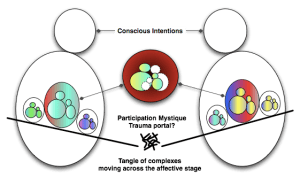
The Representation of Persona Submitting to Emotion plate pictures the shift from consciousness to activation of the complex and potential for splitting and projection of one or both poles onto the environment. In this moment, one’s ego functioning may be completely absent, reflecting a kind of highly contagious possession state.

With practice one can sense this pending deterioration of consciousness where in one or both are under the influence, affect-ego and affect-object, and seeing self/other through the blur of the complex. The greater the emotional charge and the more effective the repression of the trauma complex, the more difficult it is to stay conscious in the face of very powerful triggers.

Activating complexes often present in the form of an issue that seems to require we take a stand or take sides for or against something. The difficulty in staying conscious in the middle of such pressure usually reflects a deterioration in one’s capacity to relate to the complexity of the situation, in the direction of more concrete, black and white thinking. This suggests the activation of splitting defenses. Rather than getting pushed into a corner, or alternately demanding the other accept our rightness versus their wrongness, we want to aspire to “Not either/or, but both and more.”

It is reasonable to offer a willingness to help make the both and more case, as this requires consideration of the opposing reality on the way to opening up to the “more.” It takes practice to hold to one’s center and stay calm and conscious in the presence of intense emotion. Am I really guilty as charged? Are you truly just trying to help me in attacking me so? Did I really hurt your feelings terribly without even realizing it? (Edinger on Calcinatio and Invulnerability to Fire).

When can we trust our perception of what is real in the moment? Perry suggests (in the early object relations language):

“Objects, as they actually are, emerge only with the growth of consciousness and the differentiation of the ego, freeing it from the tangle of alignments with the various complexes that move across the affective stage.” (J W Perry p.43) I find this to be a very powerful word picture.

I have conceptualized and represented this “tangle of alignments with the various complexes that move across the affective stage” as an actual line inhabited by a number of distinctly different Experiential State symbols, as representations of the “various complexes.”

The designation of the line as the “affective stage” serves as a reminder that we are challenged to work at the level of emotion, without becoming completely possessed by or identified with the emotion itself.

I have suggested multiple versus single Experiential State symbols in recognition of the helpfulness early on in identifying the roots of the primary relationships with mother, father, siblings, and others. Taken all together, averaged and generalized over time, these point to the composite picture portrayed in the concept of the single state image.

The center figure above designated as the Couple Complex represents the combining of individual Experiential State figures into one composite complex.

When activated, both partners will feel pulled to react to either’s self/other positions. Quite often, in any encounter, some switching from adult to child to adult and back again will occur. The activation unconsciously strives to generate a script which, if submitted to, leads to both participants experiencing directly the painful, usually repressed feelings of childhood, associated with the inability to be truly seen, valued, protected, and loved.

The way this can just show up and make trouble is remarkable. A line from William Stafford’s poem Ritual to Read to Each Other paints this picture: “For there is many a small betrayal in the mind, a shrug that lets the fragile sequence break, sending with shouts the horrible errors of childhood storming out to play through the broken dike.” When activated, complexes threaten to overwhelm the most carefully constructed dikes.

The colors employed above suggest the possibility we share specific overlapping elements at the core wound level. My family colors recognize your family colors. At this point, the actual colors are not meaningful to me beyond helping to make the point that an emotional tone or color shading will be present in our unconscious recognition/selection of the other.

Perry suggests we must develop the ego’s capacity to discriminate and differentiate between inner and outer, past and present.

Until we are able to do so, feeling toned complexes are like “tractor beams” in the Star Wars saga, pulling us into emotional encounters somehow sensed to be fated. If we are to have any chance of healing, we want to understand why we must go there.

This is the “participation mystique” aspect. However we try to consciously manage our individual and relationship needs, at another level, a deeply unconscious level, we are engaged in pursuing the healing of splits in the service of recovering our wholeness. (Sandner and Beebe Psychopathology and Analysis)

When we find ourselves beyond the honeymoon and inexplicably drawn into suffering in ways we didn’t know we could, before bailing, we should consider what Perry describes as the functional intent pressing for consciousness through repeated reenactments of the wounding:

“… Complexes, in their favorable aspect = components of development. The repetition compulsion, as has been pointed out so often, provides the ego the occasion again and again to encounter these rejected components of development in order finally to assimilate them in some happy moments.”

This formulation supports the notion that we will persevere in our problem behaviors until we find someone who’s nature and strengths, in concert with ours, will allow the two of us, together, to bring to the wound that which up until now has been missing.

This perspective suggests we direct our efforts to recognizing emotion in the moment and developing the capacity to hold on impulses to actions supporting the repetition compulsion, or what I call the unconscious reenactment of the wounding with the beloved. We then have the choice to practice sitting together in the service of remembering our stories, and offering them for witnessing, with an eye for opening our hearts and reconnecting to the painful facts of our split off childhood experiences. At this time, in this way, we have access to compassionate consciousness and deep empathy, and so find we can heal the splits and suffer the recovery of a little more wholeness.