Archive for the ‘Uncategorized’ category

On seeing each other “whole and against a wide sky?”

April 2, 2014

Re: Rilke quotes on Love and Other Difficulties, ( recently liked!) I appreciate Rilke’s observations on just why we might choose to become known to each other; this active process in contrast to thinking we can assume any thing about another’s experience.

And how about the idea of the preciousness of recognizing those relationships where in one is willing to stand guard over the other’s solitude? It seems Rilke is orienting us to the positive aspects of being with one’s self deeply. And perhaps, allowing another to be present with us in this conscious experience. As if we could be, and remain centered in our being, in the presence of another. Quite an achievement.

He then suggests that out of this conscious recognition of being with another, in solitude, we are in the position to learn “only through that which steps, festively clothed, out of the great darkness.”

In short, when in the presence of emotion, suggesting an activation/constellation of complexes, if only we could breathe, get deeply centered, and wait, present in the moment, for that which steps, festively clothed, out of the great darkness.

Stories about encounters with the Festively Clothed?

“A togetherness between two people is an impossibility, and where it seems, nevertheless, to exist, it is a narrowing, a reciprocal agreement which robs either one party or both of his fullest freedom and development. But, once the realization is accepted that even between the closest human beings infinite distances continue to exist, a wonderful living side by side can grow up, if they succeed in loving the distance between them which makes it possible for each to see the other whole and against a wide sky!

Therefore this too must be the standard for rejection or choice: whether one is willing to stand guard over the solitude of a person and whether one is inclined to set this same person at the gate of one’s own solitude, of which he learns only through that which steps, festively clothed, out of the great darkness.”

See page Source: Rilke on Love and Other Difficulties


From the Developmental to the Archetypal: The Experiential State as Complex

March 17, 2014


ExperientialStateAsComplexNucleus10-21-12

Experiential State as Complex Nucleus: Trauma, Image, and Affect

First, unpacking some of the Psycho-Educational Symbolic Overview material, consider the idea of the symbol in its step down transformer function: the image as symbol provides a way for the 110 wired ego to reflect on the 220 plus experiences. A symbol both informs us about, while at the same time protects us from, an emerging, essential to conscious life awareness. Jung (1921) defined the symbol as “the best possible designation or formula for something relatively unknown yet recognized to be present, or required.” (Jung, C.G., CW6)

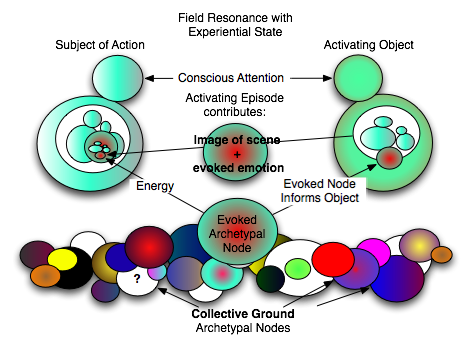
The symbol comes alive for me in the Experiential State as Complex Nucleus image. The elements present combine the internal representation of self/other/affect, in its scene remembered composite form, with its associated complex. In its experiential state aspect, it captures the essence of one’s family of origin experience. Countless interactions averaged and generalized over time serve to inform the transference at the level of primitive invariant organizing principles.

From a complex perspective, the experiential state image mirrors directly the key elements comprising the nucleus of a complex:  the scene of activation depicting the object “in the act,” and the evoked archetypal node’s energy, or dynamism, corresponding to the scene. The presence of archetypal energy suggests the resources of the collective unconscious have been called into service and will need special consideration.

I think the difficulty in grasping the meaning/implication of this detail is in understanding how the developmental experience, the human, relational dance, is key in setting the stage for archetypal activations.

I am thinking it is reasonable to observe that when one becomes overwhelmed by the presenting environmental press, at a certain point, psyche, via the collective resources, initiates to dialogue with us. Heads up! How detailed and specific may/will this guidance be? I have been thinking about the idea of archetypal bandwidth. (See next post.)

Note the Experiential State, Complex, and the Ego-Self Axis Plate differentiates the experiential state image from the complex nucleus, and the ego-Self axis


Trauma and Splitting: the Work of Individuation

March 16, 2014

We’ve all suffered what I think of as wounds of overwhelm. It’s easy to understand this in reflecting on what it’s like for infants and toddlers working so hard to find their own legs, so to speak. Jung and others have noted psyche utilizes dissociation as a defense against more serious psychological damage, and the good news is we are also wired to heal from problems secondary to the splitting solution, as well as the original trauma(s) itself.

Check out this observation from Donald Sandner and John Beebe: “Jung contended that neurosis sprang from the tendency of the psyche to dissociate or split in the face of intolerable suffering. … Such splitting ‘ultimately derives from the apparent impossibility of affirming the whole of one’s nature’ (Jung 1934, p. 98), and gives rise to the whole range of dissociations and conflicts characteristic of feeling toned complexes. This splitting is a normal part of life. Initial wholeness is meant to be broken, and it becomes pathological, or diagnosable as illness, only when the splitting off of complexes becomes too wide and deep and the conflict too intense. Then the painful symptoms may lead to the conflicts of neurosis or to the shattered ego of psychosis. The way back, the restoration – perhaps always partial – is the work of individuation.  …” (see Source: Sandner/Beebe on Dominant Harshness and Vulnerable Woundedness Complex Split page)

Donald Kalsched’s formulation of Psyche’s Self Care System takes this to another level in pointing out the role and workings of the archetypal protector complex. This complex, personified, is the voice of “never again” as in never again will we allow ourselves to be vulnerable to insult and injury.

Back to “This splitting is a normal part of life. Initial wholeness is meant to be broken, and it becomes pathological, or diagnosable as illness, only when the splitting off of complexes becomes too wide and deep and the conflict too intense.” It is helpful to recognize psyche has been dealing with the totality of human experience from the beginning. Through what Jung designated the collective unconscious, we have incredible resources available via the self care system. These resources both allow the initial split to occur, in the service of survival, and then guide us in healing of this same split. In recognizing the fact of the trauma, we can turn our attentions towards creating the conditions which support accessing these resources in re-remembering the fact of the symbolic dismemberment. In truth, we have already suffered it through at the time of the wounding.

Can we bare to embrace the lost scenes and witness them with all the attendant joy and sorrow? Joy related to walls of defenses coming down, allowing direct access to huge split off energies, and sorrow as the direct experience of the original scenes, which, by virtue of having necessitated the split in the first place, are understandably painful. In my experience, however painful the emotional facts are, the joy of release aspect as if trumps the reality of the suffering; the home coming/coming home of the lost soul essence is experienced as a most important/valuable recovery of self.

A Consciousness Challenge: Recognizing the Inner Antagonist in the Outer World

August 12, 2013

When is the last time you bumped into “an exteriorization of an inner antagonist”? It is challenging for consciousness to grasp the possibility conflict with others may reflect, at the root, an out-picturing of an important inner conflict. Think about times when you found you were very sensitive or emotional reactive to a situation or person.

What do we know about the inner antagonist and its origins? What is the meaning and purpose of  projecting this pole of the complex onto someone in the outer world?

Edward Edinger suggests we consider the possibility conflict in the outer world is psyche propelling us into a situation specifically for the purposes of learning something essential. The timing reflects our readiness in the moment to consider the next piece in working through a complex. From this perspective, what we are in conflict with is  an exteriorized, embodied, Inner Antagonist. This is a radical notion. What is the teaching? How can we be open to another who suggests our problem with them comes from us?

Conflict, with the presence of emotion signaling something important is trying to happen, brings the complex to our attention. In what way does our partner selection reflect their unique and peculiar capacities to carry the Inner Antagonist for us?

See discussion in the Representation of Persona Submitting to Emotion page.

Navigating the pages

May 7, 2013

This blog continues mostly as a kind of on-line resource file for the symbol system, theory quotes, and application essays. It may be most helpful to start with the Counseling Support for Self-Other Analysis above, and work your way down through the pages.

Best,

Chuck

Chuck’s early reflections on: Ritual Reenactment Rite of Initiatory Life Event formulation

July 22, 2010

This 2010 post was an early capturing of some of my thoughts about our men’s work, via A Ritual Reenactment of Initiatory Life Event model.

Modern men do not lack initiation altogether. Life initiates us. In surviving childhood, we each have suffered initiatory experiences. Joys and sorrows bring us into fuller awareness of what it means to be human, to live in Nature. Whatever our age or developmental readiness, woundings occur, tearing the fabric of the life we’ve known. Severe woundings generate overwhelming affect, demand submission, cause us to lose balance and fall overboard; it is as if a part of us drowns.

At times like this, we are rarely blessed with the presence of what have been described as “good enough ritual elders.” Their prayers and songs are essential to bring us through fully alive, witness the event, ritually mark us, connect us to the age appropriate teachings, and wed us to the center of community life.

Without such help, wounds of overwhelm trigger Post-Traumatic Stress Disorders. We go to pieces, are dismembered; the episode(s) is split off from awareness . The full story comes to live lodged in our bodies, outside ego-centered consciousness. There is incomplete recognition of what has occurred at the community level, and the individual does not get connected to the community collective vision.

Until the lost story can be fully reclaimed, the teachings are not directly available; as such, the experience is not integrated; these events/episodes live on in psyche as incomplete initiatory experiences.

Remembering

First half of life dynamics favor the development of a strong ego, capable of repressing anything we are unable to deal with consciously. In truth, all that is forgotten to our conscious mind remains entirely conscious, but not to the ego. Infants as early as 2 – 7 months old demonstrate the capacity for episodic memory, the ability to remember whole events without abstracting out any of the details. What happens to all the experiences we can’t remember? From a Jungian perspective, just as the ego is the center of the conscious personality, the Self is the ordering and unifying center of the total psyche (conscious and unconscious). While the ego uses blinders to manage what is experienced as a threat to optimal functioning, the Self has continuous access to all our experience. Ego repressed experiences live on in the body and psyche.
In mid-life a shift in dynamics calls for a depth of remembering that simply can not come through the existing ego structures. Re-membering trauma from this side of the veil means confronting the dismemberment we suffered at the time of injury. This is accomplished through suffering the reactivation of an axis or bridge between the ego and the Self, over which the scenes of trauma must then parade back into ego awareness. For this to occur, defenses called into service to protect the ego from overwhelm must surrender to radical restructuring. To the extent trauma is 220 plus voltage and the uninitiated ego is wired for 110 volts, we have a container problem. Ritual space pulls for the destructuring of the ego and the derepression of trauma in the service of healing.

Initiation

In ritual space, the conscious intentional wounding of the initiate serves to bind, bundle, and energetically transform all prior unconscious woundings, and bring them into service for the community good. In this way, the heat of initiation process functions as a crucible, pivotal in turning one’s attention from the personal past to the community present and future. Men need ritual support to move from woundedness to awareness and full power.

Effective ritual works symbolically to aid the psyche in moving energy that can not be fully grasped by the conscious mind. By definition, wounds of overwhelm occur when we can not grasp some horror. In approaching activation of the bridge to the deep psyche we are at risk for flooding by all the affects and images associated with our personal trauma history. And yet, to grow we must come into conscious relationship to all that has been.

On the problem, timing, and solution, Donald Sandner observes:

“Death and rebirth are the mythological symbol for a psychological event: loss of conscious control, and submission to an influx of symbolic material from the unconscious. Personality growth is usually thought of as cumulative, a gradual expansion through time as ego consciousness gains experience and wisdom. But often it turns out to be only a pursuit of illusory ideals. Then there is cessation of growth, stultifying depression, or, more ominously, severe illness. At that point no halfway measures will do; a thoroughgoing transformation is necessary for the individual’s survival. Like the sun, the ego must prepare itself for a plunge into the darkness of the unconscious underworld, there to experience rejuvenation.” (Symbolic Healing, 1979)

How can we modern men approach creating effective transformative ritual?

The Ritual Reenactment Rite of Initiatory Life Event: a Model

Men at this crossroad need community support to remember and ritually re-enter the core of their specific life and death experiences. Taken collectively, with the good enough ritual elder in attendance, these episodes hold all that is needed to complete the initiation.

We start with the call to recognize when and where the mythological world entered everyday life. We support the telling of the story that holds the story. We use this story to generate a collectively held and maintained symbolic terrain for the purpose of revisiting this space ritually. We honor the images by making regalia and sacred props to assist us in enacting the myth. Months of preparation for the initiate and the team of men who will serve him culminates in the Initiatory Rite, consisting of an attempt at return to the crossroads of one’s personal history with the mythological world. This is a Ritual Reenactment Rite of Initiatory Life Event.

During the enactment, we work with the known facts to create a point of departure and return. Somewhere in the process, we call for an opening to make a spirit boat journey to the other world. There, following ancient shamanic tradition, we seek help to restore full vitality to the petitioner. We pray for guidance, full awareness, healing. We pray to collectively constellate the good enough ritual elder in the service of ritually containing the re-activation of the deep connections to the full experience and complete meaning of all that has been initiatory, recognize the significance of what has happened, mark the event for what it was, and bring the initiate back into the community in a good way. In this way, with grace, we get connected to soul, to the spirit helpers who have guided us all along. We come into knowing the archetypal psyche.

Jung on the Psychology of the Transference Quotes

January 19, 2010

“Practical analysis has shown that unconscious contents are invariably projected first upon concrete persons and situations. Many projections can ultimately be integrated back into the individual once he has recognized their subjective origin; others resist integration, and although they may be detached from their original objects, they thereon transfer themselves to the doctor. Among these contents the relation to the parent of the opposite sex plays a particularly important part, i.e., the relationship of son to mother, daughter to father, and also that of brother to sister. As a rule this complex cannot be integrated completely, since the doctor is nearly always put in the place of the father, the brother, and even (though naturally more rarely) the mother. Experience has shown that this projection persists with all its original intensity (which Freud regarded as aetiological), thus creating a bond that corresponds in every respect to the initial infantile relationship, with a tendency to recapitulate all the experiences of childhood on the doctor. In other words, the neurotic maladjustment of the patient is now transferred to him.” (p. 170-171.)

The conventional meeting is followed by an unconscious “familiarization” of one’s partner, brought about by the projection of archaic, infantile fantasies which were originally vested in members of the patient’s own family and which, because of their positive or negative fascination, attach him to parents, brothers, and sisters. The transference of these fantasies to the doctor draws him into the atmospheres of family intimacy, and although this is the last thing he wants, it nevertheless provides a workable prima materia.” (p. 218)

“The transference is the patient’s attempt to get into psychological rapport with the doctor. He needs this relationship if he is to overcome the dissociation. The feebler the rapport, ie., the less the doctor and the patient understand one another, the more intensely will the transference be fostered and the more sexual will be its form. . . . To attain the goal of adaptation is of such vital importance to the patient that sexuality intervenes as a function of compensation. Its aim is to consolidate a relationship that cannot ordinarily be achieved through mutual understanding. ” (p.134.)

“The transference therefore consists in a number of projections which act as a substitute for a real psychological relationship. They create an apparent relationship and this is very important, since it comes at a time when the patient’s habitual failure to adapt has been artificially intensified by his analytical removal into the past.” (p. 136.)

“Even the most experienced psychotherapist will discover again and again that he is caught up in a bond, a combination resting on mutual unconsciousness. And though he may believe himself to be in possession of all the necessary knowledge concerning the constellated archetypes, he will in the end come to realize that there are very many things indeed of which his academic knowledge never dreamed.” (p. 178.)

Entering Into the Transference

“Individuation involves the transformation of the analyst as well as the patient, stirring up in his or her personality the layers that correspond to the patient’s conflicts and insights …Archetypal dynamics will affect any analyst, but particularly one whose life is not fully lived and needs to be (Jung 1975, p. 172).

“The doctor, by voluntarily and consciously taking over the psychic sufferings of the patient, exposes himself to the overpowering contents of the unconscious and hence also to their inductive action. The case begins to “fascinate” him. . . .The patient, by bringing an activated unconscious content to bear upon the doctor, constellates the corresponding unconscious material in him, owing to the inductive effect which always emanates from projections in greater or lesser degree. Doctor and patient thus find themselves in a relationship founded on mutual unconsciousness.” (CW 16, p. 176.)

Ann B. Ulanov:“Jung remarks that the sexual attraction is always used by the unconscious to represent the urge toward reconciliation with split-away parts of ourselves (1976, p.173).The sexual transference, then, is a spontaneous way by which the psyche seeks to bridge a gulf between the patient’s ego-identity and the contra sexual contents projected upon the analyst (von Franz, VI, pp. 3-4). What would otherwise be a humiliating fixation upon the analyst is redeemed by its hidden purpose – to bring light into the patient’s relation to the anima or animus,….Patients in this position need not then just go on feeling foolish for desiring someone they cannot have, and indulging in childish sulks, mopings, or resentments when refused gratification. Instead, such patients see the task set them by this welling up of emotion, impulse, and aspiration, and the sense of soul with which they cloak the analyst figure. When patients long for the analyst, it is their first direct experience of their strong longing to be reconnected to a missing part of themselves, to some aspect of their own souls (p. 73-74). Jungian Analysis

“Once the projections are recognized as such, the particular form of rapport known as the transference is at an end, and the problem of individual relationship begins. . . .The touchstone of every analysis that has not stopped short at partial success, or come to a standstill with no success at all, is always this person-to-person relationship, a psychological situation where the patient confronts the doctor upon equal terms, and with the same ruthless criticism that he must inevitably learn from the doctor in the course of his treatment. . . . This kind of personal relationship is a freely negotiated bond or contract as opposed to the slavish and humanly degrading bondage of the transference. For the patient it is like a bridge; along it, he can make the first steps towards a worthwhile existence…” (CW- 16, p. 137)

“To the extent that the transference is projection and nothing more, it divides quite as much as it connects. But experience teaches that there is one connection in the transference which does not break off with the severance of the projection. That is because there is an extremely important instinctive factor behind it: the kinship libido. . . . Everyone is now a stranger among strangers. Kinship libido-which could still engender a satisfying feeling of belonging together as for instance in the early Christian communities – has long been deprived of its object. But, being an instinct, it is not to be satisfied by any mere substitute such as a creed, party, nation , or state. It wants the human connection. That is the core of the whole transference phenomenon, and it is impossible to argue it away, because relationship to the self is at once relationship to our fellow man, and no one can be related to the latter until he is related to himself.” p. 233-234.

Harriet G. Machtiger: “The processes of projection and introjection permeate all interpersonal relationships, and as such are important components of the countertransference/transference.The introjective response of the analyst allows for the identification that is the basis of the countertransference reaction of empathy. Countertransference includes not only the analyst’s capacity for empathy, antipathy, sympathy, and other affects, but the analyst’s total mental functioning. The analyst needs to be aware of being an instrument that furthers a process. While there is talk of the analyst’s need for genuineness, warmth, patience, and humility, along with accurate empathy, additional qualities called forth in the countertransference are the ability to accept a patient’s confusion, along with painful feelings, and not promote a positive attitude. Improvement takes place when the analyst can hold the attitude in the countertransference/transference that there is growth potential (p. 89-90, Jungian Analysis, ).

Support For Conscious Surrender

Rowe Mortimer:
Concordant Countertransference: therapist identification with patient’s impulses, self experiences, & organizing efforts; byproduct of therapist’s positive transference

Complementary Countertransference: occurs because the patient treats the therapist as an internal (projected) object;

“To the degree that the therapist must disown or defend against the identifications in the concordant countertransference, the complementary countertransference is intensified (Mortimer on H. Racker formulation).

Robert Moore: Archaic Human Longing reflects a longing for essentially enthusiastic response; the development of grandiose exhibitionistic self defense; depression/addiction as defense against GES; the activation of neurotic positions in attempts to satisfy longing; six major transference positions: merger, mirror, idealizing, twinship or alter ego, adversarial, & efficacy.
Jung on "Stations Along the Road"

January 18, 2010

Dream is “a fragment of involuntary psychic activity, just conscious enough to be reproducible in the waking state. Of all psychic phenomena the dream presents perhaps the largest number of “irrational” factors.”

…reflects the autonomy of the unconscious; not only fails to obey will, but often stands in flagrant opposition to our conscious intentions. As such COMPENSATION expresses perhaps the single point of the dream. suggests attempts to balance and compare different data or points of view so as to produce an adjustment or a rectification.

The essential content of the dream-action, as I have shown above, is a sort of finely attuned compensation of the one-sidedness, errors, deviations, or other shortcomings of the conscious attitude.

Analysis, including a systematic dream-analysis, is a “process of quickened maturation..”

Must have knowledge of mythology and folklore and understanding of the psychology of primitives and of comparative religion to grasp the essence of the individuation process, which, according to all we know, lies at the base of psychological compensation.

CW8 p. 561-566 Jung

Big dreams carry energy and images from deeper level, reflecting individuation process, where we find the mythological motifs or mythologems I have designated as archetypes.

…Such dreams occur mostly during the critical phase of life, in early youth, puberty, at the onset of middle age (thirty-six to forty), and within sight of death.

At these times, when the collective level breaks into consciousness, “expectations , and opinions of the personal consciousness, are stations along the road of the individuation process. This process is, in effect, the spontaneous realization of the whole man. The ego conscious personality is only a part of the whole man, and its life does not yet represent his total life. The more he is merely “I,” the more he splits himself off from the collective man, of whom he is also a part, and may even find himself in opposition to him. But since everything living strives for wholeness, the inevitable one-sidedness of our conscious life is continually being corrected and compensated by the universal human being in us, whose goal is the ultimate integration of conscious and unconscious, or better, the assimilation of the ego to a wider personality….(in understanding big dreams)…they employ numerous mythological motifs that characterize the life of the hero, of that greater man who is semi-devine by nature. Here we find the dangerous adventures and ordeals such as occur in initiations. We meet dragons, helpful animals, and demons; also the Wise Old Man, the animal-man, the wishing tree the hidden treasure, the well, the cave, the walled garden, the transformative processes and substances of alchemy, and so forth…”

Jung “On the Nature and of Dreams”, CW Vol. 8 p. 281-297.

Alice Miller from Thou Shalt Not Be Aware

January 17, 2010

“The truth about our childhood is stored up in our body, and although we can repress it, we can never alter it. Out intellect can be deceived, our feelings manipulated, our perceptions confused, and our bodies tricked with medication. But some day the body will present its bill, for it is as incorruptible as a child who, still whole in spirit, will accept no compromises or excuses, and it will not stop tormenting us until we stop evading the truth.”

Thou Shalt Not Be Aware

Source: Breshgold and Zahm on Invariant Organizing Principles

January 17, 2010

“Stolorow “maintains that due to very early developmental experiences with others we reflexively organize how we experience certain environmental stimuli. For example, a woman who experienced her father as frequently critical and demanding with exceedingly high expectations for her has a tendency to experience others in her life, such as her husband or her therapist, as critical or demanding when they show any slight or subtle questioning of her actions, or give any indication she has disappointed them. This is how her inner world is organized, and she may react in what looks like ‘defensive’ or ‘neurotic’ ways as a result of this organizing principle…(importantly)…invariant organizing principles can be seen as reflecting a predisposition to a particular figure formation or gestalt, in response to a specific environmental stimulus.”(Breshgold and Zahm paper).