Archive for the ‘Uncategorized’ category

Differentiating Feeling from Emotion

December 13, 2017

Below is a copy of my page with the same title. I wanted to bring this forward to highlight the last couple of paragraphs exploring the meaning of Perry’s quote: “From the fire of the passionate life grows the light of awareness, but the activeness of the ego’s attitude decides the gains or losses. If the ego is passive and allows the contents to remain habitually ensconced in their emotional form, there may be only gain on the side of the unconscious. In their emotional form the images remain merely intimations of meaning; one can speak of true understanding only when the meaning is recognized by an active ego-consciousness and adopted into its structure of values and meanings. Instead of passively allowing an affect-ego to relate to the affect-object, without the effort of understanding, the active ego intervenes, insisting upon an assimilation of the meaning over a period of time.” (My italics)

Page: In light of the idea that the presence of emotion may be the most accessible and reliable indicator the unconscious is activating, learning to differentiate feeling from emotion or affect becomes a first order priority.

Recall, on the differentiation of feeling from emotion, Perry, with help from Jung, observes:

“. . . feeling is of a different order from that of emotion; feeling is a function of consciousness, and – to the degree to which it is differentiated – has the quality of choice and intentionality in judgments of value.” J W Perry p.2

“. . . emotions are the activity of the unconscious, the non-ego” (Jung, 1907)

“. . . emotions are autonomous and happen to the ego without its bidding, and the ego is the recipient of the impact of the emotions” (Jung, 1939, 1943).

“. . . we think of the unconscious as being the autonomous psyche, and it can as well be called the emotional psyche.”

Before moving into thinking about the problem of emotion and importance of discerning feeling from emotion, consider the following quote that captures emotion in its fullness:

(Jung) “…conflict engenders fire, the fire of affects and emotions, and like every other fire, it has two aspects, that of combustion and that of creating light…for emotion is the chief source of consciousness. There is no change from darkness to light or from inertia to movement without emotion…” (Perry paper)

For me the observation “there is no change from darkness to light or from inertia to movement without emotion” supports directly the importance of developing one’s capacity to work within the blur. In recognizing emotion as an essential element to this process, we might imagine encountering the blur as something like this: the fire of the emotion generates light; the light in turn, when we can bear to look into it deeply, guides us to the discovery of the missing component of development. For this to be revealed requires we bring a witnessing consciousness to the scene of emotion; this allows the activation to be suffered directly; this in turn reveals the original scene, and thereby the suffering becomes meaningful. In this moment, if/when we can pay attention to the depth of the self-other experience in its fullness, what needs to happen can happen. This time, after all this time, it is as if the help that saves the day shows up in the nick of time. Now, all is understood. It all makes sense in this happy moment.

And now back to the difficulty at hand. A trial acceptance of this premise – emotion = activation – equates with making a personal commitment to withdrawing one’s energy from an escalating power struggle. This means choosing to surrender the ego’s position of needing to make a point, and doing everything possible to acknowledge the presence of an unconscious driver. This is in the service of activating the power of witnessing consciousness. Let’s try that descriptor on for this function.

In terms of understanding what generates the emotion, Perry observes:

“. . . I find the occurrence of any emotion to consist of the interplay between two complexes. . . The subject experiences the affect that belongs to the complex with which the ego aligns itself, and assigns the other pole to the object. During the emotion the energetic value of the ego is lessened, and that of the complex heightened, and in this situation one should speak of an interrelation of an affect-ego and an affect-object.”

When you sense the presence of a feeling tone, what Perry is calling an interrelation of an affect-ego and an affect-object, perhaps having noticed clear evidence of someone’s  ego powering down, including your own, you may still have a choice to try not to surrender your own consciousness. While a melt down in process may be very obvious, it is surprising how often all of us seem willing to abandon ship and jump in, contributing our material to strengthen the power of the complex. As if a perfect storm will help the situation. (see Emotion and Invulnerability to Fire page)

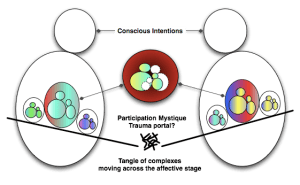
The couple complex image as symbol puts the experiential state complex graphic back into the bodies of the two who find themselves engaged at the level of the participation mystique. The experiential state complex image in the center of the two then represents the interplay of two complexes, in the moment. For me this suggests the blur exits both in self and other, with the central image standing in for both parties complexes.

COUPLEEXPERSTACOMPLEX.GRAF10-12

The Persona Submitting to Emotion plate views this scene  from the perspective of an individual Experiential State Complex.

If/when one is unable to stay conscious enough to contain an activation, the complex splits and is at risk for moving out into the room. When one pole hijacks the originator’s ego, the other pole is projected onto the object or environment. If the other unwittingly introjects the projected content, the “offering,” it is likely the re-enactment of the wounding will take place. I have positioned the symbol for the complex between the two parties, indicating the scene is under the spell of the originator’s complex image and affect.

Side note: Remember projection and introjection by definition refer to the unconscious aspects/layers of our process.  In that sense, intojection is always unwitting, as we don’t recognize we have just absorbed a projected content. We are always becoming aware of this, as intuition senses this. Really tuning in to this level can be hazardness, perhaps along the lines of the difficulty captured by William Stafford in his observation: “I call it cruel, and perhaps the root of all cruelty, to know what occurs but not recognize the fact.”

The teaching moment here is to support developing a sensitivity to picking up on this early enough to intervene with awareness. When we are conscious enough to see it coming our way, we have many options. If one misses reading the signals, and one’s own unfinished emotional business provides a hook for the projection to catch on, the stage is set for the enactment.

This is the mechanism of projective identification. While I understand there are severe forms of this defense, which is very difficult when fully activated, I find it helpful and useful to consider something of this gets constellated, at a less intense level, more frequently than we might think. Here, an intolerably painful self assessment, unable to be thought about directly, gets projected onto you, and then my experience of you is you are looking at me as if I were x, y, or z, in perfect alignment with the projected critical judgement. I feel hurt, upset, misunderstood by you, and you are going to hear about it! This dynamic also could be understood as an exteriorization of the inner antagonist.

The Couple Experiential State Complex suggests another layer of complexity, reflecting an established co-created complex. This recognizes the fact of the couple’s shared history of activations; over time these have contributed significant material to the original individual complexes (see Stein on Complexes page.) While life partners have time to notice the ritualistic, repetition compulsion aspects to their communication breakdowns, it seems activations with strangers can be every bit as problematic, if not devastating. In fact, it is quite common to get lined up on your complex at home, bringing enough consciousness to it to recognize the blur, only to then have it activated somewhere on the road. We want to try to contain this deeper work within our personal and couple’s process. When these activations occur “out there”, the goal is to recognize the “exteriorized inner antagonist” and bring him/her home.

Here is another lengthy but exquisite observation from Perry on the difficulty and importance of striving to stay conscious:

“From the fire of the passionate life grows the light of awareness, but the activeness of the ego’s attitude decides the gains or losses. If the ego is passive and allows the contents to remain habitually ensconced in their emotional form, there may be only gain on the side of the unconscious. In their emotional form the images remain merely intimations of meaning; one can speak of true understanding only when the meaning is recognized by an active ego-consciousness and adopted into its structure of values and meanings. Instead of passively allowing an affect-ego to relate to the affect-object, without the effort of understanding, the active ego intervenes, insisting upon an assimilation of the meaning over a period of time.” (Chuck’s italics)

If images in their emotional form are in fact mere intimations of meaning, the presence of emotion, when viewed from the position of an active ego consciousness, represents a bridge to true understanding. The emotional activation is an opportunity to deepen consciousness, moving from an intimation of meaning to the direct experience of the meaning. This how we come to self-knowledge. Might this be the most direct pathway to finding the mythological gift believed to be at the center of wound?


Archaic Human Longing in Everyday Life

August 14, 2017

I want to talk about some key concepts offered by Robert Moore years ago in a men’s workshop concerning the importance of recognizing archaic human longing. When men get together with an expectation for achieving a depth of intimacy, this ancient longing is activated. Of course this also applies to all humans.

Robert said this archaic human longing is – simply put – a longing for enthusiastic response. The notion is none of us got enough enthusiastic response growing up. (see Bly on the shadow) It seems to me you know you’re in it when you notice the intensity of your desire too be seen or known feels curiously, painfully humiliating.

In order to survive the pain of the recognition of what this must mean about us, we all develop a grandiose exhibitionistic self. We find a way to pump ourselves up, say we don’t need the enthusiastic love and acceptance of the one who would withhold this. What do you know about your grandiosity? Note this would be a compensatory grandiosity rather than a connection with true grandiosity via ego-Self reunion.

Because that defense takes so much energy, we then develop a defense against the grandiosity, dedicated to facilitating radical grounding. These two reflect something of a bipolar experience, mania followed by depression if you will.

Until we’re able to work into the core wound about not being seen and celebrated, allowing us to connect with, embody, and embrace our split off hurt feelings, confusion, and vulnerability, we are set up to rely on addiction defenses. Here, one gives up on approaching the longed for human connection, and instead substitutes an enthusiasm for X, Y, or Z. The addiction cycle keeps us busy with longing, longing satisfied, loss of satisfaction, and the inevitable crash. After some recovery time, we’re back at it.

We might say all the X, Y, and Z’s are but “counterfeits of goodness“. (Beatrice to Dante in the Divine Comedy)

Application: it’s helpful to think of these in a vertical column and always try to move up towards your longing. This means approaching as directly as you can that which is painful, most vulnerable and likely humiliating. If you find yourself in your grandiosity, ask where is my longing and go there directly.

If you find yourself in radical grounding/depression, ask where is my grandiosity as the grounding/depression experience is likely a defense against your grandiosity.

If you catch yourself in a little or big addiction cycle, think about who really matters to you and approach them directly about the enthusiasm problem.


Donald Kalsched on Early Trauma and Dreams, Part 1

June 20, 2017

Youtube offers this audio tape of Dr. Kalsched presenting on his findings. I can’t emphasize enough the importance of his formulation on psyche’s self care system archetypal protector complex. Check it out.

Dreams from a Lifetime: Stations Along the Road

May 17, 2017

With this post I want to report I am going to gather up the number of personal dreams I have posted separately, and begin to collect them on the Stations Along the Road (see pages column on right). In the interest of honoring the dream time, I have been committed to trying on just offering dreams without much comment to date. I am not sure how useful this may be to anyone else. In addition, some of these dreams really should come with a warning! Having created this response ease way to explore dream journal entries over one’s lifetime, I am appreciative how seeing them in series supports deepening in understanding of how the dream time (can) serves us. Here is Jung, commenting on the dream time and the idea of big dreams:

“Big dreams carry energy and images from a deeper level, reflecting individuation process, where we find the mythological motifs or mythologems I have designated as archetypes. … Such dreams occur mostly during the critical phases of life, in early youth, puberty, at the onset of middle age (thirty-six to forty), and within sight of death.

At these times, when the collective level breaks into consciousness, expectations, and opinions of the personal consciousness are stations along the road of the individuation process. This process is, in effect, the spontaneous realization of the whole man. The ego conscious personality is only a part of the whole man, and its life does not yet represent his total life. The more he is merely “I,” the more he splits himself off from the collective man, of whom he is also a part, and may even find himself in opposition to him. But since everything living strives for wholeness, the inevitable one-sidedness of our conscious life is continually being corrected and compensated by the universal human being in us, whose goal is the ultimate integration of conscious and unconscious, or better, the assimilation of the ego to a wider personality… (in understanding big dreams)… they employ numerous mythological motifs that characterize the life of the hero, of that greater man who is semi-divine by nature. Here we find the dangerous adventures and ordeals such as occur in initiations. We meet dragons, helpful animals, and demons; also the Wise Old Man, the animal-man, the wishing tree, the hidden treasure, the well, the cave, the walled garden, the transformative processes and substances of alchemy, and so forth…” Jung “On the Nature of Dreams”, CW Vol. 8 p. 281-297. (Chuck’s italics)

Getting Triggered: the Life Cycle of a Complex Activation

May 15, 2017

I have been thinking about what happens when one gets one’s buttons pushed. We’ve all experienced cycles of emotional reactivity. I have been exploring these as evidence of the blur. The basic rule with regards to becoming aware of an activation or constellation of our unfinished business, is to directly acknowledge the blur with it’s peculiar emotional intensity. That may be the easiest part. The hard part is standing up to the complex. If/when someone becomes fully charged by the complex, the ego function is mostly off line. The complex exercises it’s power as if a (psychological) possession state.

We can think about the Wolf in the tale of Little Red Riding Hood as a negative possessing complex which has in mind the goal of devouring first the Grandmother, and then Little Red Riding Hood herself. In the story, both do indeed get eaten, but, the woodcutter, recognizing what has happened, in a timely way quite easily frees the two of them before any lasting damage can occur. He dispatches the Wolf back into the ground of the dream-time. We all need to know what every woodcutter knows – how to free one’s self and others from complex possession states.

The following quote from Murry Stein contributes an interesting perspective on the role complexes play in complicating our intimate lives. We want to practice tracking triggering events – microfractures in communications – in the service of discernment of recognizing complexes within the context of their natural life-cycles. With growing awareness and sensitivity to the presence of the blur, one is challenged to speak for consciousness and if necessary, firmly insist on attending to the blur complication.

Generally, the psychological effects of complex constellations perseverate over an extended period of time after the stimulus has left off impacting the psyche. Certain experimental investigations seem to indicate that [the complex’s] intensity or activity curve has a wavelike character with a ‘wavelength’ of hours, days, or weeks.’(16) The stimulus that provokes the complex may be slight or great, of long or short duration, but its effects on the psyche can continue for extended periods of time and can come into consciousness in waves of emotion or anxiety. One of the signs of effective psychotherapy is that the complex-induced disturbances perseverate for shorter lengths of time than they did before. A more rapid recovery from complex-induced disturbances indicates increased ego strength and integration of psychic material as well as decreased power in the complexes. A shortened perseveration time means that the complex’s power has diminished. Nevertheless, it must be recognized that a complex can never be completely eliminated. The wavelike effects of complex “aftershock” are exhausting and draining.  (Stein, Murray, “The Structure of Complexes, “Jung’s Map of the Soul, p.50)

Couple Experiential State Complex: Finessing a Re-enactment of the Wounding

May 8, 2017
COUPLEEXPERSTACOMPLEX.GRAF10-12

Couple Experiential State Complex

Author comment: This page was originally posted in October of 2012. I have moved it to the front page to highlight the core formulation. The teaching I keep moving towards is in the basic idea our emotional triggers – serving to activate the blur – can be understood as psyche signaling we are ready to engage in a take 2 healing round. The emotional disconnects allowing one to live through core traumas are not meant to carry us the whole way. Can you get a sense of this from the below?

Having come together in the name of love and commitment, how are we to understand the meaning of the insensitive, unkind, and/or self/other destructive actions that always occur between two passionate human beings? The Couple Experiential State Complex formulation provides a way to begin to imagine what happens when relationships bring two Experiential State Complexes together.

While our discussion will focus on important intimate relationships, emotional encounters in everyday life all point to the transference. Many a couple, dining out, have suffered through the awkwardness of how to recover the festive mood in the aftermath of one partner experiencing just cause for upset with the wait staff.

In line with John Perry’s formulation (see Emotions and Object Relations), the very presence of emotion suggests an activation of the unconscious in the moment. With this, a blurring of the boundary between the here and now and the Experiential State suggests some degree of projection and increasing potential for introjection. Powerful dynamics demand the unconscious script be acted out. Alas, when one person is activated in this way, the usual response is the other will react with a complementary emotion. Learning to differentiate feeling from emotion or affect is a first order priority.

On the differentiation of feeling from emotion, Perry, with help from Jung, observes:

“. . . feeling is of a different order from that of emotion; feeling is a function of consciousness, and – to the degree to which it is differentiated – has the quality of choice and intentionality in judgments of value.” J W Perry p.2

“. . . emotions are the activity of the unconscious, the non-ego” (Jung, 1907)

“. . . emotions are autonomous and happen to the ego without its bidding, and the ego is the recipient of the impact of the emotions” (Jung, 1939, 1943).

“. . . we think of the unconscious as being the autonomous psyche, and it can as well be called the emotional psyche.”

In terms of understanding what generates the emotion, Perry observes:

“. . . I find the occurrence of any emotion to consist of the interplay between two complexes. . . The subject experiences the affect that belongs to the complex with which the ego aligns itself, and assigns the other pole to the object. During the emotion the energetic value of the ego is lessened, and that of the complex heightened, and in this situation one should speak of an interrelation of an affect-ego and an affect-object.”

Rowe Mortimer (1996 seminar) has observed from a self-psychology perspective the self and others are not just representations and memories. The internalized mother and father “others” are comprised of something of the actual energies of the mother and the father, as experienced and taken in over time. They organize on themes and become active, dynamic, willing agents, operating like sub-personalities. When activated by stress or triggers, a power struggle may ensue, with the mother, father, and potentially other significant internalized others challenging the ego for control of the driver’s seat.

If the ego succeeds in staying conscious enough to contain the activation, the blur is revealed, and something important can happen to advance our understanding of the deeper wound. If the ego is unable to withstand the emotional activation, then the activating “other” will either hijack/possess the ego, or be projected on to the environment; onto both willing and not so willing participants. If the “other” overpowers ego consciousness, the child state corresponding to the experiential state gets projected. Either can be the experiencing one and either can be projected. If in the moment I sound peculiarly like my angry father, it is likely I have simultaneously projected my child state onto you. If so, your reactions to my tone may be doubly painful, reflecting the possibility you have unwittingly introjected or embodied my split off wounded child state.

The Representation of Persona Submitting to Emotion plate pictures the shift from consciousness to activation of the complex and potential for splitting and projection of one or both poles onto the environment. In this moment, one’s ego functioning may be completely absent, reflecting a kind of highly contagious possession state.

With practice one can sense this pending deterioration of consciousness where in one or both are under the influence, affect-ego and affect-object, and seeing self/other through the blur of the complex. The greater the emotional charge and the more effective the repression of the trauma complex, the more difficult it is to stay conscious in the face of very powerful triggers.

Activating complexes often present in the form of an issue that seems to require we take a stand or take sides for or against something. The difficulty in staying conscious in the middle of such pressure usually reflects a deterioration in one’s capacity to relate to the complexity of the situation, in the direction of more concrete, black and white thinking. This suggests the activation of splitting defenses. Rather than getting pushed into a corner, or alternately demanding the other accept our rightness versus their wrongness, we want to aspire to “Not either/or, but both and more.”

It is reasonable to offer a willingness to help make the both and more case, as this requires consideration of the opposing reality on the way to opening up to the “more.” It takes practice to hold to one’s center and stay calm and conscious in the presence of intense emotion. Am I really guilty as charged? Are you truly just trying to help me in attacking me so? Did I really hurt your feelings terribly without even realizing it? (Edinger on Calcinatio and Invulnerability to Fire).

When can we trust our perception of what is real in the moment? Perry suggests (in the early object relations language):

“Objects, as they actually are, emerge only with the growth of consciousness and the differentiation of the ego, freeing it from the tangle of alignments with the various complexes that move across the affective stage.” (J W Perry p.43) I find this to be a very powerful word picture.

I have conceptualized and represented this “tangle of alignments with the various complexes that move across the affective stage” as an actual line inhabited by a number of distinctly different Experiential State symbols, as representations of the “various complexes.”

The designation of the line as the “affective stage” serves as a reminder that we are challenged to work at the level of emotion, without becoming completely possessed by or identified with the emotion itself.

I have suggested multiple versus single Experiential State symbols in recognition of the helpfulness early on in identifying the roots of the primary relationships with mother, father, siblings, and others. Taken all together, averaged and generalized over time, these point to the composite picture portrayed in the concept of the single state image.

The center figure above designated as the Couple Complex represents the combining of individual Experiential State figures into one composite complex.

When activated, both partners will feel pulled to react to either’s self/other positions. Quite often, in any encounter, some switching from adult to child to adult and back again will occur. The activation unconsciously strives to generate a script which, if submitted to, leads to both participants experiencing directly the painful, usually repressed feelings of childhood, associated with the inability to be truly seen, valued, protected, and loved.

The way this can just show up and make trouble is remarkable. A line from William Stafford’s poem Ritual to Read to Each Other paints this picture: “For there is many a small betrayal in the mind, a shrug that lets the fragile sequence break, sending with shouts the horrible errors of childhood storming out to play through the broken dike.” When activated, complexes threaten to overwhelm the most carefully constructed dikes.

The colors employed above suggest the possibility we share specific overlapping elements at the core wound level. My family colors recognize your family colors. At this point, the actual colors are not meaningful to me beyond helping to make the point that an emotional tone or color shading will be present in our unconscious recognition/selection of the other.

Perry suggests we must develop the ego’s capacity to discriminate and differentiate between inner and outer, past and present.

Until we are able to do so, feeling toned complexes are like “tractor beams” in the Star Wars saga, pulling us into emotional encounters somehow sensed to be fated. If we are to have any chance of healing, we want to understand why we must go there.

This is the “participation mystique” aspect. However we try to consciously manage our individual and relationship needs, at another level, a deeply unconscious level, we are engaged in pursuing the healing of splits in the service of recovering our wholeness. (Sandner and Beebe Psychopathology and Analysis)

When we find ourselves beyond the honeymoon and inexplicably drawn into suffering in ways we didn’t know we could, before bailing, we should consider what Perry describes as the functional intent pressing for consciousness through repeated reenactments of the wounding:

“… Complexes, in their favorable aspect = components of development. The repetition compulsion, as has been pointed out so often, provides the ego the occasion again and again to encounter these rejected components of development in order finally to assimilate them in some happy moments.”

This formulation supports the notion that we will persevere in our problem behaviors until we find someone who’s nature and strengths, in concert with ours, will allow the two of us, together, to bring to the wound that which up until now has been missing.

This perspective suggests we direct our efforts to recognizing emotion in the moment and developing the capacity to hold on impulses to actions supporting the repetition compulsion, or what I call the unconscious reenactment of the wounding with the beloved. We then have the choice to practice sitting together in the service of remembering our stories, and offering them for witnessing, with an eye for opening our hearts and reconnecting to the painful facts of our split off childhood experiences. At this time, in this way, we have access to compassionate consciousness and deep empathy, and so find we can heal the splits and suffer the recovery of a little more wholeness.

Salmon Boy: He said nothing…

May 5, 2017

I first heard the poem Salmon Boy on a tape presentation by David Whyte on the Imagination. The link below will take you to the complete poem by David
Wagoner (Traveling Light COLLECTED AND NEW POEMS by David Wagoner)

On the theme of radical grounding, the last half of this retelling of the Sechelt Nation legend of Salmon Boy captures a moment in the life cycle of Salmon Boy not to be forgotten.

In the poem opening, a human boy finds himself miraculously transformed into a salmon and joining with the Salmon People, swimming downstream and out into the ocean. Following their season of feeding and being in the great ocean, the time to re-enter the river comes:

“… and the Salmon People swam,

Tasting sweet, salt-less wind under the water,

Opening their mouths again to the river’s mouth,

And Salmon Boy followed, full-bellied, not afraid.


He swam fastest of all. He leaped into the air

And smacked his blue-green silvery side, crying Eyo!

I jump! again and again. Oh, he was Salmon Boy!

He could breath everything! He could see everything!

He could eat everything! And then his father speared him.


He lay on the riverbank with his eyes open,

Saying nothing while his father emptied his belly.

He said nothing when his mother opened him wide

To dry in the sun. He was full of the sun.

All day he dried on sticks, staring upriver.”

One of the very helpful points David Whyte offered in his discussion of the symbolism in this poem was to make a distinction about the father referenced in And then his father speared him. While we could think about the personal father, it shifts the meaning radically to consider this as a reference to the Great Father, or Spirit, or the Powers that show up from the Mystery in the service of initiation and transformation.


Emotion as Merely “Intimation of Meaning”?

March 27, 2017

Here is an exquisite observation from Perry on the difficulty and importance of striving to stay conscious particularly when feeling pressure from emotion generated by the blur:

“From the fire of the passionate life grows the light of awareness, but the activeness of the ego’s attitude decides the gains or losses. If the ego is passive and allows the contents to remain habitually ensconced in their emotional form, there may be only gain on the side of the unconscious. In their emotional form the images remain merely intimations of meaning; one can speak of true understanding only when the meaning is recognized by an active ego-consciousness and adopted into its structure of values and meanings. Instead of passively allowing an affect-ego to relate to the affect-object, without the effort of understanding, the active ego intervenes, insisting upon an assimilation of the meaning over a period of time.” (Chuck’s italics)

If images in their emotional form are in fact mere intimations of meaning, the presence of emotion, when viewed from the position of an active ego consciousness, represents a bridge to true understanding. The emotional activation is an opportunity to deepen consciousness, moving from an intimation of meaning to the direct experience of the meaning. This is how we come to self-knowledge. Might this be the most direct pathway to finding the mythological gift believed to be at the center of wound?

A Little Shadow Talk: “Trailing Clouds of Glory”

February 2, 2017

In A Little Book On The Human Shadow (1988), Robert Bly opens with a few images capturing our energetic beginnings. The shadow, from a Jungian perspective, may be simply all that is unconscious in us. Bly references Alice Miller’s work The Drama of the Gifted Child. (See “the truth about our childhood is stored in our bodies…

“Let’s talk about the personal shadow first. When we were one or two years old we had what we might visualize as a 360° personality. Energy radiated out from all parts of our body and all parts of our psyche. A child running is a living globe of energy. We had a ball of energy, alright; but one day we noticed that our parents didn’t like certain parts of that ball. They said things like: ‘Can’t you be still?’ Or ‘It isn’t nice to try and kill your brother.’ Behind us we have an invisible bag, and the part of us our parents don’t like, we, to keep her parents’ love, put in the bag. By the time we go to school our bag is quite large. Then our teachers have their say: ‘Good children don’t get angry over such little things.’ By the time my brother and I were twelve in Madison, Minnesota we were known as ‘the nice Bly boys.’ Our bags were already a mile long.”

“The drama is this. We came as infants ‘trailing clouds of glory,’ arriving from the farthest reaches of the universe, bringing with us appetites well preserved from our mammal inheritance, spontaneities wonderfully preserved from our 150,000 years of tree life, angers well preserved from our 5,000 years of tribal life – in short, with our 360° radiance – and we offered this gift to our parents. They didn’t want it. They wanted a nice girl or a nice boy. That’s the first act of the drama. It doesn’t mean our parents were wicked: they needed us for something. My mother, as a second-generation immigrant, needed my brother and me to help the family look more classy. We do the same thing to our children; it’s a part of life on this planet. Our parents rejected who we were before we could talk, so the pain of the rejection is probably stored in some pre–verbal place.”

Comment: Rediscovering and saying YES to our “living globes of energy” experience can be one of the best parts of the recovery journey. Can we dedicate ourselves to celebrate the emergence of these energies today, with each other?

The Partial Cure Problem (revisited)

February 1, 2017

I am bringing this February 2016 post forward in preparation for exploring in a future post the dynamics associated with dueling partial cures. It is as if we marry with the belief the beloved will be able to bring out our best, and then, each can’t help but resist at all costs.

In his essay on working with trauma in analysis, Donald Kalsched touches on the importance of recognizing the partial cure problem: “However we visualize it, the self care system accomplishes a partial cure of trauma, enough so that life continues, despite dissociation and its effects in limiting a person’s full potential. When people come for psychoanalysis they often don’t know that this partial cure is in place, nor do they expect that their identities, informed for many years by ‘interpretation’ from the self care system, will have to be ‘deconstructed’ in the course of therapy.” (my italics)

In reality, most people will not be afforded the option of analysis. Still, we all will struggle with the price of psyche’s solution enabling us to survive unbearable trauma: until we are able to rewire the disconnect we will be unable to truly be vulnerable again. This opening to re-connection process necessitates a level of conscious remembering and suffering through the original wound(s).

The partial cure is very useful place to start in framing up the problem:

  1. Consider the core defense system constructed to bring us through and into adult life is informed by interpretations from psyche’s self care system;
  2. This defense is the mechanism by which we maintain the original(s) split;
  3. This split, or what we can think of as a core disconnect, is the evidence of continued existence of trauma contained in encapsulated episodic memories;
  4. These encapsulated episodic memories – by definition hidden from conscious view – inform/contaminate our emotional responses to here and now moments in the emergence of the blur;
  5. By design, to the degree they are well encapsulated, we cannot directly access the original wound;
  6. If we think in terms of image and affect, the scene of the original wound, as an overwhelming emotional experience, swallowed whole, is the episodic memory in need of effective encapsulation.
  7. Perhaps psyche’s encapsulation function has its equivalency in nature in the oyster’s ability to create a (see) pearl: “A natural pearl begins its life inside an oyster’s shell when an intruder, such as a grain of sand or bit of floating food, slips in between one of the two shells of the oyster … and the protective layer that covers the … organs, called the mantle. In order to protect itself from irritation, the oyster will quickly begin covering the uninvited visitor with layers of nacre — the mineral substance that fashions the mollusk’s shells. Layer upon layer of nacre, also known as mother-of-pearl, coat the grain of sand until the iridescent gem is formed.”
  8. In this respect, the partial cure could be imaged as a complex set of defenses which, layer upon layer over time, serve to maintain the disconnect with the help of the encapsulation. What this means is we can function, in spite of the fact the intruding/invasive irritant is still present.
  9. The inability to remember significant traumatic experiences suggests to me the partial cure facilitated disconnect is still being employed to protect us from the historically overwhelming original wound(s).
  10. Until we can find a way to reconnect, it is as if one’s most sensitive, loving, vulnerable little kid, in essence the human embodiment of the divine child, remains lost, kidnapped, somehow locked out of the present moment.