Archive for the ‘Initiation’ category

Comment on Three Crones Dream Below

September 19, 2019

In a comment from below, Anarkali offered: “As an archetypal astrologer, I see you have noted the date and time of this dream. Be interesting to study the transit chart to see what was caught in your dream.”

I find this suggestion fascinating, as it seems the option of checking the stars on that now remote time and space would be a wonderful way to think about the collective influences, as reflected in/through the dreamer’s (me) consciousness. In the interest of this being a dialogue, I have reached out via email to Anarkali about a consultation.

The opening dream setting and imagery suggests the archetypal layer of consciousness: three crones in a space that is both ancient and contemporary in some parts of the world, the curved knives indicating iron age or more recent. The consciousness reflected in “we understand we are dead, or have died, and its not a problem for us” is an other worldly, dream time consciousness. The ritual with intention aspect offered during this current time of such global turmoil, with sacrifices being suffered in so many unconscious ways, pull for some witnessing consciousness. What are we to make of the onslaught of violence against others and all of nature? The initiated choose to suffer these symbolic deaths with consciousness and meaning. What might the stars tell us? I am open.

Making a Case for Trauma Complexes: Mending the Tear that Always shows…

June 12, 2019

I just decided to open this with a Neal Young lyric from Round and Round.

“Round and round and round we spin,
To weave a wall to hem us in,
It won’t be long, it won’t be long
How slow and slow and slow it goes,
To mend the tear that always shows.
It won’t be long, it won’t be long.”

What is with mending the tear that always shows? I am thinking this tear that always shows captures symbolically the universal experience of the time we encountered something beyond our emotional breaking point. Then, something has to give; symbolically, a tear accommodates this unbearable strain. Stein and Stein, in their discussion of Psychotherapy, Initiation and the Midlife Transition, suggest that these days, in the absence of formal rights of passage rituals for most westerners, the therapy setting can provide the container for transformative ritual processes. They reference the art and science of maieutics – midwifery – as an image for containing and supporting psyche in what is essentially a birthing process: the ego suffers a symbolic death in the process of getting more deeply connected to the guiding Self. The greater consciousness (Self) can not come through the lessor (ego) without a death.

I have suggested that in the absence of good enough ritual elders, traumas can be lived through, but remain essentially incomplete intitiatory experiences. At some point, in the midlife or later, we need to open up this encapsulated, episodic memory centered trauma complex in order to re-integrate the split off material and thereby gain conscious wisdom in the ways of the world.

Had an elder been present at the time of the original insult/injury, something like an episiotomy might have been indicated and offered, to mange the inevitability of the tear, in the service of enabling the birth of the greater awareness, while minimizing the scar tissue.

Here, below, I am trying on the idea that our universal challenge is each of us has suffered a tear somewhere along the way. For me, this tear points to the reality one has suffered through, survived, a core wound; this is a wound of disconnect. We then put in place all manner of workarounds.  Might we just accept and support, together, recognizing any and all lost and/or rejected parts of ourselves? (see not-me (Bromberg) For me the Bromberg frame recognizes all kinds of highly individualized modules of being,waiting to be invited back in; what I am talking about here is the idea that there is indeed a primary, ground zero tear that is the tear that always shows.

I believe Robert Johnson has describe this as the Fisher King wound; the wound which never heals, experienced/received at the time we first registered an emotional overwhelm which our consciousness at the time could not contain.

Walking it through:

You know, we’ve all had our troubles.

Something comes along, at some point, that you just can’t hold; consciousness is ruptured, overwhelmed; one becomes two.

Blessed psyche – blessed as in life saving – comes in and facilitates, manages, finesses this tear; we get split, disconnected, separated within our self. Symbolically, this psychological dismemberment is recorded as a death.

New defenses arise, support workarounds, adaptations. We get through, or not.

These wound-generated defenses form the basis of the partial cure. Partial in that it employs dissociation to cover up the reality of the now-buried-to-consciousness disconnect. Amnesia assists, amnesia for the amnesia enables. We go about our business.

For some, perhaps many or even most, this partial cure may be enough.

But, the fact is, until we can gain access, debride and bring healing into the primary wound, we will be characterologically challenged. Incapable of risking vulnerability, self-self and self-other communications will be burdened by an unseen constraint/constriction.

The partial cure at best functions as kind of governor on one’s ability to feel the feelings which inform emotional intimacy.

Healing this split requires we bridge this divide with consciousness.

Bridging the divide starts with bearing witness to the reality of the chasm.

Creating, embracing a mature consciousness which can priortize staying grounded enough, connected enough, safe enough, to hold the energies of the original split without splitting, is a big first step. This is the place of bearing witness. We recognize the importance of learning to open and hold steady, as we can, in the experience of an immersion into the images and affects which required the split at the time of the overwhelm. Rilke’s image of A Man Watching comes to mind here:

“I can tell by the way the trees beat, after
so many dull days, on my worried windowpanes
that a storm is coming,
and I hear the far-off fields say things
I can’t bear without a friend,
I can’t love without a sister.”

How can we hear, bear, love, in the face of such distress?

Our work is with the partial cure until such time as we can gain access to the hidden disconnect. I am thinking Jung and Donald Kalsched’s work with the divided self complex frame* is about this issue at a radical level. Perhaps it will be helpful to think about a hierarchical short list of events/episodes/scenes contributing to the composite divided self complex.

Accessing the split off trauma complex, suffering an affective immersion into the dissociated experience, heals the split. (See Sandner/Beebe on healing splits)

Understanding conceptually that increasing consciousness and well being puts one in the position to surface one’s inventory of split off episodes of trauma, one by one, sounds daunting. Really? Must I/we go there?

Gaining access to original, encapsulated scenes requires a shift in the defenses that have been deployed to maintain the encapsulation. In his discussions about the nature of Sacred Space, Robert Moore observed when sacred space is present, that which is a source of conflict for the individual or group will come in; sacred space pulls for the de-structuring of the ego, which in turn then allows for contact with that which is seeking to come into awareness. See Eliade.

With the piercing of the encapsulation, a direct, re-experiencing of the wounding becomes possible; the image and affect scene/picture of the whole-body-being-torn-in-two, the primary split, comes into view.

The experience of the relaxing of the typically decades long defense against re-membering the reality of the wound already suffered, is usually accompanied by a profound sense of relief, as one finally gets to consciously know what one has always known. This coming home to one’s self is the felt experience of re-establishing the connection with one’s lost self.

It is the completion of the incomplete initiatory experience.

*This link connects to a short essay I wrote about my divided self complex and includes references to Kalsched’s work in Trauma and the Soul, Kalsched, D. (2013) London: Routledge.

Luminous Wolf, Shared Piercing Dream

January 18, 2019

January 26, 2009 Dream: “My friends are giving me a medal, to be ‘pinned’ on my left flank, belly. I’m apprehensive, say ‘are you going to use rubbing alcohol on that large pin?’

Just then, a luminous wolf crosses from left to right in front of me. Hard to say how far, how close, her actual size, as she seems to be arriving from another dimension. Very healthy with a full silvery black coat, and surrounded by an incredible aura. She stops, turns her head over her right shoulder, to gaze at me. I notice, as part of her energetic aura, from her left flank, extending above her back, is a large arrow shaft, with feathers, suggesting she has an embedded arrow point in her left side, about where I am to be pierced. Her aura incorporates the arrow, as if she is living with it in vibrant health…”

WolfPiercedbyArrowDreamSelected

Waking Reflections: What struck me was how healthy she was, while still carrying the evidence of a likely mortal wound. Still, energetically, this arrow wasn’t limiting her presence and power.

In the dream it seems I am about to receive a blessing from the Spirit Brothers, a medal of some kind, in recognition of my relationship to my wound.

(Unpublished back story) The pinning itself will be a flesh offering. At this moment the Wolf appears, affirming our work from the dream time. YES, she shows us, one’s wound need not be the death of one’s vitality. Something like that. Associations to the pelican piercing her own breast, the piercing of Jesus’ side on the cross, and the Sun Dance ceremony all come to mind.

And, we might ask, who is she, showing up with such vibrancy and generating such an incredible aura? An image of the Self? A trans-rational presence/being?


Connecting the Dots: A Case for Embracing Conscious Enactment

June 8, 2016

My intention with this post, the first in my connecting the dots series of posts, is to pull from my pages the cluster of most helpful frames on universal problems and needs, in language everyone can hope to get working for themselves. Like it or not, we are all agents of consciousness, and when we can understand the importance of our conflicts in bringing us back into the wound that never seems to heal, we can perhaps access the guidance available within us to win our healing, self and other, together, in some happy moment. , It is, after all, a co-created system. This dot is about death and rebirth. Here we go.

Let’s start with a poem by Johann Wolfgang von Goethe, “The Holy Longing”:

“Tell a wise person, or else keep silent,
because the mass man will mock it right away.
I praise what is truly alive,
what longs to be burned to death.

In the calm water of the love-nights,
where you were begotten, where you have begotten,
a strange feeling comes over you,
when you see the silent candle burning.

Now you are no longer caught in the obsession with darkness,
and a desire for higher love-making sweeps you upward.

Distance does not make you falter.
Now, arriving in magic, flying,
and finally, insane for the light,
you are the butterfly and you are gone.
And so long as you haven’t experienced this: to die and so to grow,
you are only a troubled guest on the dark earth.”

Translated from the German by Robert Bly

The opening Tell a wise person, or else keep silent is cautionary. It seems Goethe knows something about the mass man who will mock it right away. I believe he is referring to this same mass man when he suggests And so long as you haven’t experienced this: to die and so to grow, you are only a troubled guest on the dark earth.

Until we are able to bring consciousness to our experiences of death and rebirth, we will be a troubled guest on a dark earth. This is an initiatory process. Learning to get one’s binocular vision back on line – the capacity to look both out and in with consciousness  – separates one from the herd. Honoring the reality of inner work puts one at risk for being discounted and shamed by those who have do not have a relationship with their inner work; having a sense of being locked out of one’s inner life is a kind of terrible darkness indeed. The price one pays in tolerating this state of being locked out brings Stafford to mind: “I call it cruel and maybe the root of all cruelty to know what occurs but not recognize the fact.” Reacting defensively to an invitation to share feelings is an engaging form of emotional disconnection.

From a trauma informed perspective, Sandner observed: “Death and rebirth are the mythological symbol for a psychological event: loss of conscious control, and submission to an influx of symbolic material from the unconscious.”

Emotionally overwhelming episodes – what I think of as wounds of overwhelm – introduce us to the archetypal world of mythology and the dream time, while the ego is in a state of unconsciousness.

It is critical to recognize psychological events associated with loss of conscious control may be split off from ego consciousness; at the same time they will be conscious, but not to the ego.

And until trauma, as incomplete initiatory experience, can be worked through, re-integrated into consciousness, psyche relies heavily on dissociation and projection. To be continued…


Image and Force: Jung’s Supreme Meaning

March 23, 2016

RockLight DreamImage1NoMargin3.23.16


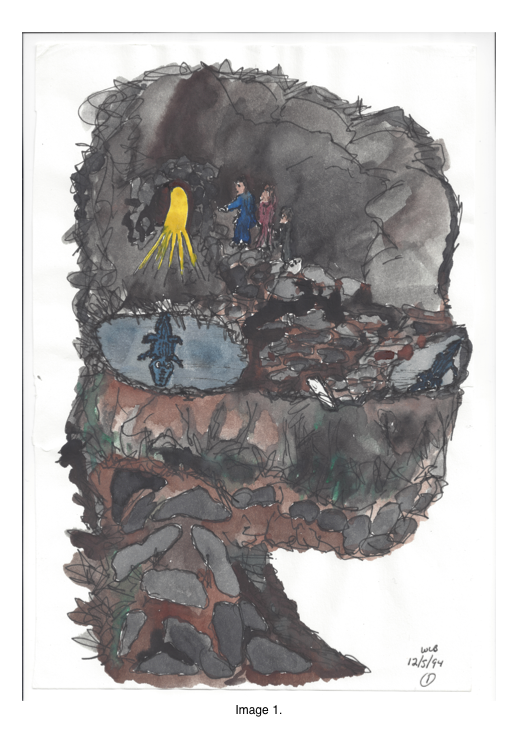
After recording the Rite of Passage Rock-Light Being dream, I decided to represent the image in pencil, pen and ink, and watercolor. My method for illustrating dreams is to begin by trying to establish the starting point of the dream sequence in the place most likely to allow me to work through and capture all the action, step by step, on one page. I opened this dream with the stone path at the bottom center of the page. I began penciling in the details with no conscious awareness of the greater reveal (Image 1.) As I finished the initial sketch, I couldn’t help but think, “Behold the ancient being with his bright flash of light for consciousness, crocodile brain stem extending into the olfactory region, and stunning child like silhouette! How striking, how primordial!”

EncounteringRLBeingImage2.3.23.16

After completing this scene, I turned my attention to capturing a close up of our approach along the rock face. My intention was to create an image-as-threshold to assist me in my ritually re-entering the startling moment. (See Image 2.)

I was challenged at this time in my work to understand what this powerful dream was really offering me. It was one of a number of dreams in a series which seemed to move out into the world, connecting me in important ways to mysterious meanings which defied rational explanation.

Twenty years later, deepening in my Jungian orientation through a seminar series with the analysts of the Santa Fe group, I came across Jung’s description of the serf’s predicament: “I am the serf who brings it and does not know what he carries in his hand. It would burn his hands if he did not place it where his master orders him to lay it” (Jung, Red Book, 2009, p. 230).

In the Red Book collection, we get to look in on Jung’s initiatory process. In his dialogues with the spirit of the times and the spirit of the depths, Jung describes how he came to understand the existence of an ancient consciousness enlivening us all, and how this guidance, this “supreme meaning” comes to us. The spirit of the depths comes in and places understanding and knowledge at the service of the inexplicable and the paradoxical, sense and nonsense. The melting together of sense and nonsense is what produces the supreme meaning. In Jung’s words (2009), supreme meaning is “the path, the way and the bridge to what is to come… image and force in one, magnificence and force together … the beginning and the end … the bridge of going across and fulfillment…

Furthermore, from this perspective, Jung observed “To understand a thing is a bridge and a possibility of returning to the path. But to explain a thing is arbitrary and even murder…” (Jung, Red Book 2009, p. 229-230).

While I was enjoying a newfound sense of freedom from my compulsion to explain and contemplating on magnificence and force together, this 1994 dream and these illustrations came to mind: might they be an example of image and force in one, magnificence and force together?

RockLight DreamImage1NoMargin3.23.16EncounteringRLBeingImage2.3.23.16

1994 Dream: Rites of Passage and the Rock-Light Being

March 22, 2016

EncounteringRLBeingImage2.3.23.16

The following two part dream was a big dream for me, one of a series of dreams during my early years with the mytho-poetic men’s community; during this period I attending many weekend and week long workshops with Robert Bly, Micheal Meade, James Hillman, Robert Moore, and Malidoma Some among others. Locally, a ragtag band of us dedicated ourselves to exploring first hand what we could learn about midlife initiatory ritual process through an evolving collective and personal story enactment model. The dream:

“I am at a grand competition of some kind, like a graduation rite, with lots of people cheering on those who have achieved their goal; the ritual consisted of the graduate first throwing a small ball out as far as he could, and then running as fast as he could to bring it back. This was an individual act, with no attention paid to the time or comparisons with anyone else. Sending him out and welcoming him back, the crowd simply roared in celebration of his achievement, reflected in his level of clarity and intention. This was most impressive, an honor and joy to behold, and the enactment enabled all to witness. I didn’t know how the game worked but his throw was so compelling that I elected to go running after the ball also; Coming from the side of the field, he had thrown it down field in my direction, I dived over and behind a large bolder in pursuit of it, and then heard an urgent warning: “Get ready because he surely is coming after it. It means a great deal to him.” The implication is that his force could unintentionally kill me if I were in his path.

Part 2: Then the scene switched to three of us, two men guided by a woman, working our way up a rocky terrain stream-bed like path. I am in the middle. It’s quite dark and there is a strong sense of wilderness, adventure. We get to a rocky rise and our guide stopped suddenly, pointing to a watery place contained by the stone to a set of large eyes watching us. An archaic archetypal crocodile, huge, was perfectly lined up on us; should we have continued up and over we would have been eaten. She motioned us to move sideways and we looked for a way up while watching for more crocodiles. I saw another one and couldn’t find an easy way up. Calling to her, she had gone up and was out of sight, she doubled back and offered a hand, pulling me up near by, saying “this old VW bus windshield comes in handy.” Working our way along the trail next to a vertical rock face, I got into the lead. As we walked along in darkness a door suddenly flew open, right in front of me, letting a flood of bright yellow light out; with it, I saw something was tossed out; then the door closed just as quickly, leaving no trace. At first I felt anxious about almost being hit or seen, then I was curious about who or what lived in the rock, and what had been thrown out? I sensed some indigenous peoples must be living there secretly.” Pausing, the alarm went off.

REFLECTIONS: At the time of this dream I was wrestling with my awareness that while I felt very serious about my personal analysis, more attention and focus was possible. In the opening celebratory ritual process scene, I noticed my dream ego was identified more with the witness who  jumped into the ritual action from the sidelines, in contrast to the dream figure  who has done the work and is moving into the new life with community blessing. In reality, I was at the time deeply engaged in working through my own childhood near death, initiatory life event with the help of a band of spirit/soul brothers.

In active imagination, I re-entered the second scene, hoping to dream-the-dream-onward and discover more about the origins of the rock dweller and the meaning of the tossed out object. I dialogued with an ancient reptile man-like being, a self identified gatekeeper and light tender who releases the light. In response to my question, “What did you throw out?” he replied they were shards of light, reflections of everything that has ever happened in my (Chuck’s) life. Each shard mirrored a scene of my life. I was to know they existed and seek to gather them all up; this was my path to self-knowledge. Considering the flash of light as an image of enlightenment, the Self shining through, I interpreted this as signaling the importance of doing the work to remember everything fully. The shards would provide every detail in turn.

Getting Back into the Boat

February 18, 2016

When we become aware of having been triggered, activated, constellated, possessed, dispossessed, dissociated, or disconnected in some important way, how can we think about getting “back into the boat?”

This image, suggesting we have somehow been knocked out of the boat, brings forward earlier references to the impact on psyche of episodes of trauma and emotional/physical overwhelm. What I am signifying as wounds of overwhelm.

These human experiences have been described as the psychological basis for the mythological motif of death and rebirth.

From Egyptian mythology, Edward Edinger has observed: “When the child Maneros witnessed Isis’ terrible loss and grief upon seeing the dead Osiris, this awesome sight was so intolerable to Maneros that he fell out of the boat and drowned.” We too are vulnerable to losing balance, falling overboard and drowning in the face of intense emotion. It is how we are wired.

From the conceptualization of the ego-Self axis, such wounds symbolically knock the 110 voltage wired ego temporarily out of the boat of consciousness, and drop down into the deep waters of total psyche, in the realm of the Self. Here, they remain as if in suspended animation until the conditions are favorable for their re-integration. These are the original encapsulated episodic memories which form the nuclei of our complexes. On a side note “suspended” is misleading in terms of these are not energetically inert bundles of split off trauma. Their energies are not diminished by time and space.

Depth work is about helping us to get back into the boat with a new relationship to the reality of the waters of the unconscious, the unseen world. It is about discovering a way to re-connecting to those very experiences which, for our survival at the time, necessitated the disconnect.

Getting back into the boat consciously means choosing to open one’s self to suffering directly the images and affects generated by the original wounding experience. By definition, when these wounds of overwhelm are sufficient to knock the ego out of the boat and into the unconscious, the wounding itself evokes archetypal energies via a match with its associated collective, primordial scene. The ego is challenged to bring such scenes back into consciousness.

Years ago I was introduced to the idea that if you want to know about what has been initiatory for a person, you just need to inquire about “when did death come into your life?”

After a long opening night, hearing a hundred personal stories about first confrontations with death, I shared mine, and was then afforded a week in deepening in that exploration.

While I had never forgotten the details of my own near actual drowning experience, I was able to see then, 30 plus years later, how intensely overwhelming that confrontation with death was for me; how it had changed me, and how it was present in my work at that time, and informs me today.

The short story is that I recognized then my intense interest and evolving skill in helping others who required hospitalization in an acute psychiatric inpatient ward, could be seen as a reflection of my own initiatory encounter with death. Recognizing this possibility for the first time, a “name” came to me spontaneously: I was He-Who-Talks-About-Deep–Over-There. I was able to connect the intensity of my interest, dedication, and seemingly inexplicable capacity to sit with the most psychotic, anxious, depressed, and overwhelming experiences of others, my deeply felt resonance with the mystery present in primary process, the non-ego realm, to my ego’s efforts to look out, not within me. My connection with the depths, though largely unconscious to me at the time, was providing some critically important glue in my ability to trust the meaning of the dynamics present in the patient’s compensation-decompensation-recompensation cycle . While we may not be able to understand it yet, it can be understood from a drive to healing perspective; it is not accurate or helpful to reduce the action to evidence of pathology. It is psyche attempting some form of corrective adjustment.

This focus on the other enabled me to be present with this level of experience in the unique energetic field of the inpatient setting, without opening to my own terror and anxiety associated with my encapsulated trauma. This would be an aspect of my partial cure adaptation. My work with inpatients was about supporting them in finding their way back. Back into the boat.

I am pulling together the story about what happened next. It is a bit unusual in that the actual sequence of events have a strikingly mythological, dream time quality.

During that week I realized I needed to find a way to revisit and complete the initiatory cycle. The thought occurred to me, if/when I was able to do so, what might my new name be? What came to me at the time was: He-Who-Talks-About-Deep-In-Here-Now. While I do work out of a talking cure modality, I would place the emphasis today on being present with the full range of emotion. Something like One-Who-Is-Fully-Present-Inner-Outer-Above-Below.

What do you think? Should we practice being fully present? I believe so. Let us make preparations together to get back into the boat of consciousness, the place of re-membering.


Chuck’s early reflections on: Ritual Reenactment Rite of Initiatory Life Event formulation

July 22, 2010

This 2010 post was an early capturing of some of my thoughts about our men’s work, via A Ritual Reenactment of Initiatory Life Event model.

Modern men do not lack initiation altogether. Life initiates us. In surviving childhood, we each have suffered initiatory experiences. Joys and sorrows bring us into fuller awareness of what it means to be human, to live in Nature. Whatever our age or developmental readiness, woundings occur, tearing the fabric of the life we’ve known. Severe woundings generate overwhelming affect, demand submission, cause us to lose balance and fall overboard; it is as if a part of us drowns.

At times like this, we are rarely blessed with the presence of what have been described as “good enough ritual elders.” Their prayers and songs are essential to bring us through fully alive, witness the event, ritually mark us, connect us to the age appropriate teachings, and wed us to the center of community life.

Without such help, wounds of overwhelm trigger Post-Traumatic Stress Disorders. We go to pieces, are dismembered; the episode(s) is split off from awareness . The full story comes to live lodged in our bodies, outside ego-centered consciousness. There is incomplete recognition of what has occurred at the community level, and the individual does not get connected to the community collective vision.

Until the lost story can be fully reclaimed, the teachings are not directly available; as such, the experience is not integrated; these events/episodes live on in psyche as incomplete initiatory experiences.

Remembering

First half of life dynamics favor the development of a strong ego, capable of repressing anything we are unable to deal with consciously. In truth, all that is forgotten to our conscious mind remains entirely conscious, but not to the ego. Infants as early as 2 – 7 months old demonstrate the capacity for episodic memory, the ability to remember whole events without abstracting out any of the details. What happens to all the experiences we can’t remember? From a Jungian perspective, just as the ego is the center of the conscious personality, the Self is the ordering and unifying center of the total psyche (conscious and unconscious). While the ego uses blinders to manage what is experienced as a threat to optimal functioning, the Self has continuous access to all our experience. Ego repressed experiences live on in the body and psyche.
In mid-life a shift in dynamics calls for a depth of remembering that simply can not come through the existing ego structures. Re-membering trauma from this side of the veil means confronting the dismemberment we suffered at the time of injury. This is accomplished through suffering the reactivation of an axis or bridge between the ego and the Self, over which the scenes of trauma must then parade back into ego awareness. For this to occur, defenses called into service to protect the ego from overwhelm must surrender to radical restructuring. To the extent trauma is 220 plus voltage and the uninitiated ego is wired for 110 volts, we have a container problem. Ritual space pulls for the destructuring of the ego and the derepression of trauma in the service of healing.

Initiation

In ritual space, the conscious intentional wounding of the initiate serves to bind, bundle, and energetically transform all prior unconscious woundings, and bring them into service for the community good. In this way, the heat of initiation process functions as a crucible, pivotal in turning one’s attention from the personal past to the community present and future. Men need ritual support to move from woundedness to awareness and full power.

Effective ritual works symbolically to aid the psyche in moving energy that can not be fully grasped by the conscious mind. By definition, wounds of overwhelm occur when we can not grasp some horror. In approaching activation of the bridge to the deep psyche we are at risk for flooding by all the affects and images associated with our personal trauma history. And yet, to grow we must come into conscious relationship to all that has been.

On the problem, timing, and solution, Donald Sandner observes:

“Death and rebirth are the mythological symbol for a psychological event: loss of conscious control, and submission to an influx of symbolic material from the unconscious. Personality growth is usually thought of as cumulative, a gradual expansion through time as ego consciousness gains experience and wisdom. But often it turns out to be only a pursuit of illusory ideals. Then there is cessation of growth, stultifying depression, or, more ominously, severe illness. At that point no halfway measures will do; a thoroughgoing transformation is necessary for the individual’s survival. Like the sun, the ego must prepare itself for a plunge into the darkness of the unconscious underworld, there to experience rejuvenation.” (Symbolic Healing, 1979)

How can we modern men approach creating effective transformative ritual?

The Ritual Reenactment Rite of Initiatory Life Event: a Model

Men at this crossroad need community support to remember and ritually re-enter the core of their specific life and death experiences. Taken collectively, with the good enough ritual elder in attendance, these episodes hold all that is needed to complete the initiation.

We start with the call to recognize when and where the mythological world entered everyday life. We support the telling of the story that holds the story. We use this story to generate a collectively held and maintained symbolic terrain for the purpose of revisiting this space ritually. We honor the images by making regalia and sacred props to assist us in enacting the myth. Months of preparation for the initiate and the team of men who will serve him culminates in the Initiatory Rite, consisting of an attempt at return to the crossroads of one’s personal history with the mythological world. This is a Ritual Reenactment Rite of Initiatory Life Event.

During the enactment, we work with the known facts to create a point of departure and return. Somewhere in the process, we call for an opening to make a spirit boat journey to the other world. There, following ancient shamanic tradition, we seek help to restore full vitality to the petitioner. We pray for guidance, full awareness, healing. We pray to collectively constellate the good enough ritual elder in the service of ritually containing the re-activation of the deep connections to the full experience and complete meaning of all that has been initiatory, recognize the significance of what has happened, mark the event for what it was, and bring the initiate back into the community in a good way. In this way, with grace, we get connected to soul, to the spirit helpers who have guided us all along. We come into knowing the archetypal psyche.

Edward F. Edinger: On Calcinatio

January 17, 2010

“The image of invulnerability to fire indicates an immunity to identification with affect. Experience of the archetypal psyche has this effect to the extent that it enlarges and deepens ego consciousness. There is then less likelihood of identification with the emotional reactions of oneself or others. By contrast a weak ego is very vulnerable to being consumed by encounter with intense affect. This phenomenon is described in a poem by Dorsha Hayes:

Filled with a clutter of unsorted stuff
a spark can set a man ablaze. What’s there
heaped high among stored rubbish at a puff
will burst in flame. No man can be aware
of how inflammable he is, how prone
to what can rage beyond control, unless
the piled up litter of his life is known
to him, and he is able to assess
what hazard he is in, what could ignite.
A man, disordered and undisciplined,
lives in the peril of a panic flight
before the onrush of a flaming wind.
Does it now seem I seek to be profound?
I stand on smoking ash and blackened ground!

…Calcinatio has a purging or purifying effect. the substance is purged of radical moisture. This would correspond to the drippings of the unconscious that accompany emerging energies. Or, in other words, the energies of the archetypal psyche first appear in identification with the ego and express themselves as desires for ego-pleasure and ego-power. …calcinatio brings about a certain immunity to affect and an ability to see the archetypal aspect of existence. To the extent that one is related to the transpersonal center of one’s being, affect is experienced as etherial fire (Holy Spirit) rather than terrestrial fire – the pain of frustrated desirousness.”

Edinger, Edward, Anatomy of the Psyche: Alchemical Symbolism in Psychotherapy