Archive for the ‘Connecting the Dots Series’ category

The Secret of Salvation in Dante’s World

September 28, 2017

The paragraph below is excerpted from a source quote posted under Images of the Journey in Dante’s Divine Comedy, by Charles H. Taylor & Patricia Finley:

“The secret of salvation in Dante’s world … is insight into the nature of who one is, how one injures, what it feels like to be oneself the victim and to make others the targets of one’s desirousness, rage, pride, and deceits. Those who make it to Purgatory are not less shadow-driven, narcissistic, obsessed, or pathological than others, but they have not refused to make conscious what they are, to bear the burden of themselves, and to come in time to take full responsibility for their own natures. By coming to know what operates in us behind appearances, whether driven by unconscious instinct and aggression or by more deliberate betrayals we can choose to take a stand against whatever in our personal character moves us to wound others and our larger selves.

Complexes as Bridge to the Symbolic World

August 1, 2017
ComplexSymbolpng

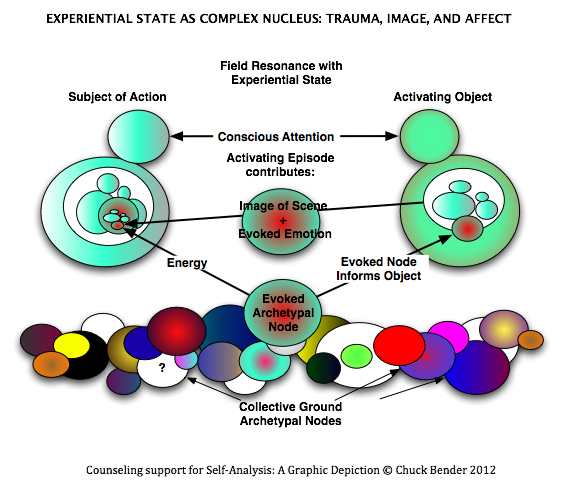
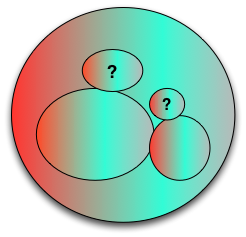
As I prepare to move into diagramming the next step on projective identification, I find I want to support reviewing complex theory as it comes into play here. My graphic representation signifying the presence of a complex is:  The key is in seeing and recognizing the significance of the overlap between the experiential state image and the image of the complex nucleus. I have tried to capture this in my page on the experiential state as a complex nucleus. Below I am going to bring forward some of my psycho-educational symbolic overview page discussion of this detail:

“Complexes as Bridge to the Symbolic World: In its mysterious, true symbol system aspect, these images hold something beyond that which I can consciously fully grasp. An image functioning as a symbol both informs us about, while at the same time protects us from, an emerging, essential to conscious life awareness. Jung (1921) defined the symbol as “the best possible designation or formula for something relatively unknown yet recognized to be present, or required.” (Jung, C.G., CW6)

The symbol comes alive for me in the Experiential State as Complex image.

The elements present combine the internal representation of self/other/affect, in its scene remembered composite form, with its associated complex. In its experiential state aspect, it captures the essence of one’s family of origin experience. Countless interactions averaged and generalized over time serve to inform the transference at the level of primitive invariant organizing principles.

From a complex perspective, the experiential state image mirrors directly the key elements comprising the nucleus of a complex: an archetypal energy, or dynamism, and the scene of activation depicting the object “in the act.” The presence of archetypal energy suggests the resources of the collective unconscious have been called into service and will need special consideration.

analytical psychology complex nucleus image affect evoked node

Jung’s formulation of the complex bridges personal experience with the archetypal world. Complexes are generated in response to overwhelming personal life experiences. Murray Stein, on the structure of the complex, notes:

“. . . Jung describes it as being made up of associated images and frozen memories of traumatic moments that are buried in the unconscious and not readily available for retrieval by the ego. These are repressed memories. What knits the various associated elements of the complex together and holds them in place is emotion. This is the glue. Furthermore, “the feeling-toned content, the complex, consists of a nuclear element and a large number of secondarily constellated associations.”(19) The nuclear element is the core image and experience on which the complex is based – the frozen memory. But this core turns out to be made up of two parts: an image or psychic trace of the originating trauma and an innate (archetypal) piece closely associated to it. (Stein, Murray, “The Structure of Complexes, “Jung’s Map of the Soul, pp. 52-53.

Traumatic experiences, by virtue of their energies having overwhelmed the ego’s ability to stay conscious, evoke specific archetypal responses, thereby connecting us to the hardwired resources of the Self. The associated nuclear element, the evoked node, provides access to the collective memory of the human experience with the same insult/injury at hand; through this activation pattern recognition resources become available to inform our personal response.

For an example of one such bridge, imagine a young child unexpectedly finding him/herself confronted with an extremely distraught mother or father. Edward Edinger observed: “When the child Maneros witnessed Isis’ terrible loss and grief upon seeing the dead Osiris, this awesome sight was so intolerable to Maneros that he fell out of the boat and drowned.” (Edinger, Edward, Anatomy of the Psyche, p. 60.)

This mythological image helps us understand the power of an upsetting personal experience at the level of the archetypal layer; it may be that while part of us that was able to stay in the boat, another part may have symbolically fallen overboard and drowned. We may not be conscious of or remember this detail. Edinger, reflecting on male psychology, goes on to say: “Most men, if they are honest, will acknowledge having had the experience of Maneros when confronted with a woman’s intense grief, desire, or anger”.

This “scene” can become the nucleus of a complex; when this happens, the complex nucleus records and contains the original activating scene of the trauma.

In this respect complexes serve to archive wounds of overwhelm, preserving them until such time the conditions allow us to revisit and heal that which has been split off from consciousness. They also function as dynamic, energetic, sub-personality-like entities. When activating, or what we call constellated, complexes challenge ego consciousness for the driver’s seat, pushing for unconscious enactments.”

Comment from today: We are all blessed with a repository of ancient knowledge via the hardwired resources of the collective unconsciousness. From an evolutionary standpoint, it seems this system is biologically auto-updating. When we experience in this life time an event of emotional significance, the corresponding evoked archetypal node contributes help in the form of image, affect, and energy.  The archetypal layer, by definition primitive, archaic patterning, resists ego level defense efforts to intervene directly. This detail speaks to the necessity of learning to think symbolically, as in the dream, mythology, and fairy tales, in order to cultivate one’s relationship with the archetypal realm.

My experiential state complex graphic representation is:

ExperientialStateComplexpng8.1.17

Projective Identification: Informing the Experiential State

July 9, 2017

In the Bollas quote posted below, we are invited to picture an interaction between a father and child complicated by the father’s not conscious enough awareness of his personal issue with feeling guilty over impulse buying or the pressure created internally by the urge to be impulsive.

For your response ease, here is the Bollas quote from the link (edit 7/10/19):

”Kleinian psychoanalysts, in particular, have focused on one way in which a person may rid himself of a particular element of psychic life. He does so by putting it into someone else. If a father feels guilty over impulse buying or the pressure created internally by the urge to be impulsive, he may break psychological contact with this impulse and its inspired guilt by criticizing his child’s ordinary impulsiveness. As the parent unconsciously rids himself of this unwanted part of himself, his overly censorious relation to the child’s impulsiveness creates the ‘desired’ effect. Unable to bear the father’s censorious approach, the child becomes even more impulsive. In studying human relations, whenever we note that one person compels another to ‘carry’ an unwanted portion of himself, then we speak of ‘projective identification’.

I believe there is a process that can be as destructive as projective identification in its violation of the spirit of mutual relating. Indeed, I am thinking of an intersubjective procedure that is almost exactly it’s reverse, a process that I propose to call extractive introjection. Extractive introjection occurs when one person steals for a certain period time (from a few seconds or minutes, to a lifetime) an element of another individual’s psychic life. Such an intersubjective violence takes place when the violator (henceforth A) automatically assumes that the violated (henceforth B) has no internal experience of the psychic element that A represents. At the moment of this assumption, an act of theft takes place, and B may be temporarily anesthetized and unable to ‘gain back’ the stolen part of the self. If such extraction is conducted by parent upon a child it may take many years of an analysis before B will ever recover the stolen part of the self.” (pp 157-158)

Discussion

The concise pattern language based example does not comment on a possible continuum of alternatives to this father’s reliance on employing this defense, only that for him the stage is set to rid himself of this discomforting conflict by simply putting it into someone else. This works, allowing him to break psychological contact with this impulse and its inspired guilt… Unfortunately, the cost of this ridding is to find/experience cause for alarm in what is described as, in reality, his child’s ordinary impulsiveness. Through his overly censorious criticism of the child, the father off-loads his burdensome urge-to-impulse-and-inspired-guilt (complex). This is a blur moment. Most people looking in on this exchange would recognize a deeper dynamic at play, something a bit or more off in some way, but not so with the father. By design, one’s consciousness is protected entirely from experiencing the dynamics responsible for the impulse/guilt conflict in need of discharge, as well as it’s origins.

ExpStateSelfOtherAffect

Representing this image/affect graphically as an experiential state scene, we can try picturing the father in the act of criticizing the child. Imagine the depth of expression for both, surrounding the giving and receiving of the wound. I am suggesting wound here, because of its identified unconscious dynamic. The father is, through this mechanism, transferring his personal conflict with impulses and guilt into the child.

How might we think about the whys? Why this mechanism? Why now? What is adaptive about its deployment? How is it likely to effect the child, over time? In the instance of this example, we see a parent has misinterpreted or miss-apprised what is identified as in reality the child’s ordinary impulse. The father is reacting to his child’s identification with the father’s projection, not his child.

From the perspective of the child being criticized with an unconscious-to-the-father overly censorious driver, we can picture this scene as one which will inform the child’s developing experiential state on the theme of something in me is not OK.

The experiential state image is a useful tool to think about what psyche does with encapsulated episodic memories. Recall, humans as early as several weeks of age demonstrate the capacity for episodic memory: in this memory storage system emotionally charged episodes get swallowed whole, encapsulated and stored, without being fully inventoried. It seems as long as unconscious contents remain unconscious, their intensities are not diminished by time and space.

When we get emotionally triggered, it is likely one of these highly charged capsules of traumatic experience has activated, contributing it’s resonant emotional tone to the scene. Typically, the encapsulated trauma memory does not announce it’s role in providing the emotion. Again, this is the blur.

If we were to orient the father to his vulnerability to employing such a defense, with increasing awareness, he might choose to experiment with checking his impulse to censor his child. If he is able to do so, what might he notice? The increasing internal pressure may well lead to a spontaneous memory or feeling. From a psychodynamic perspective, it is possible an unthought known can begin to be thought about.

The action disorder formulation gets at this starting with the observation: “Any affect or emotion which in its raw and unaltered form is too intense to be controlled by will alone may need its ritual. Without ritual, such energies may inundate the ego and force it into acting out or into obsessive behavior. Ritual brings about containment and acceptance, control of intensity, and ‘dosage’.” (Whitmont, E., Return of the Goddess, p.235.)

At a personal level, we may or may not have much of an idea about how much of a charge we are carrying related to still split off trauma.

At the level of at least doing no harm, the father in his unconsciousness is likely to be initiating a reenactment of his original wound.  From this perspective, what he puts on the child and what the child experiences, will quite likely be an out-picturing of the father’s core experiential state scene. Almost from the beginning, any two who would love will be generating a core internal image or representation of what it means to be in relationship. See Developmental Considerations)

dancepartytextlesspng

The father, suffering at some level with feelings of guilt about impulses, rids himself of the conflict by putting it into the child. His psyche sets the child up to become identified with the unacceptable impulsiveness projected onto him, setting up the father’s feeling justified in using a critical tone to find the child guilty as charged. This is the blur dynamic.

In truth, while the father is in the stage of life where in he can choose to embrace corrective experiences leading to the dissolving of the irrationality contributing to his experiential state scenes, the child is in the phase of coalescing of his/her experiential state. Recall, my first orientation to the concept of the experiential state was the fact that it was the single composite picture informed by every important interaction concerning wounds to loving. I find it helpful to think about multiple emotional challenges, on themes, which can still then be collapsed into one.

I’m going to post this now and try to approach it by reworking the graphics in the Representation of Persona Submitting to Emotion plate.

The Partial Cure Problem (revisited)

February 1, 2017

I am bringing this February 2016 post forward in preparation for exploring in a future post the dynamics associated with dueling partial cures. It is as if we marry with the belief the beloved will be able to bring out our best, and then, each can’t help but resist at all costs.

In his essay on working with trauma in analysis, Donald Kalsched touches on the importance of recognizing the partial cure problem: “However we visualize it, the self care system accomplishes a partial cure of trauma, enough so that life continues, despite dissociation and its effects in limiting a person’s full potential. When people come for psychoanalysis they often don’t know that this partial cure is in place, nor do they expect that their identities, informed for many years by ‘interpretation’ from the self care system, will have to be ‘deconstructed’ in the course of therapy.” (my italics)

In reality, most people will not be afforded the option of analysis. Still, we all will struggle with the price of psyche’s solution enabling us to survive unbearable trauma: until we are able to rewire the disconnect we will be unable to truly be vulnerable again. This opening to re-connection process necessitates a level of conscious remembering and suffering through the original wound(s).

The partial cure is very useful place to start in framing up the problem:

  1. Consider the core defense system constructed to bring us through and into adult life is informed by interpretations from psyche’s self care system;
  2. This defense is the mechanism by which we maintain the original(s) split;
  3. This split, or what we can think of as a core disconnect, is the evidence of continued existence of trauma contained in encapsulated episodic memories;
  4. These encapsulated episodic memories – by definition hidden from conscious view – inform/contaminate our emotional responses to here and now moments in the emergence of the blur;
  5. By design, to the degree they are well encapsulated, we cannot directly access the original wound;
  6. If we think in terms of image and affect, the scene of the original wound, as an overwhelming emotional experience, swallowed whole, is the episodic memory in need of effective encapsulation.
  7. Perhaps psyche’s encapsulation function has its equivalency in nature in the oyster’s ability to create a (see) pearl: “A natural pearl begins its life inside an oyster’s shell when an intruder, such as a grain of sand or bit of floating food, slips in between one of the two shells of the oyster … and the protective layer that covers the … organs, called the mantle. In order to protect itself from irritation, the oyster will quickly begin covering the uninvited visitor with layers of nacre — the mineral substance that fashions the mollusk’s shells. Layer upon layer of nacre, also known as mother-of-pearl, coat the grain of sand until the iridescent gem is formed.”
  8. In this respect, the partial cure could be imaged as a complex set of defenses which, layer upon layer over time, serve to maintain the disconnect with the help of the encapsulation. What this means is we can function, in spite of the fact the intruding/invasive irritant is still present.
  9. The inability to remember significant traumatic experiences suggests to me the partial cure facilitated disconnect is still being employed to protect us from the historically overwhelming original wound(s).
  10. Until we can find a way to reconnect, it is as if one’s most sensitive, loving, vulnerable little kid, in essence the human embodiment of the divine child, remains lost, kidnapped, somehow locked out of the present moment.

Take Two: Conscious Enactment

December 10, 2016

Conscious Enactment: from the Blur to Healing and Wholeness

What do I mean by the concept of  conscious enactment?

Let’s start with what it isn’t. Take a moment to reflect on an encounter with the blur.

When the blur is working, we believe in the reality of the manifest content. This means what gets our attention is our here and now problem, and our best guidance is too call it out and commit to resolving it together through conscious action. Sounds good. But, from the dream time perspective, if either of us has a sense of there is more here, something about the tone and intensity of the problem or need, then we want to consider the blur aspect.

This means examining the difficulty from the perspective of microfractures in communication.

What is being shown through the blur is an out-picturing of an original wounding episode(s). Psyche’s shorthand is to reduce this to an experiential state scene: something has happened, self and composite other are captured with expressions reflecting the core primary affects associated with the scene, eg: shame, abandonment, fear, anxiety.

This is the layer of the latent content.

In short, I am proposing conscious enactment as the intention to revisit the blur for the purpose of  surfacing the underlying experiential state driver of the microfracture.

Hence, take two. We want to embrace as many takes as it takes(!) to satisfy the opening and experience the deeper affects and witnessing attendant to the recovery of split off emotional life.

One more important idea: from the co-created system perspective, it is helpful to consider each participant is contributing to the core material being evoked through the blur. When consciousness can not contain an activation, if the complex is allowed to expand and split, then the figures in the experiential state, eg: raging/abandoning parent and reactive terrified child, will each attempt to hijack the ego and command the bus. When this happens, with the split, the “other” is projected onto the environment. We are both at risk for being possessed by either of the complex entities. This dance is now in the service of the re-enactment of the wounding. When one can see the blur as a kind of threshold, the opportunity for deeper healing is at hand.

In calling for Conscious Enactment, I am proposing we turn our attention to identifying the experiential state component hypothesized to be driving any blur state.

How directly might we make the shift from wound/defense to opening to the opportunity to have the most longed for dialogue? Can we imagine what would be the most satisfying expression of connection for both parties? This is the guiding image take two: conscious enactment strives for through this consciously authentic encounter. We can’t will it to occur, but it seems we can create the conditions to support dropping into the depth of the wound and then/there, bring something to the moment which was unavailable at the time of the wounding. This is what heals the complex, in some happy moment.

The micro-fracture in communication again offers a simple template: ruptures are the way in, repair and reconciliation of both the present and original wound the way to wholeness and health. More to follow…

Connecting the Dots: A Case for Embracing Conscious Enactment

June 8, 2016

My intention with this post, the first in my connecting the dots series of posts, is to pull from my pages the cluster of most helpful frames on universal problems and needs, in language everyone can hope to get working for themselves. Like it or not, we are all agents of consciousness, and when we can understand the importance of our conflicts in bringing us back into the wound that never seems to heal, we can perhaps access the guidance available within us to win our healing, self and other, together, in some happy moment. , It is, after all, a co-created system. This dot is about death and rebirth. Here we go.

Let’s start with a poem by Johann Wolfgang von Goethe, “The Holy Longing”:

“Tell a wise person, or else keep silent,
because the mass man will mock it right away.
I praise what is truly alive,
what longs to be burned to death.

In the calm water of the love-nights,
where you were begotten, where you have begotten,
a strange feeling comes over you,
when you see the silent candle burning.

Now you are no longer caught in the obsession with darkness,
and a desire for higher love-making sweeps you upward.

Distance does not make you falter.
Now, arriving in magic, flying,
and finally, insane for the light,
you are the butterfly and you are gone.
And so long as you haven’t experienced this: to die and so to grow,
you are only a troubled guest on the dark earth.”

Translated from the German by Robert Bly

The opening Tell a wise person, or else keep silent is cautionary. It seems Goethe knows something about the mass man who will mock it right away. I believe he is referring to this same mass man when he suggests And so long as you haven’t experienced this: to die and so to grow, you are only a troubled guest on the dark earth.

Until we are able to bring consciousness to our experiences of death and rebirth, we will be a troubled guest on a dark earth. This is an initiatory process. Learning to get one’s binocular vision back on line – the capacity to look both out and in with consciousness  – separates one from the herd. Honoring the reality of inner work puts one at risk for being discounted and shamed by those who have do not have a relationship with their inner work; having a sense of being locked out of one’s inner life is a kind of terrible darkness indeed. The price one pays in tolerating this state of being locked out brings Stafford to mind: “I call it cruel and maybe the root of all cruelty to know what occurs but not recognize the fact.” Reacting defensively to an invitation to share feelings is an engaging form of emotional disconnection.

From a trauma informed perspective, Sandner observed: “Death and rebirth are the mythological symbol for a psychological event: loss of conscious control, and submission to an influx of symbolic material from the unconscious.”

Emotionally overwhelming episodes – what I think of as wounds of overwhelm – introduce us to the archetypal world of mythology and the dream time, while the ego is in a state of unconsciousness.

It is critical to recognize psychological events associated with loss of conscious control may be split off from ego consciousness; at the same time they will be conscious, but not to the ego.

And until trauma, as incomplete initiatory experience, can be worked through, re-integrated into consciousness, psyche relies heavily on dissociation and projection. To be continued…


Source Quotes: Dreams as Portal to the Source (Eward Whitmont and Sylvia Perera)

November 9, 2014

Here are a number of selected quotes from a very wonderful offering by Whitmont and Perera:

P. 2: Quotes: “the dream itself is an actual and necessary expression of the life force– One that manifests in sleeping consciousness and is sometimes remembered and re counted across the threshold of waking. Like a flower or a hurricane or a human gesture, its basic purpose is the manifestation in expression of this life force. It gives us images of energy, synthesizing past and present, personal and collective experiences.” (Page 2)

P. 3. “To approach dream interpretation adequately we need to find perspectives beyond those created by dualistic consciousness, which rest content with oppositions–exterior/interior, object/subject, day/night, life/death, functional – descriptive/imaginal, focused attention/openness, etc. While these opposites are valuable for defining rational awareness, we need also to develop an integrated consciousness that can read both daily and nightly actions and events and nightly and daily visions from many perspectives and to integrate these perspectives for our selves and the patient–dreamer before us in our consulting rooms. This capacity relies on an ability to shift between the many forms of magic– affective, body, mythological, allegoric, symbolic, and rational awareness.

 P. 5: “The clinical understanding of dreams requires both art and skill. The art consists of an ability to sense the dream as a multifaceted dramatic presentation, as if one were allowed to witness a scene from the play of life. The performance would require attendance with full respect, empathy, sensitive intelligence, intuition, and a sense of symbolic expression.”

P. 6: “…  the skills acquired through the practice of techniques must always be subject to the art of interpretation. The first ‘rule’, then, is the paradox of all the healing arts: the applicability of basic principles must be determined by feeling, sensitivity, and intuition.”

P. 6: “as expressions of pre-rational, ‘altered’ states of consciousness, dreams are as variable as nature itself. Indeed they are a lusus naturae, a play of nature that can never be fitted into rigid systems. Rather, our rational thought capacity has to learn to adapt itself to the Protean variability of the life processes which dreams represent. Rational or ‘secondary’ thought must learn to adapt itself to the feeling tones and images of the dream, in reverie and to play intuitively, as seriously as a musician does with a sonata, until meanings emerge.”

P. 7: “…  in clinical practice each dream offers diagnosis, prognosis, and appropriate material and timing to address the dreamers current psychological reality and to address and compensate the dreamer’s– and/or analyst’s – blind spots of consciousness. Diagnostically, the dream’s images and structure give evidence of ego strength and may reveal qualities of relationship between various forms of consciousness and the psychological and somatic unconscious. Prognostically, the dream calls attention to what confronts consciousness, as well as to likely clinical developments, and often, to how the present awareness and capacities of the dreamer and/or analyst tend to relate to those confrontations. … The psychological reality and blind spots of consciousness are addressed because every dream points to an unconscious complex and to the archetypal dynamism behind the complex’s emotionally charged layers.”

P. 8: “Not only does the dream inevitably address the dreamer’s and analyst’s blind spots, it also… is ‘an answer in hieroglyphics to the question we would pose.’ …  The dreamer is invariably unable to see those blind spots or to realize the nature of the ‘question’ he or she needs to ‘pose.’ Too often the dreamer identifies only with the dream ego’s perspective and it’s emotional responses to the images presented.

…  Dream work, thus, requires a witness, someone to provide a perspective coming from other than the dreamer’s context, with whom the dream can initially be encountered.”

P. 9: “But even at best, and even among experienced therapist themselves, dream work needs dialogue with another person. In spite of extensive experience with dreams, such collegial checking and confrontation usually reveals essential details and personal applications that were overlooked. The saying popular among doctors, ‘the doctor who treats himself has a fool for a physician,’ applies here, for the dream brings us unconscious dynamics, and we cannot, by definition, be aware of them easily.

P. 11: “Musing on the contents of the person’s ‘own’ dreams with an empathic other, associating to them, grounding specific dream images in analogous events and patterns of daily life, finding objective explanations, sharing reactions–all provide method and material to build the safe enough therapeutic relationship in which, eventually, genuine affects and individuality can come forth. Repeatedly, such dream work brings about a sense of valuable individual contents and of awareness of capacity to deal with images. Over time such mutual activity assists greatly in conveying and developing a sense of fluid and merged, yet constant and separate, identity – a felt individuality for which play and symbolic understanding is both possible and pleasurable.”

P. 12: “Knowing immediately what a dream purports to mean rest usually on a projection of the therapist’s own bias or countertransference, rather than on genuine, and often necessarily mutual, understanding. Like all utterances from the ‘other side’, the dream tends to be multi-leveled and oracular, hence ambivalent (even polyvalent) and resistant to a rational, black– white, simplistic approach.”

P. 14: “… the therapist must revere the dream’s image material carefully in it’s context and with open puzzlement until a corresponding associative affect–response emerges from the dreamer. …  Jung’s warning: ‘The analyst who wishes to rule out conscious suggestion [must] consider every dream interpretation invalid until such time as a formula is found which wins the patients assent.” … If assent is to be reliable, it must come from what might be called an embodied or gut sense of ‘Aha!’ ‘Yes!’ ‘Touché.’ This kinesthetic validation presents a deep confirmation from ‘the Self in the body’ which knows even when the conscious ‘I’ cannot. Unless this response is forthcoming, the analyst’s views of the meaning of a dream can only be considered hypothetical possibilities still awaiting confirmation or disavowal from the Self of the dreamer. Inevitably, too, the following dreams will confirm, modify, or challenge an interpretation and the dreamer’s understanding of the dream.”

P. 17: “The dream is a spontaneous self portrayal, symbolic form, the actual situation in the unconscious.” Jung

“In each of us there is another whom we do not know. He speaks to us in dreams and tells us how differently he sees us from the way we see ourselves. When, therefore, we find ourselves in a difficult situation to which there is no solution, he can sometimes kindle a light that radically alters our attitude. (Jung)

Jung called the dream ‘a highly objective, natural product of the Psyche…  [a] self representation of the psychic life– process. …  The dream compensates or compliments a deficiency of the dreamer’s conscious position; And/or of the therapist’s position with regards to the dreamer or the analysis.”

Page 18: “… to differentiate Jung’s postulated Self from the self concept psychoanalysis… we shall capitalize it and referred to it as Guiding Self…. It is also to be viewed as the source and director of the individuation drive, that archetypal urge to ‘become what one is’. It is also to be viewed as the source and director of life events and of dream material, both providing invaluable metaphoric/allegoric and symbolic messages which aid the individuation process to those who learn to read them.

The Dream ego may represent: the dreamer’s actual and felt sense of identity as observing witness or actor.

Appears as the Guiding Self sees her or him.

The dream may point up the Self’s view of the dreamer’s identification (merger) with an ego-ideal or an inflated grandiosity.

P. 22: “Developmental possibilities through Dream Work

The dreams dramatic outcome, then, is to be considered conditional: given the situation as it is now (namely, the setting or exposition of the dream, to be discussed below), this or that is likely to develop. … nothing in a dream outcome, therefore, is to be regarded as fixed or unalterable; unless it is explicitly shown to be so by the terms of the dramatic structure of the dream itself and by the symbolic or allegoric tenor of the images.”

P. 24: “Rarely, if ever, will the dream tell the waking ego what to do. Even when a problem is solved in the dream this shows only a possibility that is available. The dream shows what psychological realities the dreamer is up against, what happens to work for or against his current attitude and position, and what the effects of that position or particular approach are likely to be. It leaves the matter to the dreamer to draw his or her own conclusion, to make decisions, and to act. In this way an ongoing dialectic occurs between conscious and unconscious dynamics. For better and/or worse, conscious freedom of response is respected and preserved.

The ‘situation as it is,’ seen from the perspective of the Guiding Self, includes both inner developmental potentials and trends, as well as the consequences inherent in the dreamer’s current, ‘just so’ psychological situation.”

P. 119: “dream series

Until now, we have been dealing with single dreams. However, there is a continuity, we might almost say, an extended story, as dreams unfold sequentially as part of a steadily evolving series. They tend to tell a running narrative, which feeds the conscious ego the kind of information it requires and is able to assimilate, given its particular position in the developmental process. As consciousness takes in response to the dream’s messages, the dreams again respond to the newly gained positions of consciousness; thus a dialectical play develops. When it is a matter of vitally important or fundamental life issues and consciousness does not respond adequately to assimilate the message, dreams will recur. Sometimes they repeat in the same form; sometimes the images become more numerous, larger, or threatening. These kind of recurrent dream series may even lead to nightmares. Such nightmares and recurring dreams – and particularly those that have been recurring since childhood – deserve urgent attention.

… When a dream journal is kept, one gets the impression of an unfolding continuum of views, and of a seeming intentionality in the selection of themes for each given moment.

Indeed, in the instance of a specific, organic symbol, birth in dreams can usually be seen to refer back to a process seeded some nine months before. Or the age of a dream figure will refer to some energy that was ‘born’ those many years before. But more than that, it is as though dream number six in October knew what dream number twenty-nine in April was going to raise and was preparing the dreamer with preliminary insights. Subsequent dreams quite often, therefore, need to be considered in the light of preceding ones, that might have dealt with the same or similar subject matter. A central theme or themes are developed in sequence overtime. Often, one cannot avoid the impression that the series operates as though the unconscious could ‘anticipate . . . future conscious achievements,’ no less than future unconscious dilemmas, for an early dream seems already to know or plan what a later dream is to pick up and carry further. This is an aspect of what Jung called the ‘prospective function’ of dreams.

Usually, such an elaboration occurs not a linear progression but rather like a circular or spiral movement around a central thematic core, casting light upon the central theme from, what might be considered, different psychological angles. It is as though dream one raises a theme; dream two raises a seemingly different one; dream three presents again another angle and so forth; while dream 12 may perhaps pick up on one, and 14 may link up what was raised by three and 12 – or whatever. This circumambulation of the dreamer psyche field bus repeatedly brings up crucial complexes, and elaborates on them, building on previous consequences. Gradually a sense of wholeness pattern adults to the process of being shown the various aspects of the themes, presented with all their very nations from a variety of viewpoints. And keeping up with the images of the dream series, one can keep up with the life– And the individuation process.”

see: Dreams, A Portal to the Source, by Whitemont, Edward, and Pereira, Sylvia, 1992.