This is a 38 minute YouTube audio tape of Robert Bly working the story known as Prince Lindworm. The description provided notes this is: “a parable of your relationship with the hostile twin coiled inside you—who was cast away during childhood, who waits years before roaring back into your life and begins swallowing those around you.” The story is … “Followed by an in-depth discussion of the story’s meaning at the 1993 Minnesota Men’s Conference. http://www.minnesotamensconference.com”
I will be adding a few comments at a later date .
Standing up to complexes is always very difficult.
Here is an interesting frame offered in the discussion following the story of Sir Gawain and the Lady Ragnell: What Do Woman Really Want.
“Embracing the hag’ initially entails coming to terms with what is dark and frightening in oneself so that one can release the partner from the burden of carrying one’s resentment, frustration and despair. Each person needs to recognize and sort through resistance and fear of change, her or his own repressions, and the dominance of particular aspects of one’s own self.
The problem of confronting and embracing the disappointments and frustrations in oneself can be conceptualized as a process of differentiation between the concerns of attachment and those of dominance within the couple relationship. When a distressed couple enters therapy (usually through the wife’s insistence or because a child has “brought” the couple to therapy by acting out), the partners are usually operating out of a “dominance-submission” posture rather than an “attachment-separation” one. The basic mode of intimate relationship is the instinctual pattern of attachment and separation. When this pattern, with its expressive gestures, symbolic meanings and recurring actions, is abandoned in favor of a dominance pattern or “power struggle,” each person feels threatened and depressed on a day-to-day basis. Instead of the two people relating emotionally as interdependent individuals with the ability to see and satisfy each other’s needs, they relate as a symbiotic or fused unit in which one person is “on top” and the other is “underneath”; there is a constant power struggle on every issue.
Although the two people may recognize the non-rational nature of their struggle (e.g. they may say, “It’s ridiculous, but we just can’t stop fighting over petty matters”), they feel it is impossible to stop struggling. Until both people face the meaning of dominance and submission in their relationship, which almost always involves the devaluing of the feminine, they cannot shift their concerns to attachment. Confrontation with the potential loss in their situation, through the therapists’ backing and elaborating the voice of the hag, often moves people out of the power struggle that had been so prominently in the center. This is just the first step in working through the dominance and submission concerns, however.” (p.21)
(My italics)
Young-Eisendrath, Polly, Hags and Heroes: A Feminist Approach to Jungian Psychotherapy with Couples, 1984
I chose the heading above to re-introduce this quote from Sandner and Beebe:
“Jung contended that neurosis sprang from the tendency of the psyche to dissociate or split in the face of intolerable suffering. … Such splitting ‘ultimately derives from the apparent impossibility of affirming the whole of one’s nature’ (Jung 1934, p. 98), and gives rise to the whole range of and conflicts characteristic of feeling toned complexes. This splitting is a normal part of life. Initial wholeness is meant to be broken, and it becomes pathological, or diagnosable as illness, only when the splitting off of complexes becomes too wide and deep and the conflict too intense. Then the painful symptoms may lead to the conflicts of neurosis or to the shattered ego of psychosis. The way back, the restoration – perhaps always partial – is the work of individuation. …”
Let’s think about the idea that such splitting ‘ultimately derives from the apparent impossibility of affirming the whole of one’s nature’.
Might we choose to embrace our inner guidance? Dedicate ourselves to making a place for our true selves? Not easy!
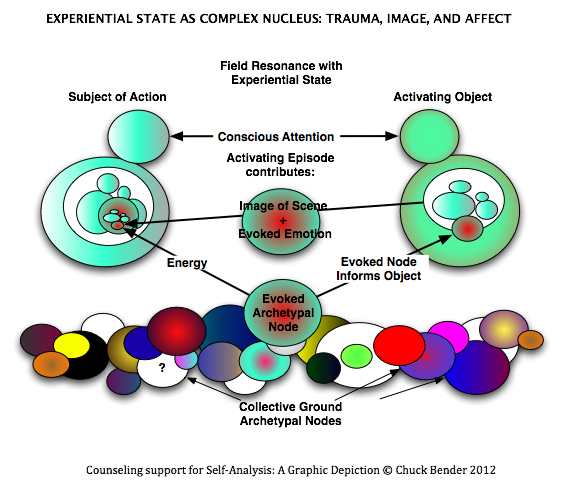
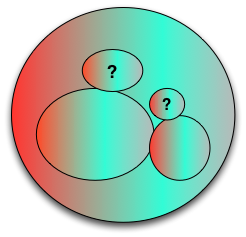
As I prepare to move into diagramming the next step on projective identification, I find I want to support reviewing complex theory as it comes into play here. My graphic representation signifying the presence of a complex is: The key is in seeing and recognizing the significance of the overlap between the experiential state image and the image of the complex nucleus. I have tried to capture this in my page on the experiential state as a complex nucleus. Below I am going to bring forward some of my psycho-educational symbolic overview page discussion of this detail:
“Complexes as Bridge to the Symbolic World: In its mysterious, true symbol system aspect, these images hold something beyond that which I can consciously fully grasp. An image functioning as a symbol both informs us about, while at the same time protects us from, an emerging, essential to conscious life awareness. Jung (1921) defined the symbol as “the best possible designation or formula for something relatively unknown yet recognized to be present, or required.” (Jung, C.G., CW6)
The elements present combine the internal representation of self/other/affect, in its scene remembered composite form, with its associated complex. In its experiential state aspect, it captures the essence of one’s family of origin experience. Countless interactions averaged and generalized over time serve to inform the transference at the level of primitive invariant organizing principles.
From a complex perspective, the experiential state image mirrors directly the key elements comprising the nucleus of a complex: an archetypal energy, or dynamism, and the scene of activation depicting the object “in the act.” The presence of archetypal energy suggests the resources of the collective unconscious have been called into service and will need special consideration.
Jung’s formulation of the complex bridges personal experience with the archetypal world. Complexes are generated in response to overwhelming personal life experiences. Murray Stein, on the structure of the complex, notes:
“. . . Jung describes it as being made up of associated images and frozen memories of traumatic moments that are buried in the unconscious and not readily available for retrieval by the ego. These are repressed memories. What knits the various associated elements of the complex together and holds them in place is emotion. This is the glue. Furthermore, “the feeling-toned content, the complex, consists of a nuclear element and a large number of secondarily constellated associations.”(19) The nuclear element is the core image and experience on which the complex is based – the frozen memory. But this core turns out to be made up of two parts: an image or psychic trace of the originating trauma and an innate (archetypal) piece closely associated to it. (Stein, Murray, “The Structure of Complexes, “Jung’s Map of the Soul, pp. 52-53.
Traumatic experiences, by virtue of their energies having overwhelmed the ego’s ability to stay conscious, evoke specific archetypal responses, thereby connecting us to the hardwired resources of the Self. The associated nuclear element, the evoked node, provides access to the collective memory of the human experience with the same insult/injury at hand; through this activation pattern recognition resources become available to inform our personal response.
For an example of one such bridge, imagine a young child unexpectedly finding him/herself confronted with an extremely distraught mother or father. Edward Edinger observed: “When the child Maneros witnessed Isis’ terrible loss and grief upon seeing the dead Osiris, this awesome sight was so intolerable to Maneros that he fell out of the boat and drowned.” (Edinger, Edward, Anatomy of the Psyche, p. 60.)
This mythological image helps us understand the power of an upsetting personal experience at the level of the archetypal layer; it may be that while part of us that was able to stay in the boat, another part may have symbolically fallen overboard and drowned. We may not be conscious of or remember this detail. Edinger, reflecting on male psychology, goes on to say: “Most men, if they are honest, will acknowledge having had the experience of Maneros when confronted with a woman’s intense grief, desire, or anger”.
This “scene” can become the nucleus of a complex; when this happens, the complex nucleus records and contains the original activating scene of the trauma.
In this respect complexes serve to archive wounds of overwhelm, preserving them until such time the conditions allow us to revisit and heal that which has been split off from consciousness. They also function as dynamic, energetic, sub-personality-like entities. When activating, or what we call constellated, complexes challenge ego consciousness for the driver’s seat, pushing for unconscious enactments.”
Comment from today: We are all blessed with a repository of ancient knowledge via the hardwired resources of the collective unconsciousness. From an evolutionary standpoint, it seems this system is biologically auto-updating. When we experience in this life time an event of emotional significance, the corresponding evoked archetypal node contributes help in the form of image, affect, and energy. The archetypal layer, by definition primitive, archaic patterning, resists ego level defense efforts to intervene directly. This detail speaks to the necessity of learning to think symbolically, as in the dream, mythology, and fairy tales, in order to cultivate one’s relationship with the archetypal realm.
My experiential state complex graphic representation is:
In the Bollas quote posted below, we are invited to picture an interaction between a father and child complicated by the father’s not conscious enough awareness of his personal issue with feeling guilty over impulse buyingor the pressure created internally by the urge to be impulsive.
For your response ease, here is the Bollas quote from the link (edit 7/10/19):
”Kleinian psychoanalysts, in particular, have focused on one way in which a person may rid himself of a particular element of psychic life. He does so by putting it into someone else. If a father feels guilty over impulse buying or the pressure created internally by the urge to be impulsive, he may break psychological contact with this impulse and its inspired guilt by criticizing his child’s ordinary impulsiveness. As the parent unconsciously rids himself of this unwanted part of himself, his overly censorious relation to the child’s impulsiveness creates the ‘desired’ effect. Unable to bear the father’s censorious approach, the child becomes even more impulsive. In studying human relations, whenever we note that one person compels another to ‘carry’ an unwanted portion of himself, then we speak of ‘projective identification’.
I believe there is a process that can be as destructive as projective
identification in its violation of the spirit of mutual relating.
Indeed, I am thinking of an intersubjective procedure that is almost
exactly it’s reverse, a process that I propose to call extractive introjection.
Extractive introjection occurs when one person steals for a certain
period time (from a few seconds or minutes, to a lifetime) an element of
another individual’s psychic life. Such an intersubjective violence
takes place when the violator (henceforth A) automatically assumes that
the violated (henceforth B) has no internal experience of the psychic
element that A represents. At the moment of this assumption, an act of
theft takes place, and B may be temporarily anesthetized and unable to
‘gain back’ the stolen part of the self. If such extraction is conducted
by parent upon a child it may take many years of an analysis before B
will ever recover the stolen part of the self.” (pp 157-158)
Discussion
The concise pattern language based example does not comment on a possible continuum of alternatives to this father’s reliance on employing this defense, only that for him the stage is set to rid himself of this discomforting conflict by simply putting it into someone else. This works, allowing him to break psychological contact with this impulse and its inspired guilt… Unfortunately, the cost of this ridding is to find/experience cause for alarm in what is described as, in reality, his child’s ordinary impulsiveness. Through his overly censorious criticism of the child, the father off-loads his burdensome urge-to-impulse-and-inspired-guilt (complex). This is a blur moment. Most people looking in on this exchange would recognize a deeper dynamic at play, something a bit or more off in some way, but not so with the father. By design, one’s consciousness is protected entirely from experiencing the dynamics responsible for the impulse/guilt conflict in need of discharge, as well as it’s origins.
Representing this image/affect graphically as an experiential state scene, we can try picturing the father in the act of criticizing the child. Imagine the depth of expression for both, surrounding the giving and receiving of the wound. I am suggesting wound here, because of its identified unconscious dynamic. The father is, through this mechanism, transferring his personal conflict with impulses and guilt into the child.
How might we think about the whys? Why this mechanism? Why now? What is adaptive about its deployment? How is it likely to effect the child, over time? In the instance of this example, we see a parent has misinterpreted or miss-apprised what is identified as in reality the child’s ordinary impulse. The father is reacting to his child’s identification with the father’s projection, not his child.
From the perspective of the child being criticized with an unconscious-to-the-father overly censorious driver, we can picture this scene as one which will inform the child’s developing experiential state on the theme of something in me is notOK.
The experiential state image is a useful tool to think about what psyche does with encapsulated episodic memories. Recall, humans as early as several weeks of age demonstrate the capacity for episodic memory: in this memory storage system emotionally charged episodes get swallowed whole, encapsulated and stored, without being fully inventoried. It seems as long as unconscious contents remain unconscious, their intensities are not diminished by time and space.
When we get emotionally triggered, it is likely one of these highly charged capsules of traumatic experience has activated, contributing it’s resonant emotional tone to the scene. Typically, the encapsulated trauma memory does not announce it’s role in providing the emotion. Again, this is the blur.
If we were to orient the father to his vulnerability to employing such a defense, with increasing awareness, he might choose to experiment with checking his impulse to censor his child. If he is able to do so, what might he notice? The increasing internal pressure may well lead to a spontaneous memory or feeling. From a psychodynamic perspective, it is possible an unthought known can begin to be thought about.
The action disorder formulation gets at this starting with the observation: “Any affect or emotion which in its raw and unaltered form is too intense to be controlled by will alone may need its ritual. Without ritual, such energies may inundate the ego and force it into acting out or into obsessive behavior. Ritual brings about containment and acceptance, control of intensity, and ‘dosage’.” (Whitmont, E., Return of the Goddess, p.235.)
At a personal level, we may or may not have much of an idea about how much of a charge we are carrying related to still split off trauma.
At the level of at least doing no harm, the father in his unconsciousness is likely to be initiating a reenactment of his original wound. From this perspective, what he puts on the child and what the child experiences, will quite likely be an out-picturing of the father’s core experiential state scene. Almost from the beginning, any two who would love will be generating a core internal image or representation of what it means to be in relationship. See Developmental Considerations)
The father, suffering at some level with feelings of guilt about impulses, rids himself of the conflict by putting it into the child. His psyche sets the child up to become identified with the unacceptable impulsiveness projected onto him, setting up the father’s feeling justified in using a critical tone to find the child guilty as charged. This is the blur dynamic.
In truth, while the father is in the stage of life where in he can choose to embrace corrective experiences leading to the dissolving of the irrationality contributing to his experiential state scenes, the child is in the phase of coalescing of his/her experiential state. Recall, my first orientation to the concept of the experiential state was the fact that it was the single composite picture informed by every important interaction concerning wounds to loving. I find it helpful to think about multiple emotional challenges, on themes, which can still then be collapsed into one.
Conscious Enactment: from the Blur to Healing and Wholeness
What do I mean by the concept of conscious enactment?
Let’s start with what it isn’t. Take a moment to reflect on an encounter with the blur.
When the blur is working, we believe in the reality of the manifest content. This means what gets our attention is our here and now problem, and our best guidance is too call it out and commit to resolving it together through conscious action. Sounds good. But, from the dream time perspective, if either of us has a sense of there is more here, something about the tone and intensity of the problem or need, then we want to consider the blur aspect.
This means examining the difficulty from the perspective of microfractures in communication.
What is being shown through the blur is an out-picturing of an original wounding episode(s). Psyche’s shorthand is to reduce this to an experiential state scene: something has happened, self and composite other are captured with expressions reflecting the core primary affects associated with the scene, eg: shame, abandonment, fear, anxiety.
This is the layer of the latent content.
In short, I am proposing conscious enactment as the intention to revisit the blur for the purpose of surfacing the underlying experiential state driver of the microfracture.
Hence, take two. We want to embrace as many takes as it takes(!) to satisfy the opening and experience the deeper affects and witnessing attendant to the recovery of split off emotional life.
One more important idea: from the co-created system perspective, it is helpful to consider each participant is contributing to the core material being evoked through the blur. When consciousness can not contain an activation, if the complex is allowed to expand and split, then the figures in the experiential state, eg: raging/abandoning parent and reactive terrified child, will each attempt to hijack the ego and command the bus. When this happens, with the split, the “other” is projected onto the environment. We are both at risk for being possessed by either of the complex entities. This dance is now in the service of the re-enactment of the wounding. When one can see the blur as a kind of threshold, the opportunity for deeper healing is at hand.
In calling for Conscious Enactment, I am proposing we turn our attention to identifying the experiential state component hypothesized to be driving any blur state.
How directly might we make the shift from wound/defense to opening to the opportunity to have the most longed for dialogue? Can we imagine what would be the most satisfying expression of connection for both parties? This is the guiding image take two: conscious enactment strives for through this consciously authentic encounter. We can’t will it to occur, but it seems we can create the conditions to support dropping into the depth of the wound and then/there, bring something to the moment which was unavailable at the time of the wounding. This is what heals the complex, in some happy moment.
The micro-fracture in communication again offers a simple template: ruptures are the way in, repair and reconciliation of both the present and original wound the way to wholeness and health. More to follow…
The following quote helps us think about the early challenges present in the family of origin home environment at the level of what was going on in the psyches of those in charge of our childhood well being. From the ancestral complex perspective page we have Vine Deloria citing Jung and observing: “If the psychology of the parents affected the infant, it was largely because the parents themselves were subject to influences that had been accumulating for many generations. When it came to the individual, Jung considered the person as but a brief episode in a much larger family spanning generations and perhaps centuries: ‘We ought rather to say that it is not so much the parents as their ancestors – the grandparents and great-grandparents – who are the true progenitors, and that these explain the individuality of the children far more then the immediate, so to speak, accidental parents.’” The following Perry quote offers additional help in thinking about how our present day challenges invariably include unfinished emotional material from days gone by.
“… the child’s emotional psyche is not affected by these ego-personalities of the parents anywhere near as much as by the unconscious components in the parents.It is at the level of ‘participation mystique’ and emotional embroilment and interaction that the complexes are formed... The genesis of complexes takes place at the level of the non-ego of the child and the non-ego of the parents, where the really powerful and uncanny parent figures are the reverse ones, the pseudo father and pseudo mother; that is, mother’s animus and father’s anima. In relation to these figures the child is apt to slip into affect-ego positions and respond with his own complexes in emotional interactions. So it is of the various other complexes that take shape along the way: they are the product of emotional relationships, bearing the imprint of non-ego and subliminal aspects of the personalities of these significant figures. They arise out of affect-objects, not true objects.” (My italics and bold)
Perry’s language around affect ego – affect object offers a way for us to think about the importance of sorting out “Am I present and conscious in this moment, or, am I succumbing to the heightened emotional state associated with the blur, signifying a/my/our complex is constellating? He observes: ‘During the emotion the energetic value of the ego is lessened, and that of the complex heightened, and in this situation one should speak of an interrelation of an affect-ego and an affect-object.‘ This affect-ego/affect-object language is such a concise way to help us reflect on being conscious within the blur; the intensity of emotion suggests the degree to which we are experiencing through a lense of projected and/or introjected emotion. Orienting to the level of the non-ego is by definition remarkably complex! Learning to help each other recognize when we are under pressure from intense emotion is more manageable.
John Weir Perry paper: Emotion and Object Relations
Deloria, Vine, Jr., C.G. Jung and the Sioux Traditions, 2009, pp. 133-134.
When we become aware of having been triggered, activated, constellated, possessed, dispossessed, dissociated, or disconnected in some important way, how can we think about getting “back into the boat?”
This image, suggesting we have somehow been knocked out of the boat, brings forward earlier references to the impact on psyche of episodes of trauma and emotional/physical overwhelm. What I am signifying as wounds of overwhelm.
These human experiences have been described as the psychological basis for the mythological motif of death and rebirth.
From Egyptian mythology, Edward Edinger has observed: “When the child Maneros witnessed Isis’ terrible loss and grief upon seeing the dead Osiris, this awesome sight was so intolerable to Maneros that he fell out of the boat and drowned.” We too are vulnerable to losing balance, falling overboard and drowning in the face of intense emotion. It is how we are wired.
From the conceptualization of the ego-Self axis, such wounds symbolically knock the 110 voltage wired ego temporarily out of the boat of consciousness, and drop down into the deep waters of total psyche, in the realm of the Self. Here, they remain as if in suspended animation until the conditions are favorable for their re-integration. These are the original encapsulated episodic memories which form the nuclei of our complexes. On a side note “suspended” is misleading in terms of these are not energetically inert bundles of split off trauma. Their energies are not diminished by time and space.
Depth work is about helping us to get back into the boat with a new relationship to the reality of the waters of the unconscious, the unseen world. It is about discovering a way to re-connecting to those very experiences which, for our survival at the time, necessitated the disconnect.
Getting back into the boat consciously means choosing to open one’s self to suffering directly the images and affects generated by the original wounding experience. By definition, when these wounds of overwhelm are sufficient to knock the ego out of the boat and into the unconscious, the wounding itself evokes archetypal energies via a match with its associated collective, primordial scene. The ego is challenged to bring such scenes back into consciousness.
Years ago I was introduced to the idea that if you want to know about what has been initiatory for a person, you just need to inquire about “when did death come into your life?”
After a long opening night, hearing a hundred personal stories about first confrontations with death, I shared mine, and was then afforded a week in deepening in that exploration.
While I had never forgotten the details of my own near actual drowning experience, I was able to see then, 30 plus years later, how intensely overwhelming that confrontation with death was for me; how it had changed me, and how it was present in my work at that time, and informs me today.
The short story is that I recognized then my intense interest and evolving skill in helping others who required hospitalization in an acute psychiatric inpatient ward, could be seen as a reflection of my own initiatory encounter with death. Recognizing this possibility for the first time, a “name” came to me spontaneously: I was He-Who-Talks-About-Deep–Over-There. I was able to connect the intensity of my interest, dedication, and seemingly inexplicable capacity to sit with the most psychotic, anxious, depressed, and overwhelming experiences of others, my deeply felt resonance with the mystery present in primary process, the non-ego realm, to my ego’s efforts to look out, not within me. My connection with the depths, though largely unconscious to me at the time, was providing some critically important glue in my ability to trust the meaning of the dynamics present in the patient’s compensation-decompensation-recompensation cycle . While we may not be able to understand it yet, it can be understood from a drive to healing perspective; it is not accurate or helpful to reduce the action to evidence of pathology. It is psyche attempting some form of corrective adjustment.
This focus on the other enabled me to be present with this level of experience in the unique energetic field of the inpatient setting, without opening to my own terror and anxiety associated with my encapsulated trauma. This would be an aspect of my partial cure adaptation. My work with inpatients was about supporting them in finding their way back. Back into the boat.
I am pulling together the story about what happened next. It is a bit unusual in that the actual sequence of events have a strikingly mythological, dream time quality.
During that week I realized I needed to find a way to revisit and complete the initiatory cycle. The thought occurred to me, if/when I was able to do so, what might my new name be? What came to me at the time was: He-Who-Talks-About-Deep-In-Here-Now. While I do work out of a talking cure modality, I would place the emphasis today on being present with the full range of emotion. Something like One-Who-Is-Fully-Present-Inner-Outer-Above-Below.
What do you think? Should we practice being fully present? I believe so. Let us make preparations together to get back into the boat of consciousness, the place of re-membering.
This was an interesting dream in that it so vividly introduced a very specific complex, at least in terms of its name! It has been sitting in my private posts will offer my personal reflections at some point. At this point, I am posting dreams which stand out in one way of another. My hope is to encourage your interest in dreams as communications from the Guiding Self.
March 27, 2010 Dream: “Seminar setting with an analyst teaching via a case. I was orienting to a screen with images, which I then realized was a modern overhead projector, showing diagrams from a text book. The analyst seemed older, but with dark hair and was prominent, but not known to me. His name was something like Bonaventuri, Italian sounding; with his shade style glasses, black tops and and clear bottom rims, he looked a bit like Marcello Mastroianni, from a 1960’s movie. The conversation, didactic at that point, got a little quiet and hard for me to hear; the analyst was surprisingly relaxed, in fact reclining on the green grass next to the podium. He had his head propped up on one hand and elbow. I asked if he could talk a little louder for me. He did so while standing up and began in earnest to orient me to the case at hand, a man with a complex demonstrating what he called a ‘terrestrial canalization.’
Next he pointed to the screen, which was now more of a blueprint or architectural drawing depicting the first floor of a house. It was a schematic, showing traffic flow, ie: kid’s play movements, as if observed and recorded over time, each signified by a stylized curved arrow symbol. These arrows showed the repeated movements, typically as if a child would duck behind a chair, moving from right to left. These multiple movements, all in the same direction, he explained, were the traces which were the indication the children had grown up in a house where the father suffered with an activated terrestrial canalization complex. The picture revealed a dozen or so arrows, all as if capturing the data from a time lapse study, and pointing to the evidence that an unseen power was guiding the movements of the family in a particular way. He observed this patterning was the basis for recognizing the presence of a terrestrial canalization complex.”
Waking reflections: The dream time naming of the complex seemed familiar, and marvelous. Could it actually exist? I have dreams about the origins, function (teleos) and healing of splits and complexes quite regularly. Upon waking, after recording it and pondering on it, I decided to Google terrestrial canalization and was surprised and gratified to find a number of hits. Psyche can be so playful! The particular one which caught my eye, in the top handful of hits, was a research paper discussing primate evolution and scapula differentiation. Plains dwellers vs jungle dwellers show critical distinctions; in short, primates evolving on the plains tend to be dedicated quadrupeds. In contrast, jungle dwelling evolutionary process pulls for a greater range of motion and differentiation of forelimb function; a shift in the scapula canalization is what enables, is required, to accomodate reaching up and overhead movements, necessary for climbing and bipedal walking. I played with the idea the dream might be showing me my upbringing was ruled by a dedicated quadruped, a plains dweller who was not evolved enough to move through the world upright? Funny, if not true!
And what about the analyst? Was he a little too relaxed, chill? A grasshopper slacker not an ant fable image? He was pretty cool, carried a deep understanding of psyche, and was teaching with the help of schematics, which is definitely a core part of my work. I thought about the detail of needing to ask him to speak up for me, and how this worked in the dream to increase our engagement in the work at hand. Back to the analyst presence, I also associated to my first pair of black rim glasses in the 1950s; Buddy Holly died ten miles from my home town about that time. I will share more at some point but the idea is play and reflection, trying on the scenes, images, and affects; opening to seeing what sticks, what doesn’t.
I recognized canalization as a real word, but didn’t remember Jung’s discussion of the canalization of libido (which was familiar to me) until my analyst referenced it the next week. Jung used the phrase canalization of libido to “characterize the process of energic transformation or conversion.” He discusses it in the context of analogues, such as a water wheel on a stream, which enables one to convert the stream/libido into a more differentiated, directable, power resource. How do we develop/evolve a healthy relationship with our full blessing of libido? (CGJ, CW Vol. 8, p. 41.)
In reviewing this offering, which has been in unpublished status for 13 years, I now see I need to update it and offer more reflections. But for now, I a
Years ago I learned a beautiful Butterfly chant and felt inspired to create a simple ritual with the intention of entering into an experience of the energies of the egg, caterpillar, chrysalis, and butterfly stages, in my life. This conscious symbolic action was helpful in supporting each of those present to reflect on the ways we all have something going on with each of these stages in any given moment.
From Wikipedia, “Metamorphosis is a biological process by which an animal physically develops after birth or hatching, involving a conspicuous and relatively abrupt change in the animal’s body structure through cell growth and differentiation. Some insects, fishes, amphibians, … undergo metamorphosis, which is often accompanied by a change of nutrition source or behavior. Animals can be divided into species that undergo complete metamorphosis (“holometaboly”), incomplete metamorphosis (“hemimetaboly”), or no metamorphosis (“ametaboly”).” wiki/Metamorphosis
Notice nature’s variations on this theme: complete, incomplete, and none.
Merriam-Webster offers this simple definition of metamorphosis: “a major change in the appearance or character of someone or something.” M-W/Metamorphosis
How might the image of metamorphosis contribute to our dance?
I want to begin an exploration of the idea the magnitude of the midlife shift in dynamics from ego-Self axis separation to ego-Self axis reunion represents a metamorphic level transformation. For ego consciousness, encounters with the Self are experienced as a dying to one’s self, a symbolic death. Edinger on Mortificatio
What do we know about the conditions conducive to enabling this transformative dying to one’s self?
Inner work starts with reflection. As we begin to sort through inner and outer conflicts, it becomes clear there is a part of us that carries the details of our early childhood conditions. Every story leads back to earlier experiences of emotional overwhelm and return; symbolically, these are death and rebirth or life – death – life cycle origin stories. Stories from the ancestral realm.
The early conditions provide the “design build” requirements for our character. These defenses bring us through, enabling us to move into our adult lives and solider onward as best we can. However, at some point we may be fortunate enough to notice our best is no longer good enough. This sets up the opportunity to consider our way of being in the world reflects what has been called the partial cure.
As one begins to turn inward in an effort to better understand why one’s intimate life has become burdened with some dis-ease, the plot thickens. Life offers many distractions, and troubles out there can be very compelling. (see Exteriorization of Inner Antagonist) The partial cure dilemma reflects the problem of the life saving defenses: while they support us, the price we pay is we’re denied the memory and direct access required to heal the original wounds. At this time we are internally drawn to begin to put together the story of how we came to be divided within; the story of our origins.
It is likely this is the midlife developmental imperative at work. When I see this in younger people, I suspect a degree of split off trauma which cannot be effectively repressed, thereby necessitating a precocious relationship to the Self. With the help of the Self, psyche is calling the ego to submit to a metamorphosis, known in the analytic community as ego-Self reunion.
At this time, some precious parts of our experience need time in the depths, undisturbed by outer influences. The chrysalis offers an image of protection and containment in support of this organic, phase specific, going within process. How much consciousness of such depths is possible? It seems the hard wired mystery of metamorphosis is by design hidden behind the veil; help from consciousness may not be a requirement for the success of the transformation. Behind the veil, the caterpillar will essentially turn to mush before evolving into its adult form, and its internally timed emergence.
This process takes the time it takes. The mystery is present here. In the waiting period, in the spirit of at least do know harm, one can endeavor to practice the art of alert reflection with, borrowing from Jung, those memories, dreams, and reflections which do come into mind.
A big idea: Is it possible complexes, with their hardwired, biological substrate, provide a primary chrysalis function? If so, this is the teleology of the complex. Wikipedia offers: Teleology (from τέλος, telos, ‘end,’ ‘aim,’ or ‘goal,’ and λόγος, logos, ‘explanation’ or ‘reason’)[1] or finality[2][3] is a reason or an explanation for something which serves as a function of its end, its purpose, or its goal, as opposed to something which serves as a function of its cause.[4wiki/Teleology
I have pages and posts dedicated to describing and diagramming ways we might understand the depth psychology underlying all manner of presenting problems. The D. H. Lawrence poem “Healing” suggests it is all about wounds to the soul, the deep emotional self.
The singularity of the “mistake” referred to by Lawrence suggests to me the workings of a complex in the background. It is the nature of the complex to drive the “endless repetition of the mistake, the mistake which mankind at large has chosen to sanctify.” As Perry observes, in their favorable aspect, complexes, via the repetition compulsion, keep us connected to our missing links, in order that we may at some point find the connection that heals us, in some happy moment. Complexes as Components of Development
In followup posts, I will be exploring the role of complexes in bringing us through and never giving up on us. Perhaps their teleology is to support healing our splits in the service of recovering our wholeness, to the degree such is possible. (see Sandner and Beebe, paragraph 2)
For a beautiful artistic representation of metamorphosis, see Alex Grey’s work. I just learned about his art and work with the subtle body from Monika Wikman. Very amazing!



 Healing Within the Blur
Recent Comments